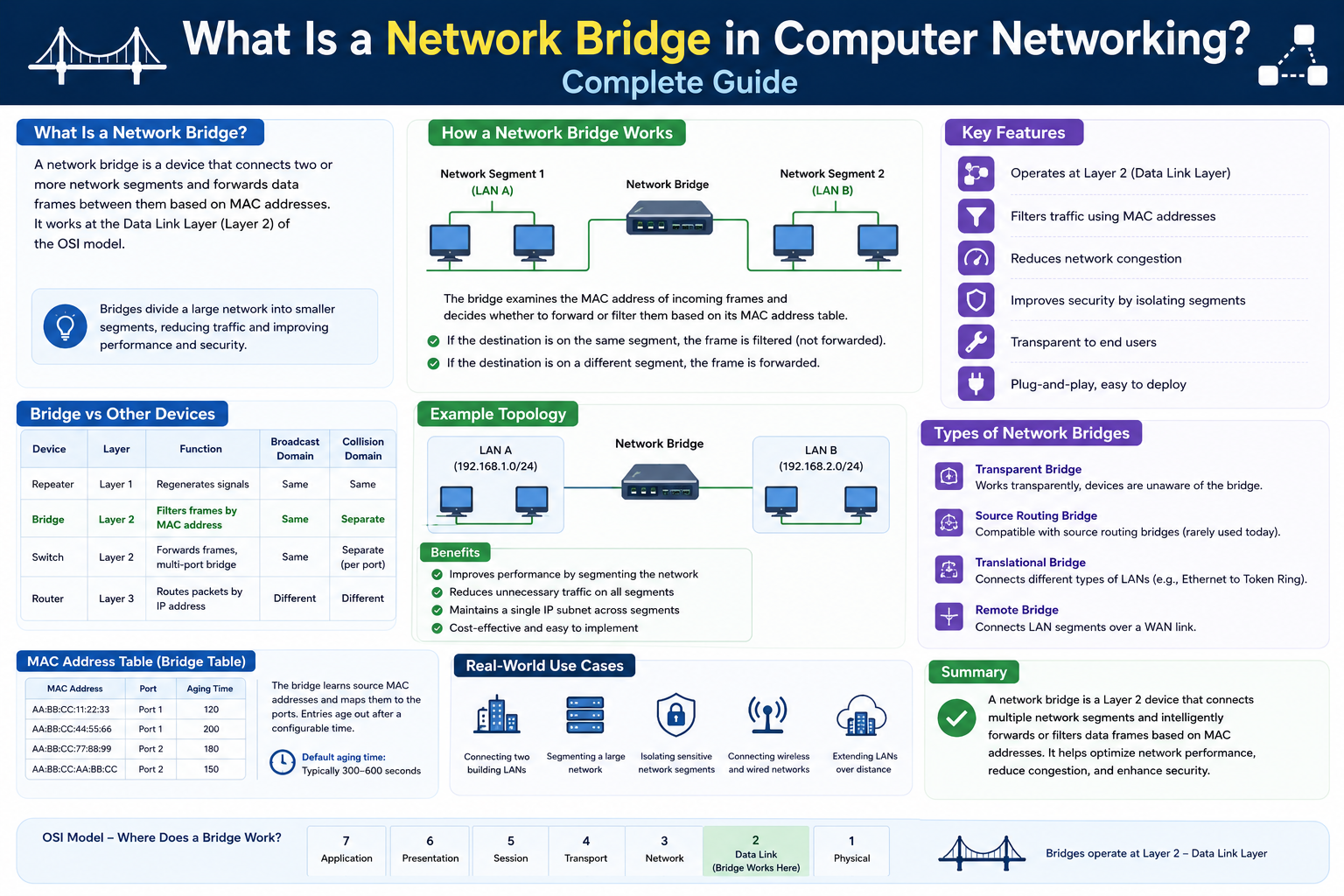
A network bridge is a fundamental device used in computer networking to connect and manage communication between different network segments. It operates at the Data Link Layer (Layer 2) of the OSI model, meaning it primarily works with MAC addresses rather than IP addresses. The main purpose of a network bridge is to filter and forward data between segments of a local area network (LAN), helping improve performance, reduce unnecessary traffic, and create more organized network structures.
In simple terms, a network bridge acts like a smart connector between two or more parts of a network. Instead of blindly passing all data through, it examines incoming frames and decides whether they should be forwarded or filtered. This selective forwarding makes networks more efficient and reduces congestion, especially in environments where multiple devices communicate frequently.
Understanding how a network bridge works is essential for anyone studying networking concepts, as it forms the basis for more advanced devices like switches and routers.
How a Network Bridge Works at Layer 2
A network bridge operates by analyzing MAC addresses, which are unique hardware identifiers assigned to network devices. When data arrives at the bridge, it does not immediately forward it. Instead, it inspects the frame and records the source MAC address in a table known as the MAC address table or forwarding database.
This table helps the bridge learn which devices are connected to which network segment. Over time, the bridge builds a map of the network by continuously updating this information as devices communicate.
When a data frame is received, the bridge follows a simple decision-making process. It checks the destination MAC address and compares it with its internal table. If the destination device is located within the same segment as the sender, the bridge filters the frame and does not forward it. This prevents unnecessary traffic from crossing network boundaries.
If the destination device is located in a different segment, the bridge forwards the frame only to the appropriate segment. In cases where the destination MAC address is unknown, the bridge broadcasts the frame to all connected segments so the correct device can respond, allowing the bridge to update its table for future communication.
This learning and forwarding mechanism allows the bridge to become more efficient over time. As the MAC address table becomes more complete, unnecessary broadcasts decrease, and network performance improves significantly.
Role of Network Bridges in Segmentation and Traffic Control
One of the most important functions of a network bridge is segmentation. In large networks, too many devices communicating on the same segment can create congestion and slow down performance. A bridge solves this problem by dividing a network into smaller, more manageable sections.
Each segment created by a bridge forms its own collision domain. A collision domain is a network area where data packets can collide if multiple devices send information simultaneously. By reducing the size of these domains, a bridge helps minimize collisions and improves overall network efficiency.
Another key benefit is broadcast control. In a typical LAN, broadcast messages are sent to all devices. While this is necessary for certain operations, excessive broadcasts can overwhelm the network. A bridge helps limit broadcast traffic by confining it to specific segments instead of allowing it to spread across the entire network.
This segmentation also enhances network organization. For example, departments within a company—such as HR, finance, and IT—can be placed on separate network segments. The bridge ensures that only relevant traffic flows between these segments, reducing unnecessary communication and improving security indirectly.
Types of Network Bridges and Their Functions
Network bridges are not all the same. Over time, different types have been developed to handle specific networking needs. One of the most common types is the transparent bridge. This type is widely used in Ethernet networks and works by learning MAC addresses automatically without requiring manual configuration. It is called “transparent” because devices on the network are unaware of its presence.
Another type is the source-route bridge, which is primarily used in Token Ring networks. In this type, the path for data transmission is determined by the source device rather than the bridge itself. The routing information is included in the data frame, allowing the bridge to follow predefined paths.
There are also wireless bridges, which connect two separate wired networks using a wireless link. These are commonly used to connect buildings or extend network coverage without laying physical cables.
In modern networking, the functionality of traditional bridges is often integrated into switches. However, the underlying concept remains the same: filtering and forwarding traffic based on MAC addresses to improve efficiency and organization.
Difference Between a Network Bridge, Switch, and Router
Although network bridges, switches, and routers may seem similar, they operate at different layers and serve different purposes.
A network bridge works at Layer 2 and connects two or more LAN segments. Its primary job is to filter traffic based on MAC addresses and reduce unnecessary data flow between segments.
A switch is essentially a more advanced version of a bridge. It also operates at Layer 2 but can handle multiple ports and connections simultaneously. While a bridge typically connects a small number of segments, a switch is designed for larger and more complex networks. It builds a detailed MAC address table and forwards data only to the specific port where the destination device is connected.
A router, on the other hand, operates at Layer 3 (the Network Layer). Instead of MAC addresses, it uses IP addresses to determine where to send data. Routers connect different networks together, such as a home network and the internet. They also provide advanced features like routing protocols, security rules, and traffic management.
In essence, a bridge connects segments within a network, a switch expands that functionality for larger environments, and a router connects entirely different networks.
Practical Uses of Network Bridges in Real-World Networks
Even though modern networks rely heavily on switches, network bridges still play an important role in certain environments. One common use is in extending network coverage. When two LAN segments need to be connected over a distance without using routing, a bridge provides a simple and efficient solution.
Another use is in network segmentation for performance improvement. In environments with heavy internal traffic, such as educational institutions or small businesses, bridges help divide traffic into manageable sections, reducing congestion and improving response times.
Network bridges are also useful in connecting different types of network media. For example, a bridge can connect a wired Ethernet network to a wireless segment, allowing devices using different communication methods to interact seamlessly.
In home networking, bridge mode is often used in routers and modems. This allows one device to handle routing while another acts purely as a bridge, preventing conflicts and simplifying network design.
Although they are not as commonly deployed as switches today, network bridges remain a foundational concept in networking and continue to influence how modern devices manage data traffic.
Expanding further on the importance of network bridges, it is worth noting how they contribute to overall network stability in environments with growing device density. As more devices connect to a LAN—such as computers, printers, IoT devices, and servers—the volume of traffic increases significantly. Without proper segmentation, this can lead to frequent congestion, packet collisions, and degraded performance. A network bridge helps manage this growth by intelligently dividing traffic paths, ensuring that only necessary data travels between segments.
Another important aspect is how bridges support gradual network expansion. Instead of redesigning an entire network infrastructure, administrators can introduce bridges to connect new segments with minimal disruption. This makes them particularly useful in scalable network designs where expansion is expected over time.
Network bridges also improve fault isolation. If one segment of a network experiences issues such as excessive broadcast traffic or device malfunction, the bridge can prevent those problems from spreading to other segments. This containment helps maintain stability across the broader network and simplifies troubleshooting.
Conclusion
A network bridge is a simple yet powerful networking device designed to connect and manage communication between different segments of a LAN. Operating at the Data Link Layer, it uses MAC addresses to intelligently forward or filter data, ensuring that only relevant traffic reaches its destination. This selective process reduces congestion, improves performance, and helps organize network structures more efficiently.
By dividing networks into smaller segments, bridges reduce collision domains and limit unnecessary broadcast traffic. This makes them especially useful in environments where network efficiency and stability are important. Although modern switches have largely replaced traditional bridges in large-scale deployments, the core principles of bridging remain essential to understanding how data flows within networks.
Network bridges also serve as a foundation for more advanced networking concepts, including switching and routing. Their role in segmentation and traffic control highlights the importance of structured network design. Even in today’s advanced digital environments, the logic behind bridging continues to influence how networks are built and optimized.
Ultimately, understanding network bridges provides a strong stepping stone toward mastering broader networking concepts and developing a clearer picture of how devices communicate in complex systems.