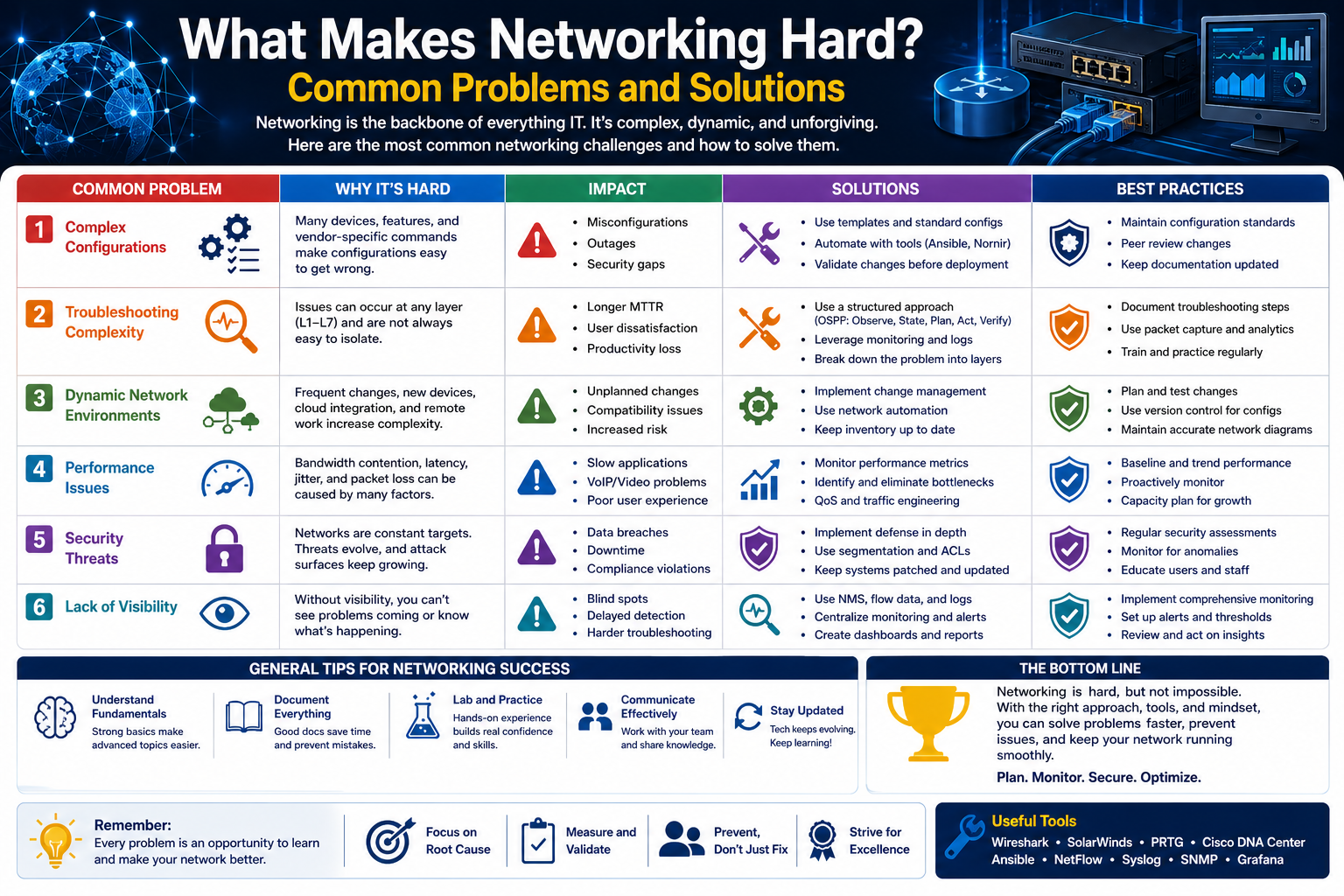
Modern networking often gives the impression that communication between devices is effortless. People click a link, open an application, or connect to Wi-Fi, and everything simply works. This smooth experience creates a powerful illusion that networking is inherently simple and already solved. Behind the scenes, however, a vast and intricate system is working continuously to make that simplicity possible.
Every time a device sends a request, whether it is loading a webpage or syncing data to the cloud, that request passes through multiple layers of hardware and software. It may travel through a wireless access point, a router, a switch, a modem, and then across several external networks before reaching its destination. Each step involves decisions, translations, and checks that must all align perfectly.
The difficulty in networking begins with this hidden complexity. Because users rarely see what happens behind the scenes, they assume stability is the default state. In reality, stability is actively maintained through constant coordination between systems that were often designed independently.
What makes this illusion even stronger is the increasing reliability of modern consumer devices. Routers automatically configure themselves, operating systems auto-detect networks, and applications silently retry failed connections. These mechanisms reduce visible failure, but they do not eliminate underlying problems. Instead, they mask them until something breaks in a noticeable way, often at the worst possible moment.
When that moment arrives, the gap between perceived simplicity and actual complexity becomes very clear.
Why Networks Feel Unpredictable
One of the most frustrating aspects of networking is its unpredictability. A configuration that works perfectly one day may behave inconsistently the next, even when nothing obvious has changed. This unpredictability is not random; it is the result of many interacting variables that are constantly shifting.
Network traffic itself is dynamic. Users join and leave networks, applications scale up or down, and devices communicate in bursts rather than steady streams. Even a small change in usage patterns can affect performance across an entire system. Unlike a single machine performing a fixed task, a network behaves more like a living ecosystem where every participant influences the others.
Environmental factors also play a role. Wireless networks are especially sensitive to interference from physical objects, distance, and competing signals. A microwave oven, a nearby router, or even structural materials in walls can subtly alter performance. These influences are often invisible, making the cause of a problem difficult to pinpoint.
Another source of unpredictability is timing. Networking depends heavily on sequences of events occurring in the correct order. Packets must arrive, be processed, acknowledged, and forwarded within expected timeframes. If delays occur at any stage, systems may interpret the delay as failure, even if the data eventually arrives intact.
Because these timing relationships are distributed across multiple devices, even a minor delay in one part of the system can cascade into visible issues elsewhere. This creates situations where symptoms appear unrelated to their cause, adding to the confusion during troubleshooting.
Heterogeneous Devices and Vendor Interoperability
Modern networks are rarely built using equipment from a single manufacturer. Instead, they consist of routers, switches, firewalls, servers, and end-user devices from many different vendors. Each of these components may follow shared standards, but they often interpret those standards in slightly different ways.
This diversity is both a strength and a challenge. It allows organizations to choose the best tools for specific needs, but it also introduces inconsistency. Even when devices claim compliance with the same protocol, subtle differences in implementation can create unexpected behavior when they interact.
For example, two systems may both support the same communication protocol but differ in how they handle edge cases such as packet retransmission or error correction. These small variations can lead to compatibility issues that are difficult to diagnose because each individual device appears to be functioning correctly.
In large environments, the complexity increases further as multiple layers of abstraction are added. Virtual networks, overlays, and software-defined components may sit on top of physical infrastructure, each introducing its own rules and behaviors. The interaction between these layers can produce outcomes that are not immediately intuitive.
As networks grow, so does the difficulty of maintaining a clear mental model of how everything connects. What seems like a straightforward path between two devices may actually involve several intermediary systems, each with its own configuration and potential points of failure.
The Role of Protocols and Their Hidden Complexity
Protocols are the foundation of communication in networking. They define how data is structured, transmitted, and interpreted between devices. Without protocols, interoperability would be impossible. However, the very flexibility that makes protocols powerful also contributes to their complexity.
Most protocols are designed to be general-purpose. They must work across different hardware types, operating systems, and network conditions. To achieve this, they include optional features, extensions, and configurable behaviors. While this flexibility allows for adaptability, it also creates room for variation in implementation.
When different vendors implement the same protocol, they may prioritize different aspects of the specification. Some may focus on performance, while others emphasize compatibility or security. As a result, two systems may technically follow the same protocol but still behave differently under certain conditions.
This becomes especially problematic when protocols evolve over time. New versions are introduced to improve efficiency or security, but not all devices are updated at the same pace. This creates mixed environments where old and new behaviors coexist, sometimes unpredictably.
Additionally, protocols often depend on other protocols layered beneath them. A single network action may involve multiple stacked protocols working together. If any layer behaves unexpectedly, the entire communication chain can be affected. This layering adds depth but also increases the difficulty of isolating issues.
When Standards Are Not as Standard as They Seem
Standards are intended to ensure consistency across networking systems. They define how devices should behave so that different technologies can work together. However, in practice, standards are often interpreted rather than strictly followed.
One reason for this is that many standards are intentionally broad. They are designed to accommodate future innovations and diverse use cases. While this makes them flexible, it also leaves room for interpretation. Vendors may implement only the parts of a standard they need, or they may extend it in proprietary ways.
Another challenge is that standards evolve. As new technologies emerge, older standards are updated or replaced. During transition periods, networks may contain a mix of legacy and modern implementations. This creates compatibility challenges that are not always immediately visible.
Even when devices fully comply with standards, real-world conditions can introduce edge cases that were not anticipated during design. High traffic loads, unusual configurations, or unexpected failure modes can expose gaps between theoretical behavior and actual performance.
This gap between design and reality is one of the reasons networking remains difficult. Standards provide a foundation, but they cannot account for every possible interaction in complex, real-world environments.
The Invisible Layers of Networking
Networking is often described in layers, each responsible for a specific part of communication. While this layered approach helps organize complexity, it also hides many of the interactions that occur beneath the surface.
At the lowest level, physical signals carry raw data across cables or wireless channels. Above that, data is structured into frames and packets. Higher layers handle addressing, routing, session management, and application-specific logic. Each layer depends on the one below it, but operates independently in terms of function.
This separation of concerns makes systems easier to design and manage, but it also means that problems can originate at any layer. A symptom observed at a high level may actually be caused by an issue several layers below.
For example, a slow application response might be caused by congestion at the network layer, misconfigured routing at another layer, or even hardware degradation at the physical layer. Because each layer abstracts the details of the one beneath it, diagnosing issues requires careful investigation across multiple levels.
The abstraction that makes networking scalable also makes it difficult to visualize as a whole. Instead of seeing a single system, administrators must think in terms of interconnected layers, each with its own behavior and potential failure points.
The Reality of Modern Network Environments
Today’s networks extend far beyond traditional office environments. They now include cloud services, remote devices, mobile endpoints, and embedded systems. This expansion has fundamentally changed the nature of networking.
Cloud infrastructure introduces abstraction at a new scale. Resources that once existed in physical locations are now distributed across virtual environments. These environments are highly dynamic, with resources being created, moved, or removed automatically based on demand.
Mobile devices add another layer of variability. They constantly switch between networks, such as Wi-Fi and cellular connections, each with different performance characteristics and security constraints. Maintaining consistent connectivity across these transitions is a complex task.
The rise of IoT devices further increases complexity. These devices often operate with limited processing power and simplified networking capabilities. They may follow different communication patterns compared to traditional computers, adding diversity to network traffic behavior.
All of these elements combine to create environments that are highly fluid. Unlike traditional static networks, modern systems must continuously adapt to changing conditions. This adaptability improves flexibility but also increases unpredictability.
Early Troubleshooting Challenges and Human Perception
When network issues arise, the first challenge is often not technical but perceptual. The symptoms of a problem rarely point directly to its cause. Instead, they appear as indirect effects scattered across different parts of the system.
A single issue may manifest as slow performance in one application, intermittent connectivity in another, and failed authentication elsewhere. These symptoms may seem unrelated, leading to confusion during initial investigation.
Human perception also plays a role in troubleshooting difficulty. People tend to focus on recent changes or obvious components, even when the root cause lies elsewhere. This can lead to assumptions that are not aligned with the actual behavior of the network.
Additionally, networking problems are often intermittent. They may appear only under specific conditions or during peak usage times. This makes them difficult to reproduce consistently, which in turn complicates diagnosis.
Because of these challenges, early stages of troubleshooting often involve gathering information rather than immediately applying fixes. Understanding what is happening requires careful observation of patterns, timing, and relationships between different events across the network.
The combination of invisible processes, layered systems, and dynamic behavior makes networking a field where problems rarely have simple, single-point explanations.
The Growing Complexity of Network Troubleshooting
As networks expand in size and capability, troubleshooting becomes less about fixing isolated issues and more about understanding complex interactions. A single symptom rarely points directly to its source. Instead, it often reflects a chain of dependencies stretching across multiple systems, devices, and protocols.
In earlier, simpler networks, problems were more localized. A faulty cable, misconfigured router, or failed switch port could often be identified quickly. Modern networks, however, are distributed, layered, and dynamic. A single user experiencing slow performance might be affected by congestion in a distant data center, a misconfigured routing policy in a cloud environment, or even a temporary DNS resolution delay.
This shift has changed troubleshooting from a straightforward technical task into a process of investigation that requires context, patience, and the ability to interpret incomplete information. Instead of focusing on a single device, engineers must consider the entire ecosystem in which that device operates.
What makes this even more challenging is that network behavior is not always deterministic. The same conditions do not always produce the same results. A problem may appear intermittently, only under specific loads or timing conditions. This inconsistency forces troubleshooting to rely heavily on observation over time rather than immediate replication.
Latency, Congestion, and the Hidden Cost of Distance
One of the most misunderstood aspects of networking is latency. While users often associate performance issues with bandwidth, latency plays an equally important role in determining how responsive a network feels.
Latency refers to the time it takes for data to travel from one point to another. Even in high-speed networks, physical distance introduces unavoidable delay. Data traveling across continents must pass through multiple routers, undersea cables, and intermediate systems, each adding small amounts of delay.
Congestion compounds this issue. When too many devices attempt to send data through the same path, queues begin to form. Packets are held temporarily before being forwarded, increasing overall delay. This queuing behavior is not always predictable because it depends on real-time traffic conditions.
What makes latency particularly difficult to troubleshoot is that it is often invisible at the application level. A system may appear to be functioning correctly while still delivering poor performance due to delayed responses. Users may perceive this as slowness or lag, without any obvious error messages.
In distributed systems, latency becomes even more critical. Applications may rely on multiple remote services, each introducing its own delay. When these delays accumulate, the overall experience can degrade significantly even if no individual component is malfunctioning.
Routing Decisions and Path Variability
At the core of every network is the process of routing—determining how data travels from its source to its destination. While routing is governed by well-defined protocols, the actual paths taken by data are not always stable.
Modern networks use dynamic routing systems that continuously evaluate the best available path based on conditions such as congestion, link availability, and policy rules. These systems are designed to optimize performance and resilience, but they also introduce variability.
A packet sent from one device to another may take a different path each time, depending on network conditions. This variability can make troubleshooting extremely difficult because issues may appear only on certain paths and not others.
Routing convergence is another important factor. When changes occur in the network—such as a link failure or a new route being introduced—routing systems must update their tables and propagate those changes across the network. During this convergence period, temporary inconsistencies can occur, leading to packet loss or delays.
In large-scale environments, convergence can take time, and during that time, different parts of the network may have slightly different views of the overall topology. This inconsistency can create transient issues that are difficult to reproduce once the network stabilizes.
DNS: The Invisible Dependency Layer
One of the most critical yet frequently overlooked components of networking is the Domain Name System. DNS acts as the translator between human-readable names and machine-readable addresses. Without it, users would need to remember numerical IP addresses instead of simple domain names.
Despite its importance, DNS is often treated as a background service, which means its role in network issues is frequently underestimated. When DNS is slow or misconfigured, the impact can appear as a general network problem rather than a specific failure.
A delay in DNS resolution can make websites appear slow to load, even if the actual network connection is functioning perfectly. In some cases, applications may fail entirely if they cannot resolve required service addresses.
DNS systems are also distributed and hierarchical. A single lookup may involve multiple servers across different regions. If any part of this chain experiences delay or failure, the entire resolution process can be affected.
Caching mechanisms are used to improve performance, but they introduce their own complexity. Cached entries may become outdated, leading to inconsistencies between different systems. As a result, two devices on the same network may resolve the same name differently at different times.
DHCP and the Fluid Nature of Address Assignment
Dynamic Host Configuration Protocol plays a key role in simplifying network management by automatically assigning IP addresses to devices. While this automation reduces manual configuration, it also introduces another layer of dynamic behavior that can complicate troubleshooting.
IP addresses assigned by DHCP are not permanent. They are leased for a specific period and may change over time. This means that a device’s network identity is not fixed, which can make tracking issues more difficult.
In environments with large numbers of devices, address conflicts or lease exhaustion can occur. These issues may lead to devices losing connectivity or being assigned incorrect configurations.
Another challenge arises from timing. When devices join or leave a network rapidly, DHCP servers must respond quickly to maintain consistency. Under heavy load, delays in assignment can cause temporary connectivity issues.
Because DHCP operates in the background, users are often unaware of its role. When problems occur, they may appear unrelated to addressing, even when the root cause lies in DHCP behavior.
Wireless Networks and Environmental Sensitivity
Wireless networking introduces a level of unpredictability that is not present in wired environments. Instead of relying on physical cables, wireless communication depends on radio signals that are highly sensitive to environmental conditions.
Signal strength can be affected by distance, physical obstacles, interference from other devices, and even changes in weather conditions in some cases. This makes wireless performance inherently variable.
Unlike wired connections, where degradation is often consistent and measurable, wireless issues can appear sporadically. A device may experience strong connectivity in one location and weak or unstable connectivity just a few meters away.
Interference is a particularly challenging factor. Many devices operate on shared frequency bands, meaning that multiple networks and appliances may compete for the same spectrum. This competition can lead to collisions, retransmissions, and reduced performance.
Roaming between access points adds another layer of complexity. As devices move, they must decide when to switch from one access point to another. Poorly timed transitions can result in brief interruptions or packet loss.
Because wireless behavior is influenced by so many external factors, reproducing and diagnosing issues often requires careful observation under controlled conditions.
Cloud Infrastructure and Abstraction Layers
The shift toward cloud-based infrastructure has fundamentally changed how networks are designed and managed. Instead of relying solely on physical hardware, many services now operate in virtualized environments that abstract underlying infrastructure.
This abstraction provides flexibility and scalability, but it also hides many of the details that were previously visible to network administrators. Systems that once could be directly inspected are now managed through interfaces that represent virtual components rather than physical devices.
In cloud environments, resources can be dynamically created, moved, or removed based on demand. This elasticity is one of the key advantages of cloud computing, but it also means that network topology is constantly changing.
Traditional troubleshooting methods that rely on static assumptions about network structure are less effective in such environments. The underlying infrastructure may shift without warning, altering traffic paths and performance characteristics.
Additionally, cloud services often depend on multiple interconnected components distributed across regions. A single application request may traverse several internal systems that are not directly visible to the user.
This level of abstraction makes it difficult to trace problems without specialized tools that can map virtual interactions to physical infrastructure.
Virtualization and Network Overlays
Virtualization extends beyond cloud computing into on-premises environments as well. Virtual machines, containers, and software-defined networks all introduce additional layers of abstraction that sit on top of physical infrastructure.
These layers allow multiple virtual networks to coexist on the same physical hardware. Each virtual network can have its own configuration, policies, and routing rules.
Network overlays are often used to create isolated environments that behave as if they are physically separate. While this improves flexibility, it also increases complexity because traffic may pass through multiple virtual and physical layers before reaching its destination.
When issues arise in virtualized environments, it can be difficult to determine whether the problem originates in the physical network, the virtualization layer, or the application itself.
Performance issues may also be introduced by resource contention between virtual machines sharing the same physical hardware. These issues are not always obvious because virtualization systems attempt to distribute resources dynamically.
Security Systems as Active Network Participants
Security is no longer a passive layer in networking. Modern security systems actively participate in traffic inspection, filtering, authentication, and policy enforcement. While these functions are essential, they also add complexity to network behavior.
Firewalls, intrusion detection systems, and access control mechanisms inspect traffic at various points in the network. Each inspection introduces processing overhead and decision-making logic that can affect performance.
Security policies are often highly granular, controlling access based on identity, device type, location, or behavior. While this improves protection, it also increases the number of conditions that must be evaluated during communication.
Encryption adds another layer of complexity. While it protects data in transit, it also makes troubleshooting more difficult because the contents of packets are no longer visible without proper decryption.
In some cases, security systems may block or delay traffic without immediately obvious signs. This can lead to situations where connectivity appears to fail even though the network itself is functioning correctly.
Time Synchronization and Subtle Dependencies
One of the less visible but critical aspects of networking is time synchronization. Many network protocols and security systems rely on consistent time across devices.
If clocks are not synchronized, authentication mechanisms may fail, logs may become inconsistent, and distributed systems may behave unpredictably. Even small differences in time can lead to significant issues in environments that rely on precise coordination.
Time synchronization protocols attempt to maintain consistency, but delays in communication or network instability can cause drift. This drift may not be immediately noticeable but can accumulate over time.
In distributed systems, time consistency is essential for ordering events correctly. Without it, it becomes difficult to determine the sequence of actions across different systems, complicating both operation and troubleshooting.
Observability and the Challenge of Understanding Networks
As networks become more complex, the need for observability increases. Observability refers to the ability to understand the internal state of a system based on its outputs.
However, achieving true observability in networking is difficult because of the sheer number of interacting components. Even with monitoring tools in place, the volume of data generated can be overwhelming.
Logs, metrics, and traces provide valuable insights, but they must be interpreted in context. Isolated data points rarely provide a complete picture. Instead, patterns over time must be analyzed to understand behavior.
The challenge is not just collecting data, but making sense of it. Networks generate vast amounts of information, but identifying meaningful signals within that noise requires both technical knowledge and contextual understanding.
Even with advanced tools, there are still gaps in visibility. Some interactions occur within encrypted channels, virtual layers, or proprietary systems that limit direct observation.
Human Factors in Network Complexity and Decision Making
While networking is often discussed in terms of protocols, hardware, and software systems, a significant portion of its difficulty comes from human decision-making. Networks are not designed in isolation; they are built, configured, and maintained by people who make assumptions, trade-offs, and sometimes mistakes.
One of the most common human factors is configuration inconsistency. In large environments, multiple administrators may manage different parts of the same network. Even when standards exist, individual interpretation can lead to subtle differences in setup. These differences may not cause immediate failure but can create long-term instability that is difficult to trace.
Another challenge is documentation. Networks evolve over time, often faster than documentation is updated. As systems are modified, expanded, or replaced, records may lag behind reality. This creates situations where the “official” view of the network does not match its actual state.
Human expectations also play a role. Users and administrators alike expect systems to behave predictably. When they do not, there is a natural tendency to assume a single cause rather than multiple interacting factors. This can lead to oversimplified troubleshooting approaches that overlook deeper issues.
Time pressure further complicates decision-making. Network issues often arise during critical operations, forcing rapid responses. Under pressure, decisions may prioritize restoring service quickly rather than understanding root causes. While this is sometimes necessary, it can also result in temporary fixes that mask underlying problems.
The complexity of modern networking is therefore not purely technical—it is also organizational and psychological, shaped by how people design, interpret, and react to systems.
The Role of Configuration Drift Over Time
Networks are rarely static. Even when no intentional changes are made, systems gradually diverge from their original configuration. This phenomenon, often referred to as configuration drift, is one of the silent contributors to networking difficulty.
Drift occurs for many reasons. Automatic updates may alter device settings. Temporary fixes applied during outages may not be reverted. Devices may be replaced with newer models that behave slightly differently. Over time, these small changes accumulate.
The problem with configuration drift is that it is often invisible until something breaks. A network may appear stable for months or even years while gradually deviating from its intended design. When issues finally appear, the root cause may lie in changes that occurred long ago.
In large environments, drift is almost unavoidable. The number of devices, services, and dependencies makes it difficult to maintain perfect consistency. Even automated management systems, while helpful, introduce their own layer of abstraction that can hide small inconsistencies.
Detecting drift requires comparison between expected and actual states, but defining “expected state” itself can be challenging when systems evolve continuously. This makes drift one of the more subtle yet persistent sources of network complexity.
Legacy Systems and Modern Integration Challenges
Many networks today are built on a mixture of modern and legacy systems. While newer technologies offer improved performance and flexibility, older systems often remain in place because they support critical functions or are too costly to replace.
Integrating these legacy systems with modern infrastructure introduces compatibility challenges. Older devices may use outdated protocols, limited encryption methods, or fixed configuration models that do not align well with modern dynamic environments.
The coexistence of old and new systems creates translation layers where data must be converted or adapted. These layers can introduce delays, errors, or unexpected behavior when assumptions between systems do not match.
In some cases, legacy systems are “black boxes” from a networking perspective. Their internal behavior may not be fully understood or documented, making troubleshooting difficult when they are involved in a problem.
Upgrading such systems is not always straightforward. Dependencies on other components may prevent replacement, or operational risks may make changes undesirable. As a result, networks often carry technical debt in the form of older systems that must still function within modern architectures.
This blending of generations of technology adds depth to networking complexity, as engineers must understand both current standards and legacy behavior simultaneously.
The Expanding Attack Surface in Modern Networks
As networks grow in size and complexity, their exposure to potential threats also increases. The concept of an attack surface refers to all possible points where unauthorized access or disruption could occur.
Modern networks have a significantly larger attack surface than earlier systems due to increased connectivity, remote access, cloud integration, and the proliferation of devices. Each new connection point introduces potential vulnerabilities.
Security measures attempt to reduce risk, but they also add complexity to network behavior. Authentication systems, encryption protocols, and access controls must all interact correctly for communication to succeed.
Misconfigurations in security systems can lead to legitimate traffic being blocked or delayed. Conversely, overly permissive settings can expose systems to risk. Finding the balance between security and functionality is an ongoing challenge.
The distributed nature of modern networks also means that security must be enforced at multiple levels. Perimeter-based security models are no longer sufficient. Instead, protection must be embedded throughout the system, including endpoints, applications, and data flows.
This layered approach increases resilience but also makes troubleshooting more difficult because security controls may influence network behavior in non-obvious ways.
The Challenge of Distributed Systems Coordination
Modern applications often rely on distributed systems, where multiple independent services work together to complete a single task. While this approach improves scalability and resilience, it also introduces coordination challenges.
In distributed systems, no single component has a complete view of the entire system state. Each service operates based on local information and communicates with others to maintain consistency.
This distributed nature means that delays, failures, or inconsistencies in one part of the system can propagate to others. A slowdown in one service may affect multiple downstream components, creating cascading effects.
Coordination between systems often relies on messaging, synchronization protocols, and consensus mechanisms. These processes are sensitive to timing and network reliability.
When communication is delayed or interrupted, systems may temporarily disagree on the state of data. This can lead to inconsistencies that are later resolved but may still cause visible issues during the interim.
Debugging distributed systems requires tracing interactions across multiple services, each of which may log information independently. Reconstructing the full sequence of events can be difficult without comprehensive observability.
Network Tools and the Illusion of Clarity
Modern networking relies heavily on diagnostic and monitoring tools. These tools provide visibility into traffic patterns, device status, and performance metrics. However, they also introduce their own limitations.
Tools such as packet analyzers, flow monitors, and logging systems generate large amounts of data. While this data is valuable, it can be overwhelming without proper filtering and interpretation.
One challenge is that tools often present information from a specific perspective. A monitoring system may show high-level summaries, while packet-level tools show low-level details. Neither view alone provides a complete picture.
Additionally, tools may themselves be affected by network conditions. If a network is unstable or congested, monitoring data may be delayed or incomplete, leading to misleading conclusions.
There is also a tendency to trust tool outputs as absolute truth. However, tools interpret data based on their own design and configuration. Misinterpretation of tool output is a common source of troubleshooting errors.
Effective use of networking tools requires understanding not only how to read their output but also what assumptions they make about the environment in which they operate.
The Impact of Scale on Network Behavior
As networks grow in size, their behavior changes in ways that are not always linear. A small increase in devices or traffic does not simply scale performance issues proportionally—it can introduce entirely new types of behavior.
At small scales, networks are relatively predictable. Communication paths are limited, and dependencies are easy to track. As scale increases, the number of possible interactions grows exponentially.
This increase in complexity leads to emergent behavior, where the network exhibits patterns that are not explicitly designed but arise from the interaction of many components.
For example, congestion may appear in unexpected parts of the network due to indirect traffic flows. Similarly, small configuration changes can have widespread effects when multiplied across many devices.
Scaling also increases the likelihood of partial failures. In large systems, it is rare for everything to fail at once. Instead, individual components may fail independently, creating inconsistent states across the network.
Managing scale requires not only more resources but also more sophisticated design principles that account for complexity as an inherent characteristic rather than an exception.
Automation and Its Double-Edged Nature
Automation has become a key feature in modern networking. It is used to configure devices, manage traffic, enforce policies, and monitor performance. While automation reduces manual effort and improves consistency, it also introduces new challenges.
Automated systems operate based on predefined rules and logic. When conditions fall outside expected patterns, automation may behave unpredictably or take unintended actions.
In some cases, automation can amplify errors. A misconfigured rule may propagate across multiple systems quickly, affecting large portions of the network before the issue is detected.
Automation also reduces direct human visibility into system behavior. When tasks are handled automatically, administrators may become less familiar with underlying processes, making troubleshooting more difficult when problems arise.
However, without automation, managing modern networks at scale would be impractical. The key challenge lies in designing automation systems that are both reliable and transparent.
This balance between efficiency and control adds another layer of complexity to networking environments.
Interdependencies Between Applications and Infrastructure
Modern applications are tightly coupled with network infrastructure. Unlike earlier systems where applications and networks were more separate, today’s environments rely on constant interaction between the two.
Applications depend on network performance for everything from data retrieval to authentication. At the same time, network behavior is influenced by application usage patterns.
This interdependency means that issues cannot always be classified as purely “network” or “application” problems. A slowdown in an application may originate from network congestion, while network load may be driven by inefficient application design.
Cloud-based applications further blur this boundary. Services may span multiple regions and rely on microservices architecture, where small components communicate frequently across networks.
Understanding performance issues requires examining both sides of this relationship. Isolating the problem domain is often one of the most difficult parts of troubleshooting.
The Continuous Evolution of Networking Knowledge
Networking is not a static field. Technologies, protocols, and architectures evolve continuously. This constant change means that knowledge must also be continuously updated.
New technologies introduce new abstractions, tools, and paradigms. Concepts that were once central may become less relevant, while new ones take their place.
At the same time, foundational principles remain important. Understanding how data moves across layers, how routing decisions are made, and how systems interact remains essential regardless of technological changes.
The challenge lies in balancing depth and breadth of knowledge. Focusing too narrowly on specific technologies can limit adaptability, while focusing too broadly can reduce practical expertise.
Networking professionals must therefore maintain a dynamic understanding of both established fundamentals and emerging trends, adapting their knowledge as systems evolve.
Subtle Interactions That Defy Simple Explanation
Some of the most difficult networking issues arise not from obvious failures, but from subtle interactions between multiple components. These interactions may not be immediately visible and often only emerge under specific conditions.
For example, a combination of moderate traffic load, specific routing behavior, and timing conditions may produce performance degradation that disappears when any one factor changes.
These types of issues are particularly challenging because they do not follow simple cause-and-effect patterns. Instead, they emerge from the combined behavior of multiple independent systems.
Identifying such issues requires careful observation, patience, and the ability to think in terms of systems rather than isolated components.
Even with advanced tools and monitoring systems, some interactions remain difficult to fully capture, making them one of the most persistent sources of complexity in networking environments.
Conclusion
Networking often appears simple on the surface—devices connect, data flows, and applications respond. Yet beneath that smooth experience lies a deeply layered system shaped by protocols, hardware diversity, software logic, human decisions, and constantly shifting conditions. The difficulty of networking does not come from a single source. It emerges from the interaction of many moving parts that rarely behave in isolation.
One of the most important realizations is that networking is not a static discipline. It evolves continuously as new technologies, architectures, and use cases emerge. Cloud computing, mobile connectivity, and distributed applications have transformed networks from relatively contained systems into vast, interconnected ecosystems. Each new layer of capability introduces new dependencies, and with those dependencies come new points of potential failure.
Another key factor is invisibility. Many of the processes that keep networks functioning are hidden from direct view. Routing decisions, protocol negotiations, caching mechanisms, and security inspections all happen behind the scenes. When something goes wrong, the symptoms often appear far removed from the actual cause, making diagnosis more challenging and time-consuming.
Human factors also play a significant role. Networks are designed, configured, and maintained by people, and human judgment introduces variability. Differences in interpretation, incomplete documentation, configuration drift, and rushed troubleshooting decisions all contribute to long-term complexity. Over time, these small inconsistencies accumulate and shape the behavior of the entire system.
At the same time, networking is constrained by physical realities. Latency, bandwidth limitations, interference, and hardware performance all impose boundaries that cannot be ignored. Even the most advanced systems must operate within these limits, and understanding them is essential for effective design and troubleshooting.
Despite its challenges, networking is not random or mystical. It follows structured principles governed by standards, protocols, and engineering practices. The difficulty lies in the scale and interaction of those principles in real-world environments. A single concept may be simple in isolation, but when combined with dozens or hundreds of other systems, its behavior becomes far more complex.
Ultimately, networking remains a field defined by continuous learning and adaptation. Tools and automation help reduce manual effort, but they do not eliminate the need for deep understanding. The ability to think systematically, observe carefully, and reason across multiple layers is what allows network behavior to be understood and managed.
Rather than being a solved problem, networking is an ongoing balancing act between simplicity and complexity, control and flexibility, stability and change.