The modern digital environment is no longer confined to a single office network or a handful of controlled endpoints. Businesses now operate across distributed environments where employees, devices, applications, and data flow continuously between on-premises systems and cloud platforms. This shift has significantly expanded the surface area that attackers can target. Every connected device, remote login session, or cloud service integration introduces a potential entry point.
As organizations adapt to this reality, network security has evolved from simple perimeter defense into a layered, adaptive system that must continuously monitor, filter, and respond to threats. The challenge is no longer just about blocking unauthorized access but also ensuring visibility, maintaining performance, and enabling seamless connectivity across global infrastructures.
Within this evolving landscape, hardware and software-based security solutions have become central to enterprise architecture. Two widely recognized names in this space—Cisco Meraki and Fortinet—represent different philosophies in addressing these challenges. While both aim to secure networks and optimize performance, their design principles, operational models, and implementation approaches differ significantly. Understanding these differences requires a closer look at how modern networks function and what businesses prioritize when selecting security infrastructure.
Understanding the Shift Toward Cloud-Driven Networking
One of the most important transformations in networking has been the movement toward cloud-centric architectures. Traditional network systems relied heavily on physical infrastructure and localized control mechanisms. While these systems were effective in controlled environments, they struggled to scale efficiently in globally distributed organizations.
Cloud-driven networking changes this model by centralizing management and distributing intelligence across connected devices. Instead of routing all traffic through a single physical hub, cloud-based systems allow for smarter traffic distribution, remote configuration, and centralized monitoring from anywhere in the world.
Cisco Meraki is often associated with this approach. Its systems are designed around cloud-based management, where administrators can control multiple network devices through a unified interface without needing direct physical access. This design reduces operational complexity and enables faster deployment across multiple locations.
Fortinet, on the other hand, incorporates cloud integration but maintains a stronger emphasis on localized security enforcement. Its systems are built to provide deep inspection and threat analysis at the network edge while still allowing centralized control. This hybrid approach appeals to organizations that prioritize granular security policies alongside scalability.
Both models reflect different interpretations of how cloud computing should support networking infrastructure, and both are shaped by the increasing need for remote accessibility and real-time security intelligence.
The Growing Importance of Integrated Security Platforms
Modern organizations rarely rely on a single security tool. Instead, they adopt integrated platforms that combine multiple security functions such as firewall protection, intrusion prevention, endpoint security, and application monitoring. The reason for this shift is simple: attackers do not operate in isolated patterns, so defenses must also be interconnected.
Integrated platforms reduce complexity by consolidating multiple functions into a unified system. This approach improves visibility across the network and ensures that security policies are consistently enforced.
Cisco Meraki approaches integration by emphasizing simplicity and unified management. Its platform allows administrators to oversee networking, wireless access, security policies, and device management through a single cloud dashboard. This reduces the need for specialized configuration across multiple systems.
Fortinet takes a broader security-centric approach. Instead of focusing solely on network management, it integrates a wide range of security services into its ecosystem. These include advanced threat protection, application control, and deep packet inspection capabilities. The goal is to create a layered defense system that actively analyzes and responds to threats in real time.
The difference in philosophy is important. One focuses on operational simplicity and centralized control, while the other prioritizes deep, multi-layered security enforcement.
Architectural Differences Between Meraki and Fortinet Systems
The underlying architecture of a networking solution plays a critical role in how it performs under load, how it scales, and how it responds to threats. Cisco Meraki and Fortinet differ in how they structure their systems and distribute intelligence across devices.
Cisco Meraki relies heavily on cloud-managed architecture. In this model, the majority of configuration, monitoring, and policy management occurs through the cloud. The physical devices at the network edge act as enforcement points that follow instructions delivered from centralized cloud controllers. This architecture simplifies deployment and reduces the need for on-site configuration expertise.
Fortinet uses a more distributed intelligence model. While it offers centralized management through platforms, its devices are designed to perform advanced processing locally. This includes real-time threat analysis, traffic inspection, and policy enforcement. By processing data closer to the source, Fortinet reduces dependency on constant cloud communication and enhances responsiveness in high-traffic environments.
These architectural differences influence everything from latency to scalability. Cloud-reliant systems benefit from simplified management, while locally intelligent systems often provide deeper analytical capabilities and faster on-device decision-making.
Security Philosophy and Threat Management Approaches
Security philosophy shapes how a vendor designs its products and prioritizes features. Cisco Meraki and Fortinet approach threat management from different perspectives.
Cisco Meraki emphasizes ease of use and centralized visibility. Its security model is designed to make it easier for administrators to detect anomalies and apply policies without requiring extensive configuration complexity. It focuses on preventing common threats and maintaining a consistent security posture across distributed environments.
Fortinet adopts a more aggressive security stance. Its systems are built to identify, analyze, and neutralize advanced threats using layered defense mechanisms. This includes behavioral analysis, signature-based detection, and machine learning-driven anomaly detection. The goal is to provide deep inspection of network traffic and block sophisticated attacks that might bypass simpler systems.
This difference reflects their target audiences. Meraki is often preferred in environments where simplicity and operational efficiency are critical, while Fortinet is favored in environments that require advanced security controls and detailed threat analysis.
Network Performance and Traffic Optimization Considerations
Network performance is a critical factor in choosing a security solution, especially in environments with high traffic volume or latency-sensitive applications. Both Meraki and Fortinet address performance optimization, but they do so in different ways.
Cisco Meraki leverages cloud-based routing and intelligent traffic distribution to reduce congestion and improve efficiency. Its systems are designed to automatically optimize routing paths and minimize unnecessary traffic hops. This helps maintain consistent performance across distributed networks.
Fortinet focuses on hardware acceleration and local processing efficiency. Its devices are engineered to handle large volumes of traffic directly at the network edge without relying heavily on cloud communication. This approach reduces latency and ensures that security inspections do not become bottlenecks in high-performance environments.
The trade-off between the two approaches often comes down to network design. Cloud-optimized systems provide flexibility and ease of management, while hardware-optimized systems provide raw performance and low-latency processing capabilities.
Deployment Models and Infrastructure Flexibility
Deployment flexibility is another important factor in enterprise networking. Organizations operate in diverse environments, ranging from small offices to global data centers, and their networking solutions must adapt accordingly.
Cisco Meraki is known for its rapid deployment model. Devices are typically designed to be plug-and-play, allowing them to connect to the cloud and automatically retrieve configuration settings. This reduces setup time and simplifies scaling across multiple locations.
Fortinet offers a more customizable deployment model. Its systems can be configured in highly specific ways to meet complex security and networking requirements. While this may require more technical expertise during setup, it provides greater control over how the system behaves in different environments.
Both approaches have advantages depending on organizational needs. Simpler deployment models reduce operational overhead, while customizable models provide greater flexibility for specialized environments.
Device Ecosystem and Network Integration Capabilities
A modern networking solution rarely exists in isolation. It must integrate with a wide range of devices, applications, and services. This includes wireless access points, switches, firewalls, endpoint devices, and cloud services.
Cisco Meraki offers a tightly integrated ecosystem where devices are designed to work seamlessly together under a unified management system. This simplifies configuration and ensures consistency across the network.
Fortinet provides a broader ecosystem that emphasizes interoperability with various third-party systems. Its architecture allows integration with different security tools and enterprise platforms, making it suitable for complex multi-vendor environments.
The choice between these approaches often depends on whether an organization prefers a unified vendor ecosystem or a flexible multi-vendor architecture.
Operational Visibility and Network Monitoring
Visibility into network activity is essential for maintaining security and performance. Without clear insights, administrators cannot effectively detect issues or respond to threats.
Cisco Meraki provides centralized dashboards that offer real-time visibility into network performance, device status, and traffic patterns. This simplifies monitoring and helps administrators quickly identify anomalies.
Fortinet provides deeper analytical tools that focus on detailed traffic inspection and threat analysis. Its monitoring systems are designed to provide granular insights into network behavior, including application-level activity and security events.
These differences reflect their broader design philosophies. One prioritizes simplicity and accessibility, while the other emphasizes depth and analytical precision.
Scalability in Distributed Enterprise Environments
Scalability is a key requirement for modern enterprises that operate across multiple regions or countries. As organizations grow, their networking infrastructure must be able to expand without introducing excessive complexity.
Cisco Meraki scales through its cloud-based architecture, allowing administrators to add new devices and locations without significant configuration overhead. This makes it well-suited for rapidly expanding organizations.
Fortinet scales through a combination of hardware performance and centralized policy management. Its systems are designed to maintain consistent security enforcement even as network size increases, making it suitable for large-scale enterprise deployments with complex security requirements.
Both approaches support scalability but differ in how they achieve it and the level of control they provide during expansion.
The Role of Automation in Modern Network Security
Automation has become an essential component of network security. As networks grow more complex, manual configuration and monitoring become increasingly impractical.
Cisco Meraki incorporates automation through cloud-managed policies that can be applied across multiple devices simultaneously. This reduces manual effort and ensures consistent policy enforcement.
Fortinet uses automation in threat detection and response mechanisms. Its systems can automatically identify suspicious activity and apply security measures in real time without requiring manual intervention.
Automation enhances both efficiency and responsiveness, but its implementation varies depending on whether the focus is on operational simplicity or advanced security response.
Subscription Models and Licensing Structures in Enterprise Networking
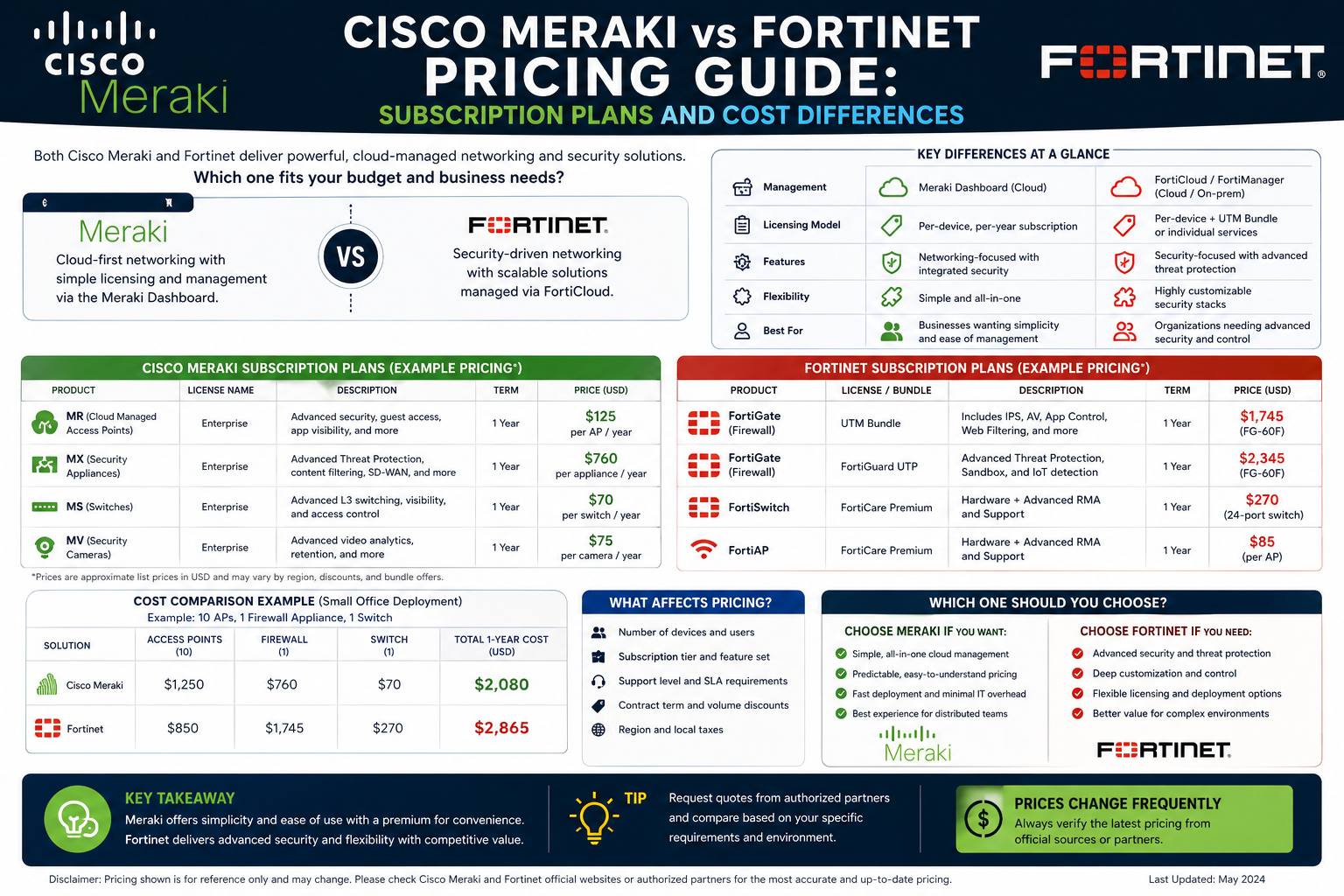
One of the most important differentiators between Cisco Meraki and Fortinet is the way their subscription and licensing models are structured. In modern enterprise networking, hardware alone is no longer sufficient to define cost. Instead, ongoing subscriptions, feature licenses, security bundles, and support contracts form the true long-term financial commitment.
Cisco Meraki operates on a subscription-centric model where nearly every device requires an active license to function fully. These licenses are typically tied directly to the hardware and are renewed regularly. Without an active subscription, many Meraki devices lose access to cloud management features, which are central to their functionality. This model aligns with the philosophy of centralized cloud control, where continuous service access is a core requirement rather than an optional enhancement.
Fortinet takes a more flexible approach. Many of its devices, particularly its firewall appliances, can operate in a basic capacity without additional subscriptions. However, advanced capabilities such as real-time threat intelligence updates, intrusion prevention signatures, web filtering, and advanced malware protection require subscription-based security services. This creates a layered licensing structure where organizations can choose which features to activate based on their needs.
The contrast here is significant. One model emphasizes mandatory subscription dependency for full functionality, while the other allows baseline operation with optional enhancements.
Total Cost of Ownership and Long-Term Financial Impact
When organizations evaluate networking solutions, the initial hardware price is only part of the financial equation. Total cost of ownership includes licensing, support contracts, scaling requirements, maintenance, and operational overhead over several years.
Cisco Meraki’s cost structure tends to be more predictable but also more consistently recurring. Since licensing is required for continued functionality, organizations must account for ongoing subscription costs across all deployed devices. This can lead to higher cumulative expenses, especially in large-scale deployments with hundreds or thousands of endpoints.
Fortinet’s cost structure is more modular. Organizations may choose to invest heavily in upfront hardware while selectively purchasing subscription services based on security requirements. This allows for more control over budgeting, especially in environments where certain features are not required across all systems.
However, Fortinet’s modular approach can also introduce complexity in cost planning, as different security services may need to be evaluated and purchased separately. Over time, organizations often find themselves balancing between feature requirements and budget constraints.
The difference in total cost of ownership often comes down to predictability versus flexibility. One model provides consistent pricing expectations, while the other allows for tailored investment strategies.
Security Feature Depth and Protection Capabilities
Security capabilities are a defining factor in choosing between enterprise networking platforms. Both Cisco Meraki and Fortinet offer comprehensive security features, but the depth and focus of these features differ significantly.
Cisco Meraki integrates security features directly into its cloud-managed ecosystem. These include firewall policies, content filtering, VPN connectivity, and basic threat detection mechanisms. The emphasis is on centralized control and ease of configuration, allowing administrators to deploy consistent security policies across distributed networks without extensive manual tuning.
Fortinet places a much stronger emphasis on advanced security capabilities. Its systems include deep packet inspection, AI-driven threat detection, behavioral analysis, sandboxing, and real-time intrusion prevention. These features are designed to identify sophisticated threats that may bypass traditional security systems.
Fortinet’s approach is often described as security-first, where network functionality is built around the assumption of persistent and evolving threats. Cisco Meraki’s approach is more integration-focused, where security is embedded into a broader networking and management framework.
SD-WAN Architecture and Traffic Intelligence Differences
Software-defined wide area networking has become a critical component of modern enterprise connectivity. It allows organizations to optimize traffic routing across multiple locations, improve application performance, and reduce reliance on traditional MPLS circuits.
Cisco Meraki implements SD-WAN through its cloud-based management system. Traffic routing decisions are influenced by centralized policies that determine how data flows across different paths. The system continuously monitors link performance and adjusts routing dynamically to maintain optimal performance.
Fortinet’s SD-WAN implementation is more deeply integrated with its security engine. Traffic routing decisions are not only based on performance metrics but also on security inspection results. This means that routing decisions can be influenced by threat detection and policy enforcement in real time.
The key difference lies in how intelligence is applied. One system prioritizes simplicity and centralized control, while the other integrates security and performance decision-making at a deeper level within the network stack.
Firewall Technology and Network Perimeter Defense
Firewalls remain one of the foundational components of network security. Both Cisco Meraki and Fortinet offer firewall capabilities, but their implementation philosophies differ significantly.
Cisco Meraki firewalls are designed for ease of use and centralized policy enforcement. Administrators can define rules through a cloud interface and apply them across multiple devices simultaneously. This simplifies configuration and reduces the likelihood of inconsistent security policies.
Fortinet firewalls are built for deep inspection and granular control. They provide extensive configuration options that allow administrators to define highly specific rules based on application behavior, user identity, and traffic patterns. These firewalls are often used in environments where security precision is critical.
Fortinet’s firewall technology is widely recognized for its ability to perform high-speed inspection without significantly impacting network performance. This is achieved through specialized hardware acceleration and optimized security processing pipelines.
Cloud Management and Operational Control Models
Cloud management has transformed how organizations administer their networks. Instead of requiring direct access to physical devices, administrators can now configure and monitor entire infrastructures remotely.
Cisco Meraki is built entirely around cloud management. Its dashboard provides a centralized interface where all devices can be monitored and configured. This eliminates the need for local management servers and simplifies administrative workflows.
Fortinet also offers cloud management capabilities, but its systems are designed to function independently of cloud connectivity. This means that even if cloud access is unavailable, devices can continue to enforce security policies and maintain network operations.
This difference reflects two distinct operational philosophies. One prioritizes centralized cloud dependency for simplicity, while the other prioritizes autonomous operation for resilience.
Endpoint Security and Device-Level Protection Strategies
Endpoint security has become increasingly important as organizations support remote workforces and bring-your-own-device environments. Protecting individual devices is now as important as securing the network perimeter.
Cisco Meraki integrates endpoint management through centralized device control systems. These systems allow administrators to enforce security policies, manage applications, and control access across mobile and desktop devices.
Fortinet approaches endpoint security through a broader security ecosystem that connects endpoint protection with network-level intelligence. This allows for coordinated threat response across both devices and infrastructure.
The difference lies in how tightly endpoint security is integrated with the broader network architecture. One system focuses on centralized device management, while the other emphasizes unified threat intelligence across multiple layers.
Threat Intelligence and Real-Time Security Updates
Modern cyber threats evolve rapidly, requiring security systems to update continuously. Threat intelligence plays a critical role in identifying new vulnerabilities and responding to emerging attack patterns.
Cisco Meraki leverages cloud-based intelligence to distribute updates across its network of devices. This ensures that security policies and threat definitions remain consistent across all deployments.
Fortinet operates its own global threat intelligence network that feeds real-time data into its security systems. This enables rapid detection of new threats and immediate updates to security policies at the device level.
Fortinet’s approach is often more granular, allowing individual devices to respond to threats independently based on local and global intelligence sources.
IoT Integration and Expanding Device Ecosystems
The growth of Internet of Things devices has introduced new security challenges. These devices often operate with limited processing power and can be difficult to secure using traditional methods.
Cisco Meraki provides IoT integration through centralized network management, allowing administrators to control access and monitor device activity across connected environments. This simplifies IoT deployment in enterprise settings.
Fortinet integrates IoT security into its broader security framework, applying deep inspection and behavioral analysis to identify unusual activity from connected devices.
Both approaches aim to secure expanding device ecosystems, but they differ in how deeply IoT devices are analyzed and controlled within the network.
Remote Access, VPN Systems, and Distributed Workforce Support
Remote access has become a fundamental requirement for modern organizations. Secure VPN connectivity ensures that employees can access internal systems from anywhere while maintaining security standards.
Cisco Meraki provides simplified VPN configuration through its cloud dashboard, allowing remote networks to be connected with minimal setup complexity. This is particularly useful for organizations with distributed offices.
Fortinet offers more advanced VPN configurations with granular control over encryption, authentication, and routing policies. This allows for highly secure remote access environments tailored to specific organizational requirements.
The trade-off between simplicity and customization is evident in how each system handles remote connectivity.
Firmware Management, Updates, and System Maintenance
Maintaining up-to-date firmware is essential for ensuring network stability and security. Both Cisco Meraki and Fortinet provide mechanisms for managing updates, but their approaches differ.
Cisco Meraki automates firmware updates through its cloud platform, allowing administrators to schedule and deploy updates across all devices simultaneously. This reduces manual effort and ensures consistency.
Fortinet provides more control over update scheduling and deployment, allowing organizations to test and validate updates before applying them across production environments.
This difference reflects broader themes of automation versus control flexibility in system maintenance strategies.
Enterprise Deployment Scenarios and Environmental Adaptability
Different organizations require different networking strategies based on size, industry, and operational complexity. Cisco Meraki is often well-suited for environments that prioritize ease of deployment and centralized management across multiple locations.
Fortinet is commonly chosen for environments that require deep security customization and high-performance processing capabilities in complex network architectures.
Both systems are adaptable to enterprise environments, but their strengths become more apparent depending on the operational context and security requirements of the organization.
Performance Engineering and Real-World Traffic Handling
Modern enterprise networks are no longer measured only by connectivity—they are judged by how efficiently they handle real-world traffic under unpredictable conditions. Applications today are highly diverse, ranging from video conferencing and SaaS platforms to real-time analytics and cloud-native workloads. This creates uneven traffic patterns that demand both intelligent routing and strong security inspection without introducing bottlenecks.
Cisco Meraki approaches performance engineering through abstraction and centralized optimization. Its cloud-managed architecture continuously evaluates link health, latency, and packet loss, then adjusts routing decisions across WAN connections. The emphasis is on maintaining a consistent application experience rather than exposing granular control over how traffic is processed. In practice, this means organizations benefit from simplified optimization rules that automatically adapt to changing network conditions.
Fortinet takes a more hardware-accelerated approach to performance. Its appliances are built to inspect traffic at high speeds using specialized processing units designed for security workloads. Instead of relying heavily on cloud-driven decision-making, Fortinet devices perform deep inspection and routing decisions locally. This reduces dependency on external control planes and ensures that even high-throughput environments can maintain strong security enforcement without performance degradation.
The contrast between the two becomes most visible in high-density environments. Where Meraki emphasizes simplified optimization through centralized intelligence, Fortinet prioritizes raw processing capability combined with advanced inspection at the edge of the network.
Security Inspection Depth and Packet-Level Analysis
Security inspection is one of the most critical functions of any modern network appliance. It determines how well a system can identify threats hidden within legitimate traffic and how effectively it can prevent unauthorized activity without disrupting normal operations.
Cisco Meraki provides security inspection through a simplified model that integrates firewall rules, content filtering, and threat detection into its cloud-managed environment. It focuses on maintaining visibility and enforcing consistent policies across distributed networks. While it includes essential inspection capabilities, it is generally designed to prioritize ease of configuration and operational clarity rather than extremely deep packet-level analysis.
Fortinet, in contrast, is widely recognized for its deep packet inspection capabilities. Its systems analyze traffic at multiple layers simultaneously, examining not just headers but also payload behavior, application signatures, and contextual patterns. This allows it to detect sophisticated threats such as zero-day exploits, advanced persistent threats, and encrypted attack vectors that might otherwise bypass simpler inspection systems.
The architectural difference is significant. One system emphasizes accessibility and unified control, while the other emphasizes granular visibility and layered security enforcement. This difference influences how each platform responds to complex or evolving cyber threats in real time.
Encryption Handling and Secure Data Transmission
Encryption plays a central role in modern network communication. As more applications move to encrypted protocols, security systems must inspect traffic without compromising performance or violating privacy requirements.
Cisco Meraki handles encrypted traffic through controlled decryption policies that can be configured at the network level. It allows administrators to define how SSL and TLS traffic should be inspected, balancing security with performance considerations. However, its focus remains on maintaining usability and minimizing configuration complexity.
Fortinet takes a more aggressive approach to encrypted traffic inspection. Its systems are designed to decrypt, analyze, and re-encrypt traffic at high speed using dedicated hardware acceleration. This enables deep inspection of encrypted sessions without introducing significant latency. As a result, it can detect malicious activity hidden within encrypted channels more effectively than systems with lighter inspection models.
The trade-off between the two approaches lies in complexity versus depth. One prioritizes straightforward configuration and controlled inspection, while the other prioritizes comprehensive visibility into encrypted traffic streams.
Network Segmentation and Access Control Strategies
Network segmentation is essential for limiting the spread of threats and enforcing security boundaries within enterprise environments. By dividing networks into smaller, controlled segments, organizations can reduce risk exposure and improve monitoring accuracy.
Cisco Meraki enables segmentation through centralized policy definitions. Administrators can create virtual networks and apply access rules across different groups of devices. This approach simplifies segmentation by providing a visual and policy-driven interface that reduces configuration complexity.
Fortinet offers more advanced segmentation capabilities that integrate deeply with its security framework. It allows segmentation based on user identity, application type, device posture, and behavioral patterns. This enables highly granular control over how traffic flows between different parts of the network.
The difference reflects broader design philosophies. One system emphasizes ease of segmentation through abstraction, while the other provides detailed control mechanisms for highly specific security requirements.
Authentication Models and Identity-Based Access Enforcement
Authentication systems determine who can access network resources and under what conditions. Modern networks require identity-based control mechanisms that go beyond simple password authentication.
Cisco Meraki integrates authentication with cloud-managed identity services. It supports role-based access control and integrates with external identity providers to simplify user management. This allows organizations to apply consistent access policies across distributed environments.
Fortinet incorporates identity-aware security at multiple layers of the network. It can enforce access policies based not only on user identity but also on device compliance, location, and behavioral analysis. This enables more dynamic access control mechanisms that adjust in real time based on risk evaluation.
The distinction lies in how identity is applied. One system focuses on centralized identity management, while the other integrates identity directly into real-time security enforcement.
Latency Optimization in Distributed Architectures
Latency is a critical factor in network performance, especially for applications such as voice communication, video conferencing, and cloud-based collaboration tools. Even small delays can significantly impact user experience.
Cisco Meraki reduces latency by optimizing routing paths through cloud intelligence. It evaluates multiple connection paths and selects the most efficient route based on real-time performance metrics. This helps ensure that traffic flows smoothly across distributed environments.
Fortinet minimizes latency by processing traffic locally using high-performance hardware acceleration. Since many decisions are made at the device level, there is less reliance on external communication with cloud services. This reduces delays introduced by remote processing.
Both approaches aim to improve responsiveness but differ in where optimization occurs—either through cloud-driven intelligence or localized processing power.
High Availability and System Redundancy Design
High availability ensures that network systems remain operational even in the event of hardware failure or connectivity issues. Redundancy is a key component of this strategy.
Cisco Meraki achieves high availability through cloud-managed redundancy configurations. Devices can automatically failover to backup links or alternative paths based on centralized policies. This reduces downtime and simplifies recovery processes.
Fortinet implements redundancy through both hardware and network-level configurations. Its systems support active-active and active-passive failover models, allowing traffic to be seamlessly redirected during failures. Because processing occurs locally, failover decisions can be executed rapidly without waiting for cloud instructions.
The difference reflects architectural priorities. One system relies on centralized coordination, while the other emphasizes autonomous resilience at the device level.
Application Visibility and Traffic Classification
Understanding what type of traffic flows through a network is essential for optimizing performance and enforcing security policies. Application visibility allows administrators to prioritize critical services and restrict unwanted activity.
Cisco Meraki provides application visibility through simplified dashboards that categorize traffic into predefined groups. This allows administrators to quickly understand network usage patterns without needing deep technical analysis.
Fortinet provides more detailed application classification, identifying specific applications, behaviors, and even sub-components within traffic streams. This level of visibility enables more precise control over how different types of traffic are handled.
The difference lies in depth versus simplicity. One provides high-level insights, while the other offers granular classification capabilities.
Policy Enforcement Consistency Across Distributed Networks
Maintaining consistent security and networking policies across multiple locations is a major challenge for global organizations. Inconsistent configurations can lead to security gaps and operational inefficiencies.
Cisco Meraki addresses this challenge by centralizing policy management in the cloud. Once a policy is defined, it can be applied uniformly across all connected devices, ensuring consistency across the entire network.
Fortinet also supports centralized policy management but allows for more localized customization. This enables organizations to apply global policies while still adapting configurations to meet regional or site-specific requirements.
The balance between consistency and flexibility is a defining difference in how each system handles large-scale deployments.
Threat Response Automation and Incident Handling
Rapid response to security incidents is essential in minimizing damage from cyberattacks. Automated response systems help reduce the time between detection and mitigation.
Cisco Meraki provides automated responses through predefined policy actions. When certain conditions are met, such as suspicious traffic detection, the system can automatically block or isolate affected devices.
Fortinet offers more advanced automation capabilities that integrate with its broader security intelligence framework. It can dynamically adjust firewall rules, isolate network segments, and trigger detailed forensic analysis based on detected threats.
The level of automation complexity varies, with one focusing on simplicity and the other on adaptive, multi-layered response mechanisms.
Network Analytics and Behavioral Insight Generation
Analytics play a crucial role in understanding network health and identifying long-term trends. Behavioral insights help organizations detect anomalies before they become critical issues.
Cisco Meraki provides visual analytics that summarize network performance, user activity, and application usage in an accessible format. This helps administrators quickly identify patterns without deep technical analysis.
Fortinet generates more advanced behavioral analytics that examine traffic flows over time, identify deviations from normal behavior, and correlate events across multiple security layers. This allows for proactive threat detection and deeper forensic investigation.
The difference reflects varying levels of analytical depth and complexity.
Multi-Cloud Integration and Hybrid Infrastructure Support
Most modern enterprises operate in hybrid or multi-cloud environments. This requires networking solutions that can seamlessly integrate with cloud platforms while maintaining on-premises security.
Cisco Meraki integrates easily with cloud environments through its centralized management system, allowing for consistent policy enforcement across hybrid infrastructures.
Fortinet provides deeper integration with multi-cloud environments, offering detailed control over traffic flows between cloud providers and on-premises systems. This makes it suitable for complex hybrid architectures with strict security requirements.
Both systems support hybrid environments but differ in the level of control and customization available.
Long-Term Network Evolution and Technology Adaptability
Network technology is continuously evolving, driven by changes in application design, security threats, and user expectations. Solutions must adapt to remain relevant over time.
Cisco Meraki evolves through updates to its cloud platform, introducing new features while maintaining a focus on simplicity and centralized management. Its evolution is often guided by usability and operational efficiency.
Fortinet evolves through continuous enhancement of its security engine, adding new detection capabilities, performance improvements, and integration features. Its development is closely tied to advancements in cybersecurity threats and defensive technologies.
The long-term adaptability of each system reflects its core design philosophy—one centered on operational simplicity, the other on security depth and technical advancement.
Extended Analysis: Emerging Trends, Future Readiness, and Strategic Fit
As enterprise networking continues to evolve, the comparison between Cisco Meraki and Fortinet becomes even more nuanced. Beyond current features and deployment models, organizations increasingly evaluate how well each platform aligns with future technological shifts. These include artificial intelligence–driven security, zero trust architecture adoption, edge computing expansion, and the increasing demand for autonomous network operations.
Cisco Meraki’s strength in this evolving landscape lies in its abstraction-first design. Centralizing management in the cloud and minimizing device-level complexity, it creates an environment where new features can be deployed broadly without requiring significant reconfiguration at individual sites. This becomes particularly important as organizations scale across multiple regions and adopt hybrid work models. The ability to push consistent updates and policies across thousands of endpoints reduces operational friction and supports rapid digital transformation initiatives.
Fortinet, on the other hand, is positioning itself strongly in the direction of security convergence and AI-enhanced threat intelligence. Its focus on embedding security directly into network traffic flows allows it to adapt to increasingly sophisticated cyber threats. As attack methods become more automated and AI-driven themselves, Fortinet’s emphasis on deep inspection and behavioral analysis provides a strong foundation for proactive defense strategies. This makes it especially relevant for industries where security threats are not only frequent but also highly targeted and evolving.
Zero Trust Architecture and Identity-Centric Security Models
One of the most important shifts in modern cybersecurity is the adoption of zero-trust principles. This model assumes that no user, device, or application should be inherently trusted, even if it exists inside the traditional network perimeter. Instead, continuous verification and strict access control are required at all times.
Cisco Meraki supports zero-trust concepts through centralized identity management and policy enforcement. It enables administrators to define access rules based on user roles, device types, and network location, all managed through a unified interface. This makes it easier for organizations transitioning from traditional perimeter-based security models to implement foundational zero trust principles without overwhelming complexity.
Fortinet takes zero-trust implementation further by embedding identity and behavioral analytics directly into its security engine. It continuously evaluates user activity, device posture, and network behavior to dynamically adjust access permissions. This creates a more adaptive security environment where trust is not static but continuously recalculated based on real-time risk assessment.
The difference is subtle but important. One approach simplifies the transition to zero trust through centralized policy management, while the other builds zero trust directly into the core of its security architecture.
Edge Computing and Distributed Processing Demands
The rise of edge computing has introduced new requirements for networking infrastructure. Instead of sending all data to centralized data centers, organizations increasingly process information closer to where it is generated. This reduces latency and improves performance for time-sensitive applications such as industrial automation, real-time analytics, and IoT ecosystems.
Cisco Meraki supports edge environments by extending cloud-managed control to distributed devices. However, its reliance on centralized cloud management means that edge devices still depend heavily on connectivity to maintain full functionality. This works well in stable network environments but may present limitations in highly distributed or intermittently connected deployments.
Fortinet is more naturally aligned with edge computing environments due to its strong local processing capabilities. Its devices can perform security inspection, routing decisions, and policy enforcement independently of cloud connectivity. This autonomy makes it particularly suitable for environments where edge devices must operate reliably even under limited or unstable network conditions.
As edge computing continues to expand, the ability to process data locally while maintaining centralized visibility will become increasingly important.
Conclusion
Cisco Meraki and Fortinet represent two distinctly different approaches to modern network security and enterprise connectivity, each shaped by its own design philosophy and operational priorities. While both solutions aim to protect networks, optimize performance, and support growing digital infrastructures, they achieve these goals through fundamentally different methods.
Cisco Meraki is built around simplicity, cloud centralization, and operational efficiency. Its architecture reduces the complexity traditionally associated with network management by shifting control into a unified cloud-based dashboard. This allows organizations to deploy, monitor, and manage large-scale networks with minimal manual configuration. For teams that prioritize ease of use, rapid deployment, and consistent policy enforcement across distributed environments, Meraki offers a streamlined experience that reduces the burden on internal IT resources.
Fortinet, in contrast, is designed with a strong emphasis on security depth, performance optimization, and granular control. Its systems are engineered to perform advanced inspection at the network edge, enabling deep packet analysis, sophisticated threat detection, and real-time response capabilities. This makes it particularly well-suited for environments where security requirements are complex and where organizations need detailed visibility into network behavior. Fortinet’s architecture gives administrators more control over how traffic is inspected, filtered, and managed, which is valuable in high-security or highly regulated industries.
The comparison between the two is not simply about which is better, but rather which is more appropriate for a specific environment. Cisco Meraki tends to align well with organizations that value operational simplicity, scalability through cloud management, and reduced administrative overhead. Fortinet tends to align more closely with organizations that require advanced cybersecurity capabilities, high-performance inspection, and flexible security customization.
Cost considerations also play a significant role in decision-making. Meraki’s subscription-driven model creates predictable but continuous expenses, while Fortinet’s modular licensing allows for more tailored investment depending on required features. This difference often influences long-term budgeting strategies and infrastructure planning.
Ultimately, both platforms are highly capable and widely trusted within the industry. Their effectiveness depends on how well their strengths align with organizational priorities, technical requirements, and security expectations. Choosing between them requires a careful evaluation of not only current needs but also future scalability, security posture, and operational complexity.