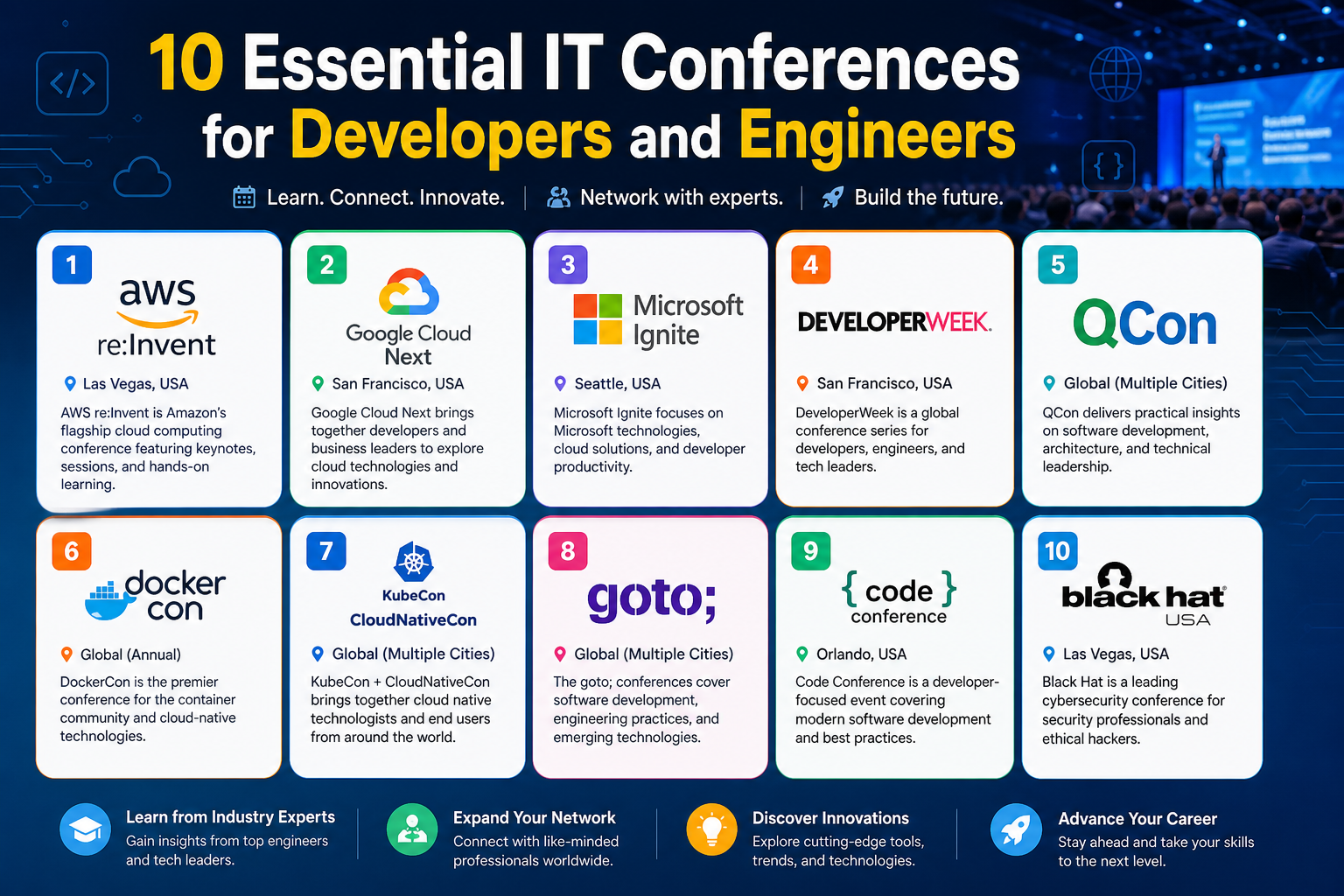
In the modern IT landscape, conferences have shifted far beyond simple gatherings where vendors showcase products. By 2026, they will function as dynamic ecosystems where technology, business strategy, and professional development intersect. The pace of change in areas such as cloud computing, cybersecurity, artificial intelligence, and infrastructure automation has made continuous learning essential rather than optional. Conferences now act as structured environments where professionals can absorb concentrated knowledge in a short period of time, while also observing how different technologies connect in real-world environments.
One of the most significant transformations is the blending of technical depth with strategic context. Earlier conferences often focused heavily on product announcements or marketing-driven messaging. In contrast, current IT events emphasize applied knowledge—how systems are actually designed, deployed, secured, and optimized in production environments. This shift reflects the growing complexity of enterprise IT systems, where decisions are no longer isolated to a single domain but span across cloud platforms, security frameworks, and operational tooling.
Another important factor is the increasing specialization of conferences. Instead of general IT gatherings, many events are now tailored toward specific domains such as cloud infrastructure, security research, enterprise collaboration, or developer ecosystems. This specialization allows attendees to dive deeper into relevant subject areas without being overwhelmed by unrelated content. It also helps professionals build targeted expertise aligned with their career paths or organizational needs.
Additionally, conferences have become key nodes for informal knowledge exchange. While scheduled sessions remain central, much of the learning now happens in side discussions, networking environments, and community-driven interactions. These informal exchanges often provide insights that are not captured in official presentations, especially when it comes to troubleshooting real-world issues or understanding implementation challenges.
Why IT Professionals Continue to Rely on Conferences
Despite the rise of online learning platforms, documentation libraries, and virtual training environments, IT conferences remain highly relevant. One major reason is the immediacy of knowledge transfer. In rapidly evolving fields like cybersecurity or cloud architecture, published documentation can quickly become outdated. Conferences offer exposure to the most current thinking from engineers, architects, and researchers who are actively working on the latest technologies.
Another advantage is exposure to diverse perspectives. In everyday professional environments, IT teams often operate within the constraints of their organization’s technology stack and policies. Conferences break that limitation by bringing together professionals from different industries, regions, and technical backgrounds. This diversity allows attendees to compare approaches, evaluate alternative solutions, and challenge assumptions that may have become normalized within their own environments.
The hands-on aspect of many conferences also plays a significant role. Modern IT events frequently include live demonstrations, interactive labs, and scenario-based discussions that simulate real-world challenges. These formats help professionals move beyond theoretical understanding and observe how technologies behave under realistic conditions. This experiential learning is particularly valuable in areas such as network engineering, cloud migration, and security incident response.
Furthermore, conferences provide visibility into industry direction. Major technology vendors and research communities often use these events to signal future developments, architectural shifts, and product roadmaps. While not every announcement directly impacts day-to-day operations, understanding the broader direction of technology helps professionals make informed long-term decisions. This is especially important for those involved in infrastructure planning or enterprise architecture.
Finally, conferences serve as professional calibration points. They allow individuals to assess their own skill levels relative to industry standards. By observing the complexity of discussions, tools in use, and depth of technical exploration, attendees can identify gaps in their knowledge and adjust their learning priorities accordingly.
How to Evaluate Which IT Conferences Are Worth Attending
Choosing the right IT conference requires careful consideration, especially given the financial and time investment involved. Not all conferences provide equal value for every professional. The first factor to evaluate is relevance to current responsibilities. A conference aligned with one’s daily work environment tends to deliver immediate practical benefits, while unrelated events may offer interesting insights but limited applicability.
Another key consideration is alignment with future career goals. Professionals aiming to transition into cloud architecture, cybersecurity leadership, or enterprise systems design should prioritize conferences that reflect those domains. Exposure to advanced concepts in these areas can accelerate skill development and open pathways to new roles.
The depth of technical content is also important. Some conferences are designed for broad audiences and focus on high-level trends, while others cater to deeply technical roles. Understanding the nature of the sessions helps in selecting events that match one’s preferred learning style. Engineers and administrators often benefit more from events that include detailed configuration discussions, architecture breakdowns, and real-world implementation case studies.
Additionally, the presence of peer communities can significantly influence the value of a conference. Events that attract active practitioner communities tend to offer richer discussions and more meaningful networking opportunities. Engaging with peers who face similar technical challenges can lead to practical insights that extend well beyond the conference itself.
Geographical and logistical factors also play a role. Large-scale international conferences may offer extensive content but require substantial travel planning and cost consideration. Regional or specialized events may be more accessible and still provide focused learning opportunities. Balancing accessibility with content quality is a practical part of the decision-making process.
Finally, the structure of the event should be considered. Conferences that offer a balanced mix of sessions, demonstrations, and informal engagement tend to provide a more holistic learning experience. Overly lecture-heavy formats may limit interaction, while highly unstructured events may lack depth in key areas.
Large-Scale Vendor Ecosystems and Their Influence
Vendor-led conferences continue to play a dominant role in the IT conference landscape. These events are typically organized by major technology companies whose platforms underpin a large portion of enterprise infrastructure. As a result, they tend to attract large audiences and offer extensive technical coverage across their ecosystems.
One defining characteristic of these conferences is their focus on integrated technology stacks. Instead of presenting isolated tools, vendors showcase how different components of their ecosystem work together. This is particularly important in modern IT environments where integration between networking, cloud services, identity management, and security tools is essential for operational efficiency.
Vendor conferences also provide early access to upcoming features and architectural changes. While these announcements are often framed within product ecosystems, they can have broader implications for enterprise planning. For example, shifts in cloud service models or identity frameworks may require organizations to adjust their infrastructure strategies or security policies.
Another important aspect is the scale of technical education offered. Large vendor conferences often include multiple parallel tracks covering beginner, intermediate, and advanced topics. This structure allows attendees with different experience levels to engage meaningfully with the content. It also enables professionals to explore adjacent areas outside their primary expertise.
In addition to technical content, these conferences often emphasize real-world case studies. Organizations that have implemented vendor technologies at scale share their experiences, including challenges faced during deployment, optimization strategies, and lessons learned. These insights are particularly valuable because they reflect practical realities rather than theoretical design.
Vendor ecosystems also influence community development. Many conferences host user groups, developer meetups, and certification-oriented discussions that contribute to long-term professional engagement. This ecosystem-driven approach ensures that learning continues beyond the conference itself through ongoing collaboration and knowledge sharing.
Cisco Live 2026 and the Evolution of Network-Centric Infrastructure
Cisco Live remains one of the most significant events for networking professionals and infrastructure specialists. By 2026, its scope will have expanded beyond traditional routing and switching discussions to include cloud networking, automation, observability, and security integration. The conference reflects the ongoing transformation of enterprise networks into highly dynamic, software-defined environments.
A key theme at Cisco-focused events is the convergence of networking and cloud infrastructure. As organizations adopt hybrid and multi-cloud architectures, the role of networking has become more complex. Cisco Live typically explores how network engineers can manage distributed environments where workloads span on-premises systems, private clouds, and public cloud platforms.
Automation is another central focus. Traditional manual configuration methods are increasingly being replaced by programmatic and policy-driven approaches. Cisco Live sessions often highlight how automation frameworks can reduce operational overhead, improve consistency, and enhance scalability. This shift is particularly relevant for large enterprises managing thousands of network devices across multiple locations.
Security integration is also a major component of modern networking discussions. Rather than treating security as a separate layer, current architectural models embed security principles directly into network design. Topics often include segmentation strategies, identity-based access control, and threat detection integrated with network telemetry.
The event also emphasizes real-world operational experiences. Engineers and architects share insights into large-scale deployments, including challenges related to performance optimization, fault tolerance, and lifecycle management. These discussions provide valuable context for professionals responsible for maintaining complex network environments.
Hands-on learning remains a core feature. Practical sessions allow attendees to experiment with configuration scenarios, observe system behavior, and explore troubleshooting techniques in controlled environments. This experiential approach helps bridge the gap between theoretical knowledge and real-world application.
Microsoft 365 Community Conference 2026 and Enterprise Productivity Systems
The Microsoft 365 Community Conference focuses on the operational realities of managing enterprise collaboration and productivity environments. By 2026, these systems will have evolved into highly integrated platforms that combine communication, identity management, security, and endpoint control.
A central theme of the conference is identity-driven architecture. Modern enterprise environments rely heavily on identity systems to manage access across applications and devices. Discussions often explore how identity frameworks integrate with security policies, compliance requirements, and user lifecycle management.
Collaboration platforms are another major focus area. As remote and hybrid work models continue to evolve, organizations depend on unified communication tools to maintain productivity. Sessions typically examine how these tools can be optimized for performance, reliability, and security across distributed teams.
Security and compliance are deeply embedded in the content. Enterprises must navigate complex regulatory environments while ensuring data protection and user privacy. Conference discussions often highlight strategies for managing compliance frameworks, protecting sensitive information, and responding to emerging security threats.
Endpoint management is also a significant topic. With the proliferation of devices accessing enterprise systems, maintaining control over endpoints has become increasingly challenging. Sessions explore modern approaches to device provisioning, configuration management, and policy enforcement.
The conference also emphasizes practical deployment experiences. IT professionals share real-world examples of system rollouts, migration challenges, and operational troubleshooting. These insights help attendees understand how theoretical architectures perform under real conditions.
Google Cloud Next 2026 and Cloud-Native Transformation
Google Cloud Next represents a major focal point for cloud-native development and infrastructure innovation. In 2026, the conference continues to highlight advancements in distributed systems, data analytics, artificial intelligence, and containerized application environments.
One of the primary themes is scalable cloud architecture. Organizations are increasingly designing systems that can dynamically adjust to workload demands. Discussions often focus on microservices architecture, container orchestration, and service mesh technologies that enable flexible and resilient applications.
Data-driven systems are another major area of exploration. Cloud environments now serve as central hubs for data processing, analytics, and machine learning workflows. Conference sessions typically examine how organizations can build pipelines that transform raw data into actionable insights.
Artificial intelligence integration is also deeply embedded in cloud discussions. Rather than treating AI as a separate discipline, modern cloud platforms incorporate AI capabilities directly into infrastructure services. This allows organizations to enhance automation, improve decision-making, and optimize system performance.
Security in cloud environments remains a critical topic. With increasing reliance on distributed systems, securing workloads, APIs, and data flows requires advanced strategies. Discussions often cover identity management, encryption practices, and threat detection in cloud-native architectures.
Operational efficiency is another focus area. Cloud environments introduce new challenges in cost management, performance monitoring, and resource optimization. Sessions explore techniques for maintaining visibility and control over complex distributed systems.
Black Hat USA 2026 and the Evolving Cybersecurity Threat Landscape
Black Hat USA is widely recognized as a leading forum for cybersecurity research and vulnerability disclosure. By 2026, the conference will continue to serve as a critical platform for understanding emerging threats and defensive strategies in digital environments.
A defining characteristic of this event is its emphasis on deep technical research. Presentations often reveal newly discovered vulnerabilities, attack methodologies, and exploitation techniques. This level of detail is essential for security professionals responsible for defending enterprise systems.
Another important aspect is the exploration of defensive strategies. While offensive security research is a key component, equal attention is given to mitigation techniques, detection mechanisms, and resilient system design. This balanced approach helps organizations prepare for evolving threats.
The conference also highlights trends in attack surfaces. As technology ecosystems expand to include cloud services, IoT devices, and distributed applications, the number of potential entry points for attackers increases. Discussions often focus on how to manage and reduce these risks effectively.
Incident response and threat intelligence are also central topics. Security teams must be able to detect, analyze, and respond to threats in real time. Sessions frequently examine frameworks and methodologies for improving response times and minimizing impact.
Another important dimension is the collaboration between researchers, vendors, and security practitioners. This collaborative environment allows for the rapid dissemination of vulnerability information and defensive techniques, contributing to a more secure digital ecosystem overall.
The Rise of Community-Driven and Inclusive Tech Conferences
As the IT industry continues to mature in 2026, one of the most noticeable shifts in the conference landscape is the growing emphasis on community-driven and inclusive events. Unlike traditional vendor-led gatherings that focus heavily on product ecosystems, community-oriented conferences prioritize people, shared experiences, and long-term professional development.
These events are built around the idea that technological progress is not driven solely by tools, but by the individuals who design, deploy, and maintain them. As a result, the structure of these conferences tends to be more open, collaborative, and participatory. Instead of strictly hierarchical presentations, attendees are encouraged to engage in discussions, share personal experiences, and contribute to collective learning.
A defining feature of this category is its focus on representation. The IT industry has historically faced challenges related to diversity, and modern conferences increasingly aim to address this gap by providing platforms for underrepresented groups. This includes not only gender diversity but also cultural, regional, and professional diversity. The result is a richer exchange of ideas that better reflects the global nature of technology.
Community-driven conferences also tend to emphasize career development in ways that extend beyond technical knowledge. Topics such as mentorship, leadership growth, workplace navigation, and skill-building are often integrated alongside technical sessions. This combination helps attendees develop both hard and soft skills, which are essential for long-term career progression in IT roles.
Another important aspect is accessibility. Many of these events incorporate hybrid participation models, allowing both in-person and remote attendance. This approach has broadened participation significantly, enabling professionals from different regions to engage without the constraints of travel costs or time limitations.
In addition, community-driven conferences often create long-lasting professional networks. Unlike transactional interactions that may occur at larger corporate events, these networks tend to be more personal and supportive. They frequently evolve into ongoing collaboration groups, discussion forums, or peer mentoring circles that continue well after the event ends.
Grace Hopper Celebration 2026 and Representation in Computing
Among the most prominent community-centered IT events is the Grace Hopper Celebration, widely recognized for its focus on women in computing and technology leadership. By 2026, this conference will continue to serve as a major gathering point for professionals seeking both technical advancement and career empowerment.
The event is structured around a wide range of thematic areas that reflect the diversity of modern computing. These include artificial intelligence, cybersecurity, software engineering, human-computer interaction, and emerging technologies. Each thematic area is designed to accommodate multiple levels of expertise, ensuring that both early-career professionals and experienced engineers can find relevant content.
One of the defining strengths of the Grace Hopper Celebration is its integration of technical and professional development tracks. While many conferences separate these areas, this event blends them in a way that reflects the real-world experience of working in technology. Participants can explore advanced technical concepts while also engaging in discussions about leadership development, career transitions, and organizational dynamics.
The career development component is particularly significant. Large-scale career fairs and networking sessions allow attendees to connect with a broad range of organizations. However, beyond recruitment opportunities, these interactions also serve as platforms for understanding industry expectations, role requirements, and emerging skill demands.
Workshops and mentorship sessions are another core feature. These sessions often focus on practical challenges faced by professionals in technology roles, such as navigating career progression, balancing technical and managerial responsibilities, and developing confidence in leadership positions. The emphasis is not only on skill acquisition but also on long-term professional resilience.
A distinctive aspect of the Grace Hopper Celebration is its emphasis on community storytelling. Participants often share personal journeys that highlight challenges, achievements, and lessons learned throughout their careers. These narratives contribute to a broader understanding of the human side of technology work, which is often overlooked in purely technical environments.
The conference also reflects broader industry shifts, particularly in the adoption of artificial intelligence and automation. Sessions frequently explore how these technologies are influencing job roles, skill requirements, and organizational structures. Rather than presenting AI as a replacement for human roles, discussions often focus on augmentation and collaboration between human expertise and machine intelligence.
Enterprise Strategy and Leadership Focus in Gartner IT Symposium/Xpo
The Gartner IT Symposium/Xpo occupies a unique position in the conference ecosystem due to its strong focus on IT leadership, strategic planning, and enterprise transformation. Unlike highly technical events that concentrate on implementation details, this conference is designed for decision-makers who shape long-term technology direction within organizations.
A central theme of the symposium is digital transformation strategy. Organizations today face continuous pressure to modernize infrastructure, improve operational efficiency, and adopt emerging technologies. Sessions at this conference often explore how enterprises can navigate these changes while balancing risk, cost, and performance considerations.
A significant portion of the content is focused on aligning IT strategy with business objectives. This includes discussions on how technology investments support organizational growth, competitive positioning, and customer experience. The emphasis is on ensuring that IT is not viewed as a support function but as a core driver of business value.
Another important area is risk management. As digital systems become more complex, the potential impact of failures, breaches, or inefficiencies increases. Conference discussions often examine frameworks for identifying, assessing, and mitigating risk across cloud environments, hybrid infrastructure, and enterprise applications.
Artificial intelligence strategy is also a major topic. Rather than focusing on technical implementation, these sessions explore governance, ethical considerations, and organizational readiness for AI adoption. Leaders are encouraged to think about how AI impacts workforce planning, decision-making structures, and operational models.
The conference also provides structured opportunities for direct engagement with industry analysts. These interactions allow attendees to discuss specific challenges faced within their organizations and receive guidance on strategic direction. This advisory component is one of the defining characteristics of the event.
Additionally, the symposium emphasizes technology modernization roadmaps. Organizations are guided through approaches for transitioning from legacy systems to more flexible, scalable architectures. This includes considerations around cloud migration, application modernization, and infrastructure consolidation.
AWS re: Invent 2026 and the Expansion of Cloud Ecosystems
AWS re: Invent continues to be one of the largest and most influential cloud computing conferences in the world. By 2026, it will have evolved into a central hub for exploring the expanding AWS ecosystem, which spans infrastructure, artificial intelligence, data analytics, and application development.
One of the core themes of the event is cloud scalability and architectural design. As organizations increasingly rely on distributed systems, the ability to design resilient and scalable architectures has become critical. Sessions often explore how to build systems that can handle variable workloads while maintaining performance and reliability.
Another major focus is the integration of artificial intelligence services into cloud environments. AWS has increasingly embedded AI capabilities into its platform, enabling organizations to incorporate machine learning into applications without building models from scratch. Conference discussions typically highlight how these capabilities are being used in areas such as predictive analytics, automation, and customer engagement.
Security remains a foundational topic. Cloud environments introduce unique security challenges due to their distributed nature and shared responsibility models. Sessions often examine identity management, encryption strategies, network security, and compliance frameworks designed for cloud-native systems.
Data management and analytics are also central themes. As organizations generate increasing volumes of data, the ability to process and analyze that information efficiently becomes essential. Discussions focus on building scalable data pipelines, optimizing storage architectures, and leveraging analytics services for real-time insights.
Operational efficiency is another key area of exploration. Cloud environments offer flexibility but also introduce complexity in cost management and resource allocation. Sessions often explore strategies for monitoring usage, optimizing performance, and maintaining financial control over large-scale deployments.
The event also emphasizes hands-on experimentation. Interactive environments allow attendees to test configurations, explore services, and simulate real-world scenarios. This experiential learning approach helps professionals understand not just how systems are designed, but how they behave under operational conditions.
Microsoft Ignite 2026 and the Future of Enterprise Platforms
Microsoft Ignite remains one of the most significant enterprise-focused technology conferences, particularly for professionals working with large-scale IT environments. By 2026, the event continues to reflect Microsoft’s broad ecosystem, spanning cloud infrastructure, enterprise applications, development platforms, and security frameworks.
A central theme of Ignite is integrated enterprise architecture. Modern organizations rely on interconnected systems that span productivity tools, cloud platforms, identity services, and security infrastructure. Sessions often explore how these components work together to form unified enterprise environments.
Hybrid infrastructure continues to be a key focus. Many organizations operate in environments that combine on-premises systems with cloud services. Discussions at Ignite frequently address how to manage these hybrid systems effectively, ensuring consistency, security, and performance across different environments.
Security integration is deeply embedded in the conference content. As cyber threats become more sophisticated, organizations must adopt multi-layered security strategies. Sessions often examine identity protection, endpoint security, threat detection, and incident response frameworks.
Developer ecosystems also play a significant role. Modern enterprise platforms rely heavily on extensibility and integration capabilities. Ignite sessions frequently explore how developers can build applications that integrate seamlessly with enterprise systems, enabling automation and improved operational efficiency.
Artificial intelligence is increasingly embedded across Microsoft’s ecosystem, and Ignite reflects this trend. Discussions often focus on how AI capabilities can be integrated into business processes, productivity tools, and infrastructure management systems.
The conference also emphasizes organizational transformation. As enterprises adopt new technologies, they must also adapt their operational models and workforce structures. Sessions explore change management strategies, skill development, and the evolving role of IT professionals in modern organizations.
Cross-Cloud and Multi-Platform Integration Trends at Conferences
One of the most significant overarching trends in IT conferences by 2026 is the increasing focus on cross-cloud and multi-platform integration. As organizations adopt services from multiple cloud providers and technology vendors, the ability to integrate these systems has become a critical skill area.
Conferences across different ecosystems now frequently address interoperability challenges. This includes how to manage workloads that span multiple cloud environments, how to unify identity systems, and how to maintain consistent security policies across platforms.
Another important aspect is data portability. Organizations want the ability to move data between systems without friction or vendor lock-in. Conference discussions often explore architectural approaches that enable flexible data movement while maintaining security and compliance.
API-driven architectures are also a central topic. Modern systems rely heavily on APIs to enable communication between services. Sessions often examine how to design, secure, and manage APIs at scale, particularly in distributed environments.
Containerization and orchestration technologies continue to play a major role in integration strategies. These technologies allow applications to run consistently across different environments, simplifying deployment and scaling processes.
Observability and monitoring across platforms is another growing area of focus. As systems become more distributed, maintaining visibility into performance, security, and operational health becomes increasingly complex. Conferences often explore tools and strategies for achieving unified observability across heterogeneous environments.
Artificial Intelligence Dominance in 2026 Conference Agendas
Artificial intelligence has become a dominant theme across nearly all major IT conferences by 2026. Rather than being treated as a standalone topic, AI is now embedded across infrastructure, applications, security, and business strategy discussions.
One major focus is the integration of AI into operational workflows. Organizations are increasingly using AI to automate repetitive tasks, optimize system performance, and support decision-making processes. Conference sessions often explore how these integrations can be implemented effectively.
Another important area is responsible AI development. As AI systems become more influential, concerns around transparency, fairness, and ethical use have grown. Discussions often address governance frameworks and organizational policies designed to ensure responsible deployment.
AI-driven security is also a growing topic. Machine learning models are increasingly used to detect anomalies, identify threats, and respond to incidents in real time. Conferences frequently examine how these systems can enhance traditional security approaches.
In addition, AI is transforming data analytics. Instead of relying solely on traditional reporting methods, organizations are increasingly using AI to generate predictive insights and automate analysis processes.
The broader implication is that AI is no longer a separate discipline within IT conferences. It has become a foundational layer that influences nearly every aspect of modern technology discussions.
The Shift Toward Hands-On Immersive Learning Environments
Across the 2026 IT conference landscape, there is a clear shift toward immersive, hands-on learning environments. Rather than passive listening experiences, conferences increasingly emphasize active participation.
This includes simulation-based labs where attendees can experiment with real-world scenarios. These environments allow professionals to test configurations, explore system behavior, and develop troubleshooting skills in controlled settings.
Another growing format is interactive architecture sessions. Instead of simply presenting designs, speakers and participants collaboratively build and analyze system architectures in real time.
Gamified learning experiences are also becoming more common. These formats introduce competitive or scenario-based challenges that encourage problem-solving and collaboration under realistic constraints.
Virtual and augmented environments are also beginning to play a role in conference learning experiences. These technologies enable more immersive simulations of infrastructure environments, making it easier to visualize complex systems.
The overall shift reflects a broader recognition that effective learning in IT requires more than theoretical understanding. It requires repeated exposure to practical scenarios that mirror real operational environments.
Networking Culture, Career Mobility, and Knowledge Exchange
Beyond technical content, IT conferences in 2026 continue to serve as powerful platforms for networking and career development. The value of these interactions often extends far beyond the duration of the event itself.
One key aspect is peer-to-peer learning. Professionals often gain insights from informal discussions that are not covered in formal sessions. These conversations frequently focus on real-world challenges, troubleshooting techniques, and implementation strategies.
Another important element is career mobility. Conferences provide exposure to new roles, technologies, and organizational structures. This can help professionals identify opportunities for advancement or transition into new areas of expertise.
Mentorship interactions also play a significant role. Many conferences facilitate structured or informal mentorship opportunities where experienced professionals guide those earlier in their careers.
Community building is another important outcome. Many professional relationships formed at conferences evolve into long-term collaborations, knowledge-sharing networks, or ongoing discussion groups.
Ultimately, these networking environments contribute to a broader ecosystem of continuous learning. Rather than being isolated events, conferences function as nodes within an ongoing professional development network that supports career growth and knowledge exchange over time.
Emerging Hybrid Conference Models and the Future of IT Events
By 2026, IT conferences will no longer be defined strictly by physical venues or fully virtual formats. Instead, a hybrid model has become the dominant structure, blending in-person experiences with digital participation. This evolution has significantly expanded access, allowing professionals from different regions and time zones to engage in high-quality technical learning without the traditional constraints of travel.
Hybrid conferences are designed with dual-layer content delivery. In-person attendees benefit from hands-on labs, live demonstrations, and direct networking opportunities, while virtual participants gain access to streamed sessions, recorded content, and interactive Q&A platforms. This structure ensures that the core knowledge transfer remains consistent across audiences, while still preserving the unique advantages of physical attendance.
One of the most important outcomes of this shift is increased inclusivity. Professionals who previously could not attend due to budget limitations, visa restrictions, or time constraints are now able to participate in real time. This has broadened the global IT conversation, introducing more diverse perspectives into technical discussions.
At the same time, conference organizers have had to rethink engagement strategies. Simply broadcasting sessions is no longer sufficient. Instead, platforms now incorporate real-time polling, virtual breakout rooms, and interactive technical challenges to keep remote participants actively engaged. These enhancements aim to replicate the spontaneity and energy of in-person networking in a digital environment.
Another emerging trend is asynchronous learning integration. Many conferences now provide extended access to recorded sessions and supplementary materials long after the event concludes. This allows professionals to revisit complex topics, study at their own pace, and reinforce learning over time rather than compressing it into a short event window.
Specialized IT Conferences and Deep-Dive Technical Focus Areas
As the IT industry becomes increasingly complex, there is a growing demand for highly specialized conferences that focus on narrow but deeply technical domains. These events cater to professionals who require advanced knowledge in specific areas such as cloud security, network automation, artificial intelligence engineering, or infrastructure observability.
Unlike broad IT conferences, specialized events prioritize depth over breadth. Sessions are often designed for experienced practitioners who already have foundational knowledge and are seeking advanced techniques or emerging best practices. This allows for more technical rigor and detailed exploration of architecture patterns, optimization strategies, and failure analysis.
One major advantage of specialization is relevance. Attendees are exposed to content that directly aligns with their day-to-day responsibilities, making it easier to apply insights immediately in real-world environments. This reduces the gap between learning and implementation, which is particularly important in fast-moving domains like cybersecurity and cloud engineering.
Specialized conferences also tend to foster stronger peer communities. Because attendees share similar roles and challenges, discussions are often highly focused and practical. This leads to deeper collaboration and more meaningful exchange of troubleshooting experiences, design approaches, and operational strategies.
Another notable feature is the involvement of practitioners who are actively working on the technologies being discussed. Instead of purely theoretical presentations, many sessions are delivered by engineers, architects, and researchers who contribute directly to production systems or open-source projects. This ensures that the knowledge shared is grounded in real-world application rather than abstract concepts.
The Growing Importance of Security-Centric Conferences
Security continues to be one of the most dominant themes across the IT conference landscape in 2026. As digital infrastructure expands, so does the attack surface, making cybersecurity a central concern for organizations of all sizes. Security-focused conferences now play a critical role in shaping defensive strategies and threat awareness.
One of the key developments in this space is the increasing sophistication of threat actors. Attacks are no longer limited to simple malware or phishing attempts; instead, they often involve multi-stage campaigns targeting cloud infrastructure, identity systems, and supply chains. Security conferences reflect this evolution by focusing on advanced detection techniques, threat intelligence sharing, and proactive defense mechanisms.
Another major focus is identity security. With the shift toward distributed work environments and cloud-based systems, identity has become the primary security boundary. Conferences explore how identity systems can be hardened, monitored, and integrated with broader security frameworks to prevent unauthorized access.
Zero-trust architecture has also become a foundational topic. Instead of assuming trust based on network location, zero trust models require continuous verification of users, devices, and applications. Security conferences frequently examine how these models can be implemented effectively across complex enterprise environments.
Incident response remains another critical area of discussion. Organizations must be able to respond quickly and effectively to security breaches. Conferences often include scenario-based exercises that simulate real-world attacks, allowing participants to practice detection, containment, and recovery strategies.
Additionally, there is growing attention on automation in security operations. Artificial intelligence and machine learning are increasingly used to identify anomalies, correlate events, and reduce response times. These technologies are helping security teams manage large-scale environments more efficiently.
Cloud Ecosystem Expansion and Multi-Platform Complexity
The cloud computing landscape in 2026 is characterized by increasing complexity and diversification. Organizations are no longer relying on a single provider but are instead adopting multi-cloud and hybrid-cloud strategies to optimize performance, cost, and resilience.
This shift has significant implications for IT conferences, which now dedicate substantial focus to cross-platform integration and interoperability. Professionals must understand how to manage workloads across different cloud environments while maintaining consistency in security, performance, and governance.
One of the most important challenges discussed at conferences is workload portability. Moving applications between cloud platforms requires careful architectural planning to avoid vendor lock-in and ensure compatibility. Sessions often explore containerization strategies, abstraction layers, and infrastructure-as-code approaches that support portability.
Data management across multiple clouds is another key topic. Organizations must ensure that data remains consistent, secure, and accessible regardless of where it resides. Conferences frequently address replication strategies, synchronization techniques, and governance models that support distributed data environments.
Cost optimization is also a recurring theme. Multi-cloud environments can lead to unpredictable expenses if not managed carefully. Conferences often explore methods for monitoring usage, optimizing resource allocation, and implementing financial governance frameworks.
Observability across distributed systems is another major concern. As infrastructure becomes more fragmented, maintaining visibility into system health becomes increasingly difficult. Conferences highlight tools and strategies for unified monitoring, logging, and tracing across multiple environments.
Artificial Intelligence as a Core Infrastructure Layer
By 2026, artificial intelligence will no longer be a standalone discipline within IT conferences. Instead, it has become a foundational layer that influences nearly every aspect of technology discussions. From infrastructure management to application development, AI is deeply embedded in modern systems.
One major trend is the use of AI for infrastructure automation. Systems can now self-optimize based on usage patterns, automatically scaling resources, balancing workloads, and predicting potential failures before they occur. Conferences frequently explore how these capabilities are implemented in real-world environments.
Another significant development is AI-driven decision support. Organizations are increasingly using machine learning models to analyze large datasets and provide actionable insights. This is particularly valuable in areas such as business intelligence, security analysis, and operational planning.
AI is also transforming software development practices. Tools powered by machine learning assist in code generation, testing, debugging, and performance optimization. Conferences often discuss how these tools are reshaping development workflows and improving productivity.
In cybersecurity, AI plays a crucial role in threat detection and response. Machine learning models can identify unusual patterns of behavior, detect potential intrusions, and trigger automated defensive actions. This significantly reduces response times and improves overall security posture.
Ethical considerations are also becoming increasingly important. As AI systems become more autonomous, concerns around bias, transparency, and accountability are gaining attention. Conferences frequently explore governance frameworks designed to ensure responsible AI deployment.
Conclusion
IT conferences in 2026 continue to play a vital role in shaping how professionals learn, connect, and evolve within an increasingly complex technology landscape. Across cloud computing, cybersecurity, artificial intelligence, enterprise collaboration, and infrastructure engineering, these events bring together practical experience and forward-looking innovation in a way that few other formats can match.
What makes modern conferences especially valuable is their ability to blend deep technical learning with real-world application. Whether through hands-on labs, expert-led discussions, or peer-driven conversations, attendees gain insights that directly translate into their daily responsibilities. At the same time, the diversity of conference types—from large vendor ecosystems to specialized security gatherings and community-focused events—ensures that professionals at every stage of their career can find relevant growth opportunities.
Equally important is the networking dimension. Relationships formed at these events often extend far beyond the conference itself, evolving into long-term professional connections and collaborative learning communities. As technology continues to advance rapidly, these human connections become just as important as the technical knowledge being shared.
Ultimately, IT conferences remain a cornerstone of professional development in 2026, helping individuals stay informed, adaptable, and prepared for the continuous transformation of the digital world.