Artificial intelligence has moved from being a specialized research field into something that shapes everyday digital life. Behind this transformation are AI engineers, the professionals responsible for turning complex algorithms into practical systems that can be used in real applications. Their role sits at the intersection of software development, data science, and advanced computational modeling, making it one of the most dynamic careers in modern technology.
At its core, AI engineering is about building systems that can learn from data and make decisions or predictions without constant human instruction. These systems power everything from recommendation engines and voice assistants to fraud detection systems and automated customer support tools. While the final products often feel seamless to users, the process of creating them involves layers of design, testing, optimization, and continuous refinement.
An AI engineer typically begins with raw data, which is often messy, incomplete, or inconsistent. A significant portion of their work involves preparing this data so that it can be used effectively by machine learning models. This includes cleaning datasets, identifying patterns, handling missing values, and transforming information into formats that algorithms can understand. Without this step, even the most advanced models will fail to perform reliably.
Once the data is ready, AI engineers move on to model selection and training. This is where mathematical concepts and computational logic come into play. Engineers evaluate different algorithms to determine which approach best fits the problem they are trying to solve. Some models are better suited for prediction tasks, while others excel at classification or pattern recognition. Choosing the right one requires both technical knowledge and practical experience.
Training a model is rarely a straightforward process. It involves feeding data into an algorithm repeatedly, adjusting parameters, and measuring performance until the system reaches an acceptable level of accuracy. This phase can take hours, days, or even weeks depending on the complexity of the task and the size of the dataset. Engineers must constantly evaluate whether the model is improving or simply memorizing data without learning meaningful patterns.
After training, the focus shifts to evaluation and testing. AI engineers examine how well the model performs on unseen data, ensuring that it can generalize beyond the examples it was trained on. This step is critical because a model that performs well in testing but fails in real-world scenarios is not useful. Engineers often refine their models multiple times, adjusting variables and retraining until performance stabilizes.
However, building a model is only part of the job. AI engineers also work on integrating these models into larger software systems. This means ensuring that the model can function within applications used by real people, often under strict performance requirements. It must respond quickly, handle large volumes of requests, and remain stable even under heavy usage. This integration process requires collaboration with software engineers, product teams, and infrastructure specialists.
Another important aspect of the role is monitoring and maintenance. AI systems are not static; they continue to learn and adapt over time. This means their performance can change as new data becomes available. AI engineers are responsible for tracking these changes, identifying performance degradation, and updating models when necessary. Without this ongoing attention, even well-built systems can become outdated or inaccurate.
The skill set required for AI engineering is broad and continuously evolving. Programming is a foundational requirement, with most engineers relying heavily on languages that support data processing and machine learning workflows. In addition to coding skills, a strong understanding of mathematics, particularly statistics and linear algebra, is essential. These concepts underpin how models learn and make predictions.
Equally important is familiarity with machine learning frameworks and tools that simplify the process of building and training models. These tools allow engineers to experiment with different architectures and optimize performance more efficiently. As the field evolves, new frameworks and libraries are constantly emerging, meaning AI engineers must continuously update their technical knowledge.
AI engineering roles are not uniform. Different companies and industries use different job titles for similar responsibilities. Some professionals focus specifically on machine learning systems, while others specialize in areas like language processing or image recognition. Despite these variations, the core objective remains the same: building intelligent systems that solve real-world problems.
What makes this profession particularly interesting is how closely it is tied to real-world impact. AI engineers are not just working with abstract models; they are designing systems that influence business decisions, healthcare outcomes, financial transactions, and even public services. This level of influence adds both responsibility and complexity to the role.
As organizations continue to adopt AI at scale, the demand for skilled engineers continues to rise. Companies are increasingly integrating artificial intelligence into their core operations rather than treating it as an experimental technology. This shift has elevated the importance of AI engineers, placing them at the center of digital transformation efforts across industries.
The growing reliance on AI systems also means that engineers are expected to think beyond technical implementation. They must consider ethical implications, data privacy, fairness, and transparency. These concerns are becoming more prominent as AI systems take on roles that directly affect human lives. Engineers are often involved in discussions about how models should behave and what safeguards need to be in place.
In many organizations, AI engineers also act as problem solvers who bridge the gap between technical teams and business stakeholders. They translate business requirements into technical solutions and ensure that AI systems align with organizational goals. This requires not only technical expertise but also communication skills and strategic thinking.
The pace of change in this field is rapid. New techniques, models, and tools emerge regularly, reshaping how AI systems are built. Engineers must remain adaptable, continuously learning and experimenting with new approaches. This constant evolution is part of what makes the profession both challenging and rewarding.
As AI becomes more deeply integrated into everyday systems, the role of AI engineers will likely continue to expand. Their responsibilities will grow beyond model development into broader system design, infrastructure optimization, and ethical governance. This evolution reflects the increasing importance of artificial intelligence in shaping modern digital ecosystems.
Understanding AI Engineer Compensation Across Markets and Experience Levels
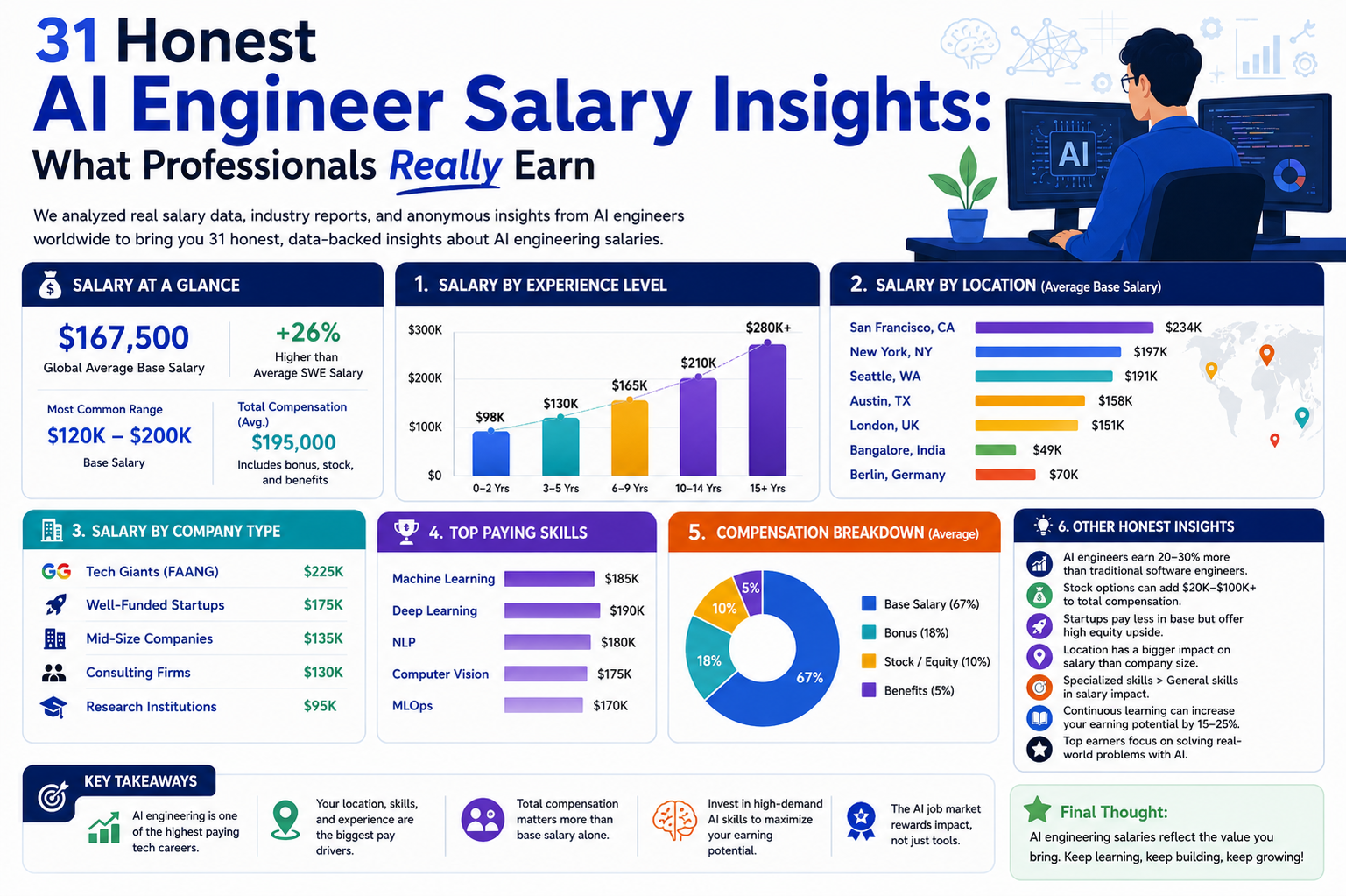
The compensation landscape for AI engineers reflects both the complexity of their work and the growing demand for their expertise. Salaries in this field are influenced by a combination of factors, including geographic location, experience level, specialization, and the type of industry in which an engineer works. Unlike more standardized roles, AI engineering compensation varies widely, making it a highly dynamic profession in terms of earning potential.
In regions with strong technology ecosystems, compensation tends to be significantly higher. Cities that host large concentrations of technology companies, research institutions, and startups often offer more competitive pay structures. This is largely driven by competition for talent, as companies compete to attract engineers who can develop advanced AI systems. In these environments, salaries can reach levels well above national averages, particularly for experienced professionals.
However, higher salaries in major tech hubs are often balanced by higher living costs. Housing, transportation, and general expenses can significantly reduce disposable income despite higher gross earnings. This creates an interesting dynamic where engineers must weigh salary against lifestyle considerations when choosing where to work. Some professionals prioritize higher pay, while others choose locations that offer a better balance between income and cost of living.
In contrast, regions with lower living costs tend to offer more modest salary ranges. While base compensation may be lower, engineers in these areas often benefit from improved affordability and financial stability. This balance can make secondary tech markets attractive to professionals who prefer a more sustainable lifestyle without the pressures of high-cost urban environments.
Experience plays a major role in determining salary progression. Early-career AI engineers typically start with foundational responsibilities such as assisting in data preparation, supporting model training, and contributing to experimentation. At this stage, compensation reflects both their learning curve and their growing technical capability. As they gain experience, their responsibilities expand, and so does their earning potential.
Mid-level engineers often transition into more independent roles. They begin to design and implement machine learning models on their own, take ownership of specific projects, and contribute to system architecture decisions. At this stage, compensation increases significantly because these professionals are no longer just contributors—they are active decision-makers in technical development.
Senior-level engineers operate at a strategic level within organizations. They design complex AI systems, oversee large-scale deployments, and often guide teams of other engineers. Their role extends beyond technical execution into leadership and system design. Compensation at this level reflects both technical mastery and the ability to influence organizational direction.
Specialization is another key factor influencing earnings. Engineers who focus on advanced or high-demand areas of artificial intelligence often receive higher compensation. Fields such as deep learning, natural language processing, and computer vision require specialized expertise that is not universally available. As a result, professionals with these skills are highly sought after.
Emerging areas of AI also tend to command premium compensation. Technologies involving generative systems, large-scale language models, and adaptive learning systems are particularly valuable due to their growing adoption across industries. Engineers working in these areas are often at the forefront of innovation, which increases their market value.
Industry choice also plays a significant role in determining salary levels. Technology companies are major employers of AI engineers, but they are not the only ones. Financial institutions use AI for risk assessment and fraud detection, healthcare organizations apply it for diagnostics and predictive modeling, and automotive companies rely on it for autonomous systems. Each of these industries values AI differently, which leads to variation in compensation structures.
In highly regulated or high-stakes industries, AI engineers often earn more due to the critical nature of their work. Systems that influence financial decisions, medical outcomes, or safety-critical operations require higher levels of precision and reliability. Engineers working in these environments are expected to meet strict performance standards, which increases their overall value.
Another important factor is the maturity of the projects engineers are involved in. Those working on production-level systems that directly impact users or business outcomes tend to earn more than those focused on experimental or research-based projects. Production systems require ongoing maintenance, optimization, and scalability considerations, making them more demanding in terms of responsibility.
As engineers progress in their careers, salary growth is not only tied to technical skill but also to their ability to influence outcomes. Communication, leadership, and strategic thinking become increasingly important. Engineers who can align technical solutions with business objectives are often rewarded with higher compensation and greater responsibilities.
The overall compensation landscape for AI engineers reflects a combination of technical demand, business impact, and specialization. As artificial intelligence continues to evolve and integrate into more industries, salary structures are likely to remain competitive and dynamic, adapting to the increasing importance of AI-driven systems in modern economies.
Skills, Tools, and Career Growth Pathways for AI Engineers
The career trajectory of an AI engineer is shaped not only by experience but also by the depth and breadth of their technical skill set. In a field defined by rapid innovation, continuous learning is essential. Engineers must stay current with evolving technologies, frameworks, and methodologies while also developing strong problem-solving and analytical thinking abilities.
Programming is the foundation of AI engineering. Engineers rely on it to build models, manipulate data, and integrate systems. Beyond coding, however, the ability to think in terms of data structures, algorithms, and system design is equally important. These foundational concepts allow engineers to build efficient and scalable solutions that can handle real-world demands.
Mathematics plays a critical role in shaping how AI systems function. Concepts from probability, statistics, and linear algebra underpin most machine learning models. Without a solid understanding of these principles, it becomes difficult to interpret model behavior or improve performance. AI engineers use mathematical reasoning to evaluate outcomes, adjust parameters, and optimize results.
Machine learning frameworks simplify much of the complexity involved in building AI systems. These tools provide pre-built structures for training models, testing algorithms, and deploying solutions. Familiarity with these frameworks allows engineers to focus more on problem-solving and less on low-level implementation details. As a result, proficiency with these tools is often a key requirement in professional roles.
In addition to traditional machine learning tools, AI engineers frequently work with systems designed for specialized tasks. Natural language processing tools enable machines to interpret and generate human language, while computer vision libraries allow systems to analyze images and videos. These tools expand the range of applications that engineers can build, from chat-based systems to visual recognition platforms.
Cloud computing has become an essential part of AI engineering. Training and deploying machine learning models often require significant computational resources, which cloud platforms provide. These environments allow engineers to scale their work efficiently, manage large datasets, and deploy models to production environments accessible to users worldwide.
Another important aspect of modern AI engineering is system deployment and scalability. Building a model in a controlled environment is very different from deploying it in a production system where it must handle real-time requests. Engineers must ensure that their models are reliable, efficient, and capable of operating under varying levels of demand.
Experiment tracking and version control are also crucial in professional AI development. Engineers often run multiple experiments to compare model performance. Without proper tracking systems, it becomes difficult to reproduce results or understand which changes led to improvements. Organized experimentation is essential for building reliable and consistent AI systems.
As engineers gain experience, career progression often leads to broader responsibilities. Many move into roles where they oversee system architecture, coordinate teams, or define AI strategies for organizations. These positions require not only technical expertise but also leadership and decision-making skills.
Some engineers choose to specialize deeply in a particular area, becoming experts in fields such as language modeling, reinforcement learning, or predictive analytics. Others move into more general roles that require them to oversee multiple aspects of AI system development. Both paths offer opportunities for growth, depending on personal interests and strengths.
Career advancement is also influenced by the ability to connect technical work with real-world outcomes. Engineers who can demonstrate how their systems improve efficiency, reduce costs, or enhance user experience are often recognized for their contributions. This ability to link technology with impact is a key factor in long-term career success.
The field of AI engineering continues to evolve rapidly. New models, tools, and techniques emerge regularly, reshaping how systems are built and deployed. Engineers must remain adaptable, continuously updating their skills to stay relevant in an increasingly competitive landscape.
As artificial intelligence becomes more deeply embedded in society, the role of AI engineers will continue to expand. Their work will not only involve building intelligent systems but also shaping how those systems interact with the world, ensuring they remain effective, responsible, and aligned with human needs.
Global Expansion, Compensation Structures, and the Future Direction of AI Engineer Earnings
The financial landscape for AI engineers is no longer shaped by a single region or a limited set of tech hubs. It has become a global system influenced by distributed teams, cross-border collaboration, and the rapid digitization of industries in nearly every economy. As artificial intelligence continues to mature, the way engineers are hired, compensated, and evaluated is shifting in ways that are more complex than traditional software engineering roles.
One of the most significant changes is the globalization of AI talent markets. Companies are no longer restricted to hiring within their immediate geographic boundaries. Instead, they recruit from international talent pools where highly skilled engineers can be found across North America, Europe, South Asia, East Asia, and emerging tech regions. This global competition has introduced both upward pressure on salaries in high-demand regions and new opportunities in markets that were previously underrepresented in advanced technology fields.
In traditionally dominant markets such as the United States, compensation remains among the highest globally, largely due to the concentration of large technology companies, venture-backed startups, and research institutions. However, other regions are steadily closing the gap. Parts of Western Europe have developed strong AI ecosystems supported by government investment and academic collaboration. Countries in Northern Europe, for instance, are increasingly producing competitive AI talent, though salary structures often differ due to economic models and taxation systems.
In Asia, the AI engineering landscape is expanding rapidly. Countries with large-scale digital infrastructure and strong engineering education systems are producing significant numbers of skilled professionals. While base compensation in some regions may be lower compared to Western markets, the growth rate of salaries is accelerating due to increasing demand and the expansion of AI-driven industries such as e-commerce, fintech, and smart manufacturing.
Meanwhile, emerging markets in the Middle East are investing heavily in artificial intelligence as part of long-term economic diversification strategies. This has led to the creation of specialized AI hubs, research centers, and government-backed initiatives that aim to attract global talent. Engineers working in these regions may encounter competitive compensation packages, particularly when working on large-scale national projects or enterprise-level systems.
A major factor influencing global compensation is the rise of remote and distributed work. AI engineering is particularly well-suited to remote environments because much of the work is digital, collaborative, and infrastructure-based. As a result, many companies now hire engineers regardless of location and adjust compensation based on either local market rates or standardized global benchmarks.
This shift has created a complex dynamic in salary structures. Some organizations maintain location-based pay, where engineers are compensated according to the cost of living in their region. Others adopt a global pay model, where compensation is tied to role level rather than geography. Both approaches have implications for earning potential, mobility, and workforce distribution.
Remote work has also enabled engineers in lower-cost regions to access higher-paying roles previously concentrated in major tech hubs. This has contributed to a redistribution of talent and a gradual leveling of opportunity across borders. However, it has also intensified competition, as engineers are no longer competing only with local peers but with global candidates.
Compensation for AI engineers is rarely limited to base salary alone. In many organizations, especially those in the technology sector, total compensation includes multiple components. Base salary forms the foundation, but additional elements such as performance bonuses, stock options, and long-term equity incentives often play a significant role in overall earnings.
Equity compensation, in particular, has become a defining feature of AI engineering roles in high-growth companies. Instead of relying solely on immediate salary, engineers may receive ownership stakes in the organization. This aligns their financial outcomes with the long-term success of the company. In rapidly growing organizations, equity can sometimes exceed the value of base salary, especially if the company experiences significant growth or public listing.
Performance bonuses are another component of compensation that reflect both individual and organizational success. These bonuses may be tied to project delivery, system performance, or broader company metrics. In AI roles, where outcomes can directly influence product performance or operational efficiency, bonus structures often reflect the strategic importance of engineering contributions.
As compensation models become more complex, engineers are increasingly required to evaluate offers beyond headline salary figures. Understanding the full structure of compensation is essential for accurately assessing job opportunities. Two roles with identical base salaries may differ significantly in total value depending on equity distribution, bonus potential, and long-term incentives.
Negotiation plays a critical role in determining compensation outcomes. Unlike entry-level roles in more standardized professions, AI engineering salaries often involve significant flexibility. Companies may have wide compensation bands, particularly for roles requiring specialized expertise. Engineers who understand market trends, demand dynamics, and their own skill positioning are often better equipped to negotiate effectively.
However, negotiation in this field is not purely transactional. Employers often evaluate candidates based on technical depth, problem-solving ability, and potential contribution to complex systems. Demonstrating impact through prior work, projects, or system design experience can significantly influence compensation discussions. Engineers who can clearly articulate how their skills translate into measurable outcomes tend to have stronger negotiating positions.
Hiring processes for AI engineers are also more rigorous than many other technical roles. Interviews typically assess a combination of theoretical understanding, practical implementation skills, and system-level thinking. Candidates may be evaluated on their ability to design machine learning pipelines, interpret model behavior, and solve problems involving data complexity and scalability.
Unlike traditional software engineering interviews, AI-focused evaluations often include discussions around model architecture, training strategies, and performance optimization. Candidates are expected to demonstrate not only coding ability but also a strong understanding of how machine learning systems operate in real-world environments. This makes preparation more multidimensional, requiring both conceptual knowledge and applied experience.
Another important aspect of hiring is the increasing emphasis on portfolio-based evaluation. While formal education remains valuable, many employers prioritize demonstrated ability over academic credentials alone. Engineers who can showcase practical experience through projects, contributions to open systems, or applied research often stand out in competitive hiring environments.
At the same time, advanced degrees still play a role in certain segments of the industry. Research-focused roles, particularly those involving cutting-edge model development or theoretical work, may favor candidates with advanced academic backgrounds. However, the industry as a whole has become more flexible, allowing multiple pathways into AI engineering careers.
The evolution of artificial intelligence itself is also influencing salary structures. As generative systems, large language models, and autonomous agents become more prevalent, demand for engineers with expertise in these areas has increased significantly. These technologies require specialized knowledge in model training, data scaling, and system integration, which has led to a premium on related skill sets.
New categories of AI engineering roles are also emerging. Instead of a single generalized role, the field is gradually diversifying into specialized positions such as AI system architects, model deployment engineers, and AI safety specialists. Each of these roles focuses on different aspects of the AI lifecycle, from design and training to deployment and governance.
AI safety and alignment engineering, in particular, has gained importance as systems become more powerful and widely deployed. Engineers in this area focus on ensuring that models behave predictably, ethically, and transparently. This includes addressing issues such as bias, fairness, interpretability, and unintended consequences. As regulatory frameworks around AI continue to develop, demand for these roles is expected to increase.
Another factor shaping the future of compensation is the increasing automation of certain engineering tasks. AI tools themselves are becoming capable of assisting in code generation, data preprocessing, and even model selection. While this may increase productivity, it also shifts the nature of AI engineering work toward higher-level design, oversight, and system architecture.
Rather than reducing demand for AI engineers, automation is changing the skill profile required for success. Engineers who focus solely on routine implementation may find certain tasks becoming automated, while those who specialize in system design, optimization, and integration remain highly valuable. This shift is gradually pushing compensation toward more strategic roles within organizations.
Economic cycles also influence salary trends in the AI industry. During periods of rapid investment and technological expansion, compensation tends to rise as companies compete aggressively for talent. In more conservative economic environments, hiring may slow, but demand for highly specialized engineers typically remains stable due to the critical nature of AI systems in modern infrastructure.
Despite fluctuations, the long-term trajectory of AI engineering compensation has remained upward. This is largely due to the increasing integration of artificial intelligence into core business operations across industries. As AI transitions from experimental technology to foundational infrastructure, the importance of skilled engineers continues to grow.
Workload expectations in AI engineering can also influence compensation indirectly. Many roles involve high levels of responsibility, particularly when working with production systems that impact real users or business outcomes. Engineers may be expected to respond to system issues, optimize performance under pressure, and continuously improve model behavior. These responsibilities often contribute to higher compensation levels but also require strong resilience and adaptability.
The future of AI engineering compensation is likely to be shaped by several converging forces: global talent competition, evolving technology complexity, and the increasing strategic importance of artificial intelligence. As systems become more advanced and deeply integrated into society, the value placed on engineers who can design, build, and manage these systems is expected to continue rising in both scale and scope.
Career Acceleration, Advanced Specialization, and Long-Term Earning Trajectories in AI Engineering
As AI engineering matures as a profession, one of the most important shifts is not just how much engineers earn at different stages, but how rapidly those earnings can change within relatively short periods of time. Unlike many traditional engineering fields where salary growth tends to follow predictable annual increments, AI engineering is shaped by rapid technological evolution, sudden demand spikes in specialized skills, and the ongoing restructuring of how companies build intelligent systems. This creates a career environment where growth can be uneven, accelerated, and highly dependent on strategic decisions made early in a professional path.
A key feature of long-term compensation growth in AI engineering is the increasing divergence between generalists and specialists. In earlier stages of a career, many engineers work broadly across machine learning tasks, gaining exposure to data processing, model training, and basic deployment. Over time, however, those who remain generalists often experience steady but moderate salary progression. In contrast, engineers who choose to specialize in high-demand domains frequently see sharper increases in compensation, particularly when their expertise aligns with emerging technological trends.
Specialization in AI is not simply about focusing on a narrow topic; it is about developing deep expertise in areas that are both technically complex and economically valuable. For example, engineers who develop expertise in large-scale model optimization often find themselves working on systems that require significant computational efficiency improvements. These systems are expensive to run, and even small optimizations can lead to substantial cost savings for organizations. As a result, engineers who can meaningfully improve efficiency are often rewarded with higher compensation due to their direct impact on operational budgets.
Another area of specialization that significantly influences earning potential is real-time AI system development. These systems must operate under strict latency constraints, meaning predictions or outputs must be generated almost instantly. Designing such systems requires not only knowledge of machine learning models but also deep understanding of system architecture, distributed computing, and performance engineering. Engineers who can reliably build and maintain such systems are often placed in highly critical roles, which naturally command higher salaries.
As AI systems become more integrated into decision-making processes, another specialization area gaining importance is interpretability and explainability. Organizations are increasingly required to understand how and why their models make certain predictions, especially in regulated industries. Engineers who can design models that are both accurate and interpretable are becoming increasingly valuable, as they help bridge the gap between technical performance and regulatory compliance.
The concept of “career acceleration” in AI engineering is also closely tied to timing. Engineers who enter the field during periods of rapid technological expansion often experience faster salary growth compared to those entering during more stable phases. This is largely due to the scarcity of experienced talent during innovation cycles. When new technologies emerge, such as transformer-based architectures or generative systems, there is often a lag between industry demand and available expertise. Engineers who quickly adapt to these shifts can position themselves at the higher end of compensation bands relatively early in their careers.
Another major driver of career acceleration is the ability to work on high-impact systems. In AI engineering, impact is often measured not just in technical complexity but in business value. Engineers who contribute to systems that directly influence revenue, user engagement, or operational efficiency tend to experience faster promotion cycles and stronger salary increases. This is because their work is more visible to organizational leadership and more tightly linked to business outcomes.
However, impact is not only about scale; it is also about responsibility. Engineers who take ownership of entire systems or pipelines, rather than isolated components, tend to grow faster in both role seniority and compensation. Ownership implies accountability for performance, reliability, and scalability, all of which are critical in production AI environments. This level of responsibility is often rewarded with leadership opportunities and higher compensation tiers.
In addition to technical specialization, cross-disciplinary skills are becoming increasingly valuable. AI engineering no longer exists in isolation; it intersects with product development, data infrastructure, cybersecurity, and business strategy. Engineers who understand how their models fit into broader organizational systems are better positioned for senior roles. This ability to translate technical work into strategic value is often a distinguishing factor in long-term career growth.
One of the most important but often overlooked factors in compensation progression is communication ability. As engineers advance in their careers, they are expected to explain complex technical systems to non-technical stakeholders. This includes product managers, executives, and sometimes external partners. The ability to clearly articulate trade-offs, limitations, and system behavior becomes increasingly valuable. Engineers who excel in this area often move into roles where they influence decision-making at a higher level, which is typically associated with increased compensation.
Leadership transitions also play a significant role in long-term salary growth. Many senior AI engineers eventually transition into roles such as technical leads, AI architects, or engineering managers. These positions shift focus from individual contribution to team coordination and system-level design. Compensation in these roles is often structured differently, with a greater emphasis on performance-based incentives and organizational impact.
However, not all engineers choose to move into management. A growing trend in the AI industry is the expansion of senior individual contributor tracks. These roles allow engineers to continue working deeply on technical problems while still advancing in seniority and compensation. In such paths, expertise becomes the primary driver of value, and engineers can reach compensation levels comparable to or even exceeding management roles.
Another important dimension of long-term earning potential is mobility between organizations. AI engineering is a highly competitive field, and movement between companies often results in significant salary increases. This is partly due to the demand for experienced talent and partly due to the fast-changing nature of technology stacks. Engineers who move between roles strategically, particularly after gaining significant project experience, often see faster compensation growth than those who remain in a single organization for extended periods.
However, mobility is not solely about switching companies; it is also about moving between domains. Engineers who transition between industries—such as from finance to healthcare or from e-commerce to autonomous systems—often expand their skill sets in ways that increase their market value. Each industry presents unique challenges, and exposure to multiple domains makes engineers more adaptable and versatile.
Another emerging factor influencing long-term compensation is involvement in system-scale architecture decisions. As AI systems become more complex, organizations increasingly rely on engineers who can design entire machine learning ecosystems rather than individual models. These ecosystems include data pipelines, training infrastructure, deployment systems, and monitoring frameworks. Engineers who can think at this level of abstraction are often placed in highly senior roles, where compensation reflects both technical and strategic responsibility.
The evolution of AI tooling also plays a role in shaping career trajectories. As tools become more automated, certain tasks that once required manual engineering effort are now streamlined. This shift does not reduce the need for engineers but changes the nature of their work. Instead of focusing on repetitive tasks, engineers are increasingly expected to focus on system design, optimization strategies, and problem-solving at scale. This shift tends to favor experienced professionals who can operate at higher levels of abstraction.
At the same time, the increasing complexity of AI systems means that the ceiling for expertise continues to rise. New models, architectures, and training paradigms require continuous learning. Engineers who actively engage with research developments and experimental technologies often position themselves for higher-paying opportunities, particularly in organizations that prioritize innovation.
Long-term compensation in AI engineering is also influenced by the growing importance of responsible AI development. As organizations adopt artificial intelligence at scale, concerns around fairness, accountability, and transparency are becoming central to system design. Engineers who specialize in building ethical AI systems, auditing model behavior, or ensuring compliance with regulatory frameworks are becoming increasingly valuable. This specialization is still relatively new, which means demand often exceeds supply.
Another important aspect of long-term earning trajectories is the role of uncertainty and experimentation in the field. Unlike more mature engineering disciplines, AI engineering still involves a significant degree of exploration. Engineers often work on systems that are not fully defined at the outset, requiring iterative development and experimentation. Those who are comfortable working in ambiguous environments and can still deliver reliable outcomes tend to advance more quickly in their careers.
The relationship between compensation and risk is also notable. High-paying AI roles often come with high levels of responsibility and uncertainty. Engineers working on frontier technologies or large-scale systems are expected to manage complexity and unpredictability. Organizations are willing to compensate for this because the potential impact of successful systems is substantial.
As AI continues to integrate into critical infrastructure, the role of engineers will likely become even more central to organizational success. This increased importance is expected to sustain strong compensation trends over time. However, the nature of compensation will continue to evolve, with greater emphasis on long-term incentives, performance-based rewards, and strategic impact rather than purely technical output.
In the long view of an AI engineering career, earning potential is shaped less by isolated achievements and more by the accumulation of expertise, adaptability, and system-level thinking. Engineers who continuously evolve their skills, align themselves with emerging technologies, and take ownership of meaningful systems are likely to experience sustained growth throughout their professional journey.
Conclusion
AI engineering has rapidly evolved into one of the most influential and financially rewarding careers in modern technology, shaped by the accelerating adoption of artificial intelligence across nearly every industry. What began as a highly specialized niche within computer science has now become a central function in organizations that rely on data-driven decision-making, automation, and intelligent systems. As a result, the role of an AI engineer is no longer limited to experimental model building; it now extends into production systems, business strategy, and large-scale infrastructure design.
Across the series, one consistent theme is that AI engineer salaries are not defined by a single factor. Instead, they are the result of multiple interconnected elements, including experience, specialization, industry demand, geographic location, and the ability to translate technical work into measurable business value. Engineers working in high-cost technology hubs tend to earn more on paper, but compensation is also deeply influenced by global hiring trends, remote work opportunities, and organizational pay structures that increasingly operate beyond traditional boundaries.
Experience remains one of the strongest predictors of salary progression. Early-career engineers typically focus on foundational tasks such as data preparation and model training, while mid-level professionals take on independent system development and deployment responsibilities. Senior engineers, on the other hand, operate at a strategic level, designing complex architectures, leading teams, and aligning AI initiatives with broader business objectives. Each stage reflects not only increasing technical expertise but also growing responsibility and influence within an organization.
Specialization further amplifies earning potential. Engineers who focus on advanced domains such as deep learning, natural language processing, computer vision, or generative AI often command higher salaries due to the scarcity of expertise and the complexity of the problems they solve. As artificial intelligence continues to expand into new applications, emerging areas such as AI safety, model interpretability, and large-scale system optimization are also becoming highly valuable.
Beyond technical ability, long-term success in AI engineering depends on adaptability. The field evolves quickly, with new tools, frameworks, and methodologies constantly reshaping how systems are built. Engineers who remain engaged with these developments and continuously refine their skills are better positioned for sustained career growth. Communication, leadership, and system-level thinking also become increasingly important as engineers move into more senior roles.
Ultimately, the financial trajectory of an AI engineer reflects the broader evolution of artificial intelligence itself. As AI becomes more deeply embedded in global infrastructure, the demand for skilled professionals capable of designing, deploying, and maintaining these systems will continue to grow. While compensation levels may fluctuate across regions and industries, the overall direction of the field suggests sustained opportunity and long-term value for those who develop both technical depth and strategic understanding.