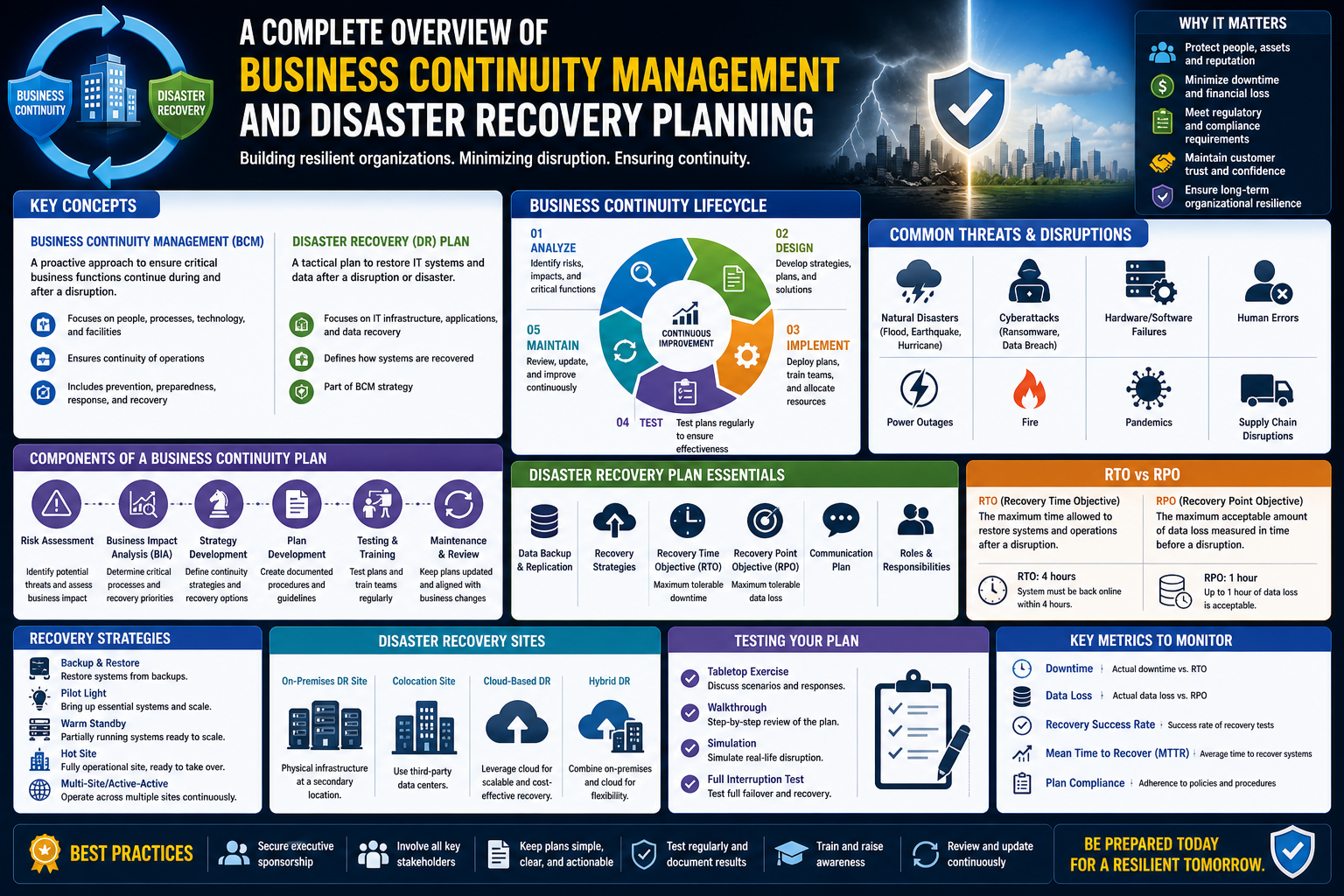
Business Continuity Management (BCM) is a structured approach that helps organizations continue operating during disruptions and recover effectively afterward. At its core, BCM is about ensuring that essential business functions remain available even when unexpected events occur. These events can range from natural disasters and cyberattacks to power failures, supply chain disruptions, or even global health crises.
Rather than focusing only on technology or disaster recovery systems, BCM takes a broader view. It considers the entire organization, including people, processes, physical resources, and digital systems. The goal is not just to recover after a disruption but to maintain critical operations while the disruption is happening.
In practical terms, BCM is about preparation. It ensures that when something goes wrong, the organization does not collapse into confusion or inactivity. Instead, it follows a pre-planned structure that allows it to continue delivering services, protecting assets, and meeting obligations.
A key idea behind BCM is that not all risks can be eliminated. Some risks are too expensive or too unpredictable to fully prevent. Because of this, BCM focuses on resilience—building the ability to absorb disruptions and continue functioning with minimal impact.
This makes BCM different from simple risk avoidance. It does not assume that threats can be fully removed. Instead, it assumes that disruptions will happen at some point and prepares the organization to handle them effectively.
The Broad Scope of Threats That Affect Business Continuity
Modern organizations operate in complex environments where threats can come from many directions. These threats are not limited to physical disasters but extend into digital, operational, and human-related risks.
Natural events such as floods, earthquakes, storms, and fires can disrupt physical infrastructure. These events can damage buildings, destroy equipment, and prevent employees from accessing workplaces. In regions where environmental risks are high, these threats become a critical part of continuity planning.
Technology-related threats are equally significant. Cybersecurity incidents, including ransomware attacks, data breaches, and system failures, can bring business operations to a standstill. Many organizations rely heavily on digital systems, and even a short outage can lead to major financial and operational losses.
Utility failures also pose a major risk. Power outages, water supply interruptions, and communication breakdowns can disrupt both physical and digital operations. Without electricity or internet connectivity, many modern businesses cannot function at all.
Human-related risks include labor shortages, strikes, errors, and unexpected absences of key personnel. In many organizations, specific individuals hold critical knowledge or responsibilities, and their sudden unavailability can create serious operational gaps.
Global disruptions such as pandemics add another layer of complexity. These events affect workforce availability, supply chains, customer demand, and transportation systems simultaneously. Unlike localized incidents, global disruptions are harder to predict and manage.
Because threats are so varied, BCM must take a wide-angle view. It must consider how different types of risks interact and how multiple disruptions could occur at the same time.
Why Organizations Need Structured Continuity Planning
Organizations often assume that normal operations will continue without interruption. However, real-world experience shows that disruptions are not only possible but inevitable over time. The question is not whether a disruption will occur, but when it will happen and how severe it will be.
Without structured planning, organizations tend to react in an uncoordinated manner when disruptions occur. This leads to confusion, delays, financial losses, and sometimes permanent damage to operations. Employees may not know what to do, systems may not be prioritized correctly, and critical decisions may be delayed.
A structured continuity approach helps avoid this situation by defining clear actions in advance. It establishes priorities, assigns responsibilities, and outlines recovery procedures. This ensures that when something goes wrong, the organization responds quickly and efficiently rather than improvising under pressure.
Another important reason for continuity planning is dependency. Modern businesses rely on interconnected systems, vendors, and partners. A failure in one area can quickly spread to others. For example, a disruption in a cloud service provider can impact multiple businesses simultaneously. Without planning, these dependencies become weak points.
Financial stability is also closely linked to continuity. Even short disruptions can lead to lost revenue, penalty charges, and increased operational costs. In highly competitive industries, prolonged downtime can also lead to loss of customers and market share.
Over time, organizations that consistently manage disruptions well tend to build stronger reputations. Customers and partners are more likely to trust businesses that demonstrate reliability even under difficult conditions.
Identifying Critical Business Functions and Dependencies
A fundamental step in continuity thinking is identifying what actually keeps the business running. Not all activities within an organization are equally important. Some functions are essential for survival, while others can be temporarily paused without major consequences.
Critical business functions are those that must continue even during a disruption. These may include payment processing, customer support, production systems, logistics coordination, or regulatory reporting. If these functions stop, the organization may face immediate operational or legal consequences.
Understanding dependencies is equally important. Most business functions rely on other systems, teams, or external providers. For example, a customer service team may depend on IT systems, databases, communication platforms, and internet connectivity. If any of these components fail, the function is impacted.
Mapping these relationships helps organizations understand where vulnerabilities exist. It also helps prioritize recovery efforts. Instead of trying to restore everything at once, organizations can focus on restoring the most important functions first.
This prioritization is critical during emergencies. Resources are often limited during disruptions, so decisions must be made about what to restore immediately and what can wait. Without clear identification of priorities, recovery efforts become inefficient.
Understanding Risk Identification in Business Continuity Management
Risk identification is the process of recognizing potential events that could disrupt operations. It is not enough to simply know that risks exist; organizations must actively list and categorize them in relation to their specific environment.
Different industries face different types of risks. A manufacturing company may be more concerned about equipment failure and supply chain disruption, while a financial institution may focus more on cybersecurity and data integrity. This means risk identification must be tailored to the organization rather than generic.
Once risks are identified, they are analyzed in terms of likelihood and impact. Some risks may occur frequently but have minor effects, while others may be rare but extremely damaging. Both types must be considered in continuity planning.
Risk identification is not a one-time activity. As technology, markets, and external conditions change, new risks emerge while others become less relevant. This requires continuous monitoring and updating of risk assessments.
Organizations often use structured discussions involving different departments to identify risks more effectively. Employees from various areas can provide insights into vulnerabilities that may not be visible at the management level.
Business Impact Analysis and Its Role in Continuity Planning
Business Impact Analysis (BIA) is a critical step that follows risk identification. It focuses on understanding how disruptions affect business operations over time. Instead of only identifying what could go wrong, it evaluates what happens if it does go wrong.
BIA examines how long a business function can be unavailable before serious damage occurs. Some functions may tolerate short interruptions, while others require immediate restoration. This helps define recovery priorities.
It also evaluates financial, operational, legal, and reputational impacts. Financial impacts may include lost revenue or increased costs. Operational impacts affect productivity and service delivery. Legal impacts may involve compliance violations or contractual penalties. Reputational impacts can influence customer trust and long-term business relationships.
By understanding these impacts, organizations can make informed decisions about where to invest in continuity measures. Not all systems require the same level of protection, so resources must be allocated strategically.
BIA also helps define recovery time objectives. These are internal targets that determine how quickly systems and processes should be restored. While these targets must be realistic, they provide clear direction during recovery planning.
The Role of Budget and Resource Constraints in BCM
While ideal continuity planning may involve extensive protection and redundancy, real-world implementation is limited by budget and resources. Organizations cannot protect against every possible risk at maximum cost, so decisions must be balanced.
This is where prioritization becomes important. Organizations must decide which risks are worth investing in and which ones can be managed with lower-cost solutions or accepted as residual risk.
Financial limitations often force organizations to make trade-offs. For example, implementing fully redundant systems across all operations may be too expensive, so only critical systems are given high levels of protection.
Resource constraints also include personnel and time. Continuity planning requires trained staff, regular testing, and ongoing updates. Without sufficient resources, even well-designed plans can become outdated or ineffective.
Effective BCM recognizes these constraints and works within them. The goal is not perfection but practicality—creating a system that provides meaningful protection within available limits.
The Importance of Organizational Awareness and Stakeholder Involvement
Continuity planning is not an isolated technical activity. It requires involvement from multiple levels of the organization. Leadership provides direction and resources, while operational teams provide practical insights into daily processes.
Senior management plays a key role in ensuring that BCM is taken seriously. Without leadership support, continuity planning often lacks authority and resources. When leadership is engaged, BCM becomes part of the organizational culture.
Operational teams contribute detailed knowledge of workflows and dependencies. Their input ensures that plans are realistic and applicable in real situations.
Cross-functional involvement also helps identify hidden risks. Different departments often have different perspectives on what is critical, and combining these perspectives leads to a more complete understanding of the organization.
Communication between stakeholders is essential throughout the BCM process. It ensures alignment, reduces misunderstandings, and improves coordination during both planning and actual disruptions.
Building a Structured BCM Framework for Organizations
A Business Continuity Management framework provides the structured foundation that guides how an organization prepares for, responds to, and recovers from disruptions. Without a framework, continuity efforts tend to become scattered, inconsistent, and difficult to manage. A well-defined framework brings order by breaking BCM into clear stages and responsibilities.
Most BCM frameworks follow a lifecycle approach. This means they are not treated as a one-time project but as an ongoing cycle of planning, implementation, testing, and improvement. This cycle ensures that continuity capabilities evolve alongside the organization itself.
At the heart of the framework is the idea of preparedness. Organizations must first understand their environment, then design strategies, implement solutions, and continuously refine them. Each stage builds on the previous one, creating a layered defense against disruptions.
A strong framework also ensures accountability. It defines who is responsible for decision-making, who manages execution, and who oversees evaluation. This clarity is essential during emergencies when fast decisions are required.
Without this structured approach, continuity efforts often fail because responsibilities become unclear, resources are mismanaged, and critical steps are overlooked.
Expanding Business Impact Analysis for Deeper Operational Insight
Business Impact Analysis (BIA) is one of the most important components of continuity planning because it helps organizations understand the real consequences of disruptions over time. While basic risk identification focuses on what could go wrong, BIA focuses on what actually happens when things go wrong.
A deeper BIA goes beyond listing critical functions. It examines how each function behaves under stress and how long the organization can survive without it. Some processes may degrade gradually, while others may fail immediately when interrupted.
For example, a customer service system may experience increasing backlogs over time, while a financial transaction system may stop functioning entirely if disrupted. Understanding these differences helps organizations prioritize recovery efforts more effectively.
BIA also evaluates interdependencies between departments. A delay in one area often creates a ripple effect across others. For instance, a disruption in procurement can impact production, which then affects sales and customer delivery schedules. These cascading effects must be carefully mapped.
Time sensitivity is another key element of BIA. It is not only important to know what is affected, but also when the impact becomes critical. Some functions may tolerate hours of downtime, while others may require restoration within minutes.
By analyzing these time thresholds, organizations can define recovery priorities with greater accuracy. This ensures that resources are allocated where they are needed most during an emergency.
Designing Effective Recovery Objectives and Priorities
Recovery objectives are targets that define how quickly business functions should be restored after a disruption. These objectives are essential because they translate analysis into actionable goals.
One of the most important recovery objectives is the time-based recovery target. This determines the maximum acceptable downtime for each critical function. It ensures that recovery efforts are aligned with business priorities rather than technical convenience.
Another important concept is data recovery expectations. Organizations must decide how much data loss is acceptable in a worst-case scenario. Some systems may require near-zero data loss, while others can tolerate limited gaps depending on their function.
Recovery priorities are established based on impact severity and dependency relationships. Systems that support multiple critical functions are often prioritized higher than isolated systems.
These priorities must be realistic. Setting overly ambitious recovery goals can lead to failed recovery efforts, while setting overly relaxed goals can increase business risk. The balance must reflect both operational needs and available resources.
Recovery objectives also guide investment decisions. Systems with stricter recovery requirements often require more robust infrastructure, redundancy, and backup systems.
Developing Continuity Strategies for Different Types of Disruptions
Continuity strategies are the methods an organization uses to maintain or restore operations during disruptions. These strategies vary depending on the nature of the threat, the structure of the organization, and available resources.
One common strategy is redundancy, where critical systems are duplicated so that if one fails, another can take over. This is often used in technology environments but can also apply to physical infrastructure and staffing.
Another strategy is relocation. If a primary location becomes unavailable, operations are moved to an alternate site. This may involve temporary offices, remote work arrangements, or backup facilities.
Manual workarounds are also important in continuity planning. In some cases, automated systems may fail, but processes can still continue manually for a limited period. While slower and less efficient, manual processes can prevent complete operational shutdown.
Outsourcing is another strategy where certain functions are transferred to external providers during a disruption. This helps maintain continuity without requiring full internal capability.
Each strategy has trade-offs. Redundancy improves resilience but increases cost. Manual processes reduce dependency on systems but may reduce efficiency. Relocation provides flexibility but may require significant logistical planning.
Effective BCM involves combining multiple strategies to create layered protection rather than relying on a single solution.
Strengthening IT Systems and Digital Continuity Planning
Modern organizations depend heavily on digital systems, making IT continuity a critical part of overall BCM. Without functioning technology systems, many businesses cannot operate at all.
IT continuity planning focuses on ensuring that servers, networks, applications, and data remain available or can be restored quickly during disruptions. This often includes backup systems, failover mechanisms, and disaster recovery environments.
Data protection is a key component of IT continuity. Regular backups ensure that information can be restored if systems fail or data becomes corrupted. These backups must be stored securely and tested regularly to ensure reliability.
System redundancy is another important element. Critical systems may be duplicated across multiple locations so that if one environment fails, another can take over without interruption.
Network resilience is also essential. Communication systems must remain functional even during partial outages. This includes internet connectivity, internal communication platforms, and external communication channels.
Cybersecurity plays a major role in IT continuity. Cyberattacks can disrupt operations just as severely as physical disasters. Protecting systems from unauthorized access, malware, and data breaches is essential for maintaining continuity.
Managing People and Workforce Continuity During Disruptions
While systems and infrastructure are important, people are at the center of business continuity. Without employees, even the most advanced systems cannot function.
Workforce continuity planning ensures that employees can continue performing their roles during disruptions. This may involve remote work arrangements, flexible scheduling, or temporary reassignment of duties.
One of the key challenges in workforce continuity is communication. Employees must know what is expected of them during an incident. Without clear instructions, confusion can delay response efforts and reduce efficiency.
Another challenge is role dependency. Some employees hold specialized knowledge or skills that are critical to operations. If these individuals become unavailable, the organization may struggle to maintain certain functions.
To address this, organizations often implement cross-training programs. This ensures that multiple employees can perform critical tasks, reducing dependency on single individuals.
Employee safety is also a priority. During physical disasters, ensuring the safety of staff takes precedence over operational continuity. Organizations must balance business needs with human well-being.
Establishing Communication Systems for Crisis Situations
Communication is one of the most important elements of continuity management. During a disruption, timely and accurate communication can significantly reduce confusion and improve response effectiveness.
Internal communication ensures that employees understand what is happening, what actions to take, and where to report issues. Without clear internal communication, even well-designed plans can fail.
External communication is equally important. Customers, suppliers, and partners must be informed about disruptions and expected recovery timelines. Transparent communication helps maintain trust and reduce uncertainty.
Communication systems must be resilient. If primary communication channels fail, backup methods must be available. This may include alternative digital platforms, phone systems, or offline coordination procedures.
Message consistency is also critical. Inconsistent communication can create confusion and reduce confidence in the organization’s response.
During emergencies, communication should be simple, direct, and focused on actions rather than technical details.
Implementing Emergency Response Procedures and Immediate Actions
Emergency response procedures define the immediate actions taken when a disruption occurs. These procedures are designed to stabilize the situation and prevent further damage.
The first priority in any emergency is safety. Protecting human life and ensuring safe evacuation or sheltering is more important than restoring operations.
Once safety is secured, the focus shifts to containment. This involves limiting the impact of the disruption so that it does not spread further.
For example, in a cyberattack, systems may be isolated to prevent further compromise. In a physical disaster, damaged areas may be restricted to prevent additional harm.
After containment, initial recovery actions begin. These actions aim to restore essential services and stabilize operations.
Emergency procedures must be clearly documented and easy to follow. During crises, complex instructions are difficult to execute, so simplicity is essential.
Testing, Exercising, and Validating Continuity Plans
A continuity plan is only effective if it works in practice. This is why testing and exercising are essential components of BCM.
Testing involves evaluating specific parts of the plan to ensure they function correctly. This may include testing backup systems, communication tools, or recovery processes.
Exercises simulate real-life scenarios to assess how well the organization responds under pressure. These exercises help identify weaknesses, gaps, and areas for improvement.
Validation ensures that plans remain relevant over time. As systems, personnel, and business processes change, continuity plans must be updated accordingly.
Without regular testing, organizations may assume they are prepared when in reality their plans are outdated or incomplete.
Testing also improves employee readiness. When staff participate in exercises, they become more familiar with their roles during an actual disruption.
Governance, Documentation, and Continuous Improvement in BCM
Governance provides oversight and structure for continuity management. It ensures that BCM activities are properly managed, reviewed, and aligned with organizational objectives.
Clear documentation is essential for continuity planning. Plans must be written in a way that is accessible, organized, and easy to follow during emergencies. Poor documentation can lead to delays and confusion when it matters most.
Continuous improvement ensures that BCM evolves over time. After every test, exercise, or real incident, lessons learned should be used to improve plans and processes.
This ongoing improvement cycle helps organizations stay prepared for new and emerging risks. It ensures that continuity management is not static but adaptive.
Governance also ensures accountability. It defines who is responsible for maintaining plans, approving changes, and ensuring compliance with internal and external requirements.
Without governance, continuity planning can become fragmented and inconsistent, reducing its effectiveness during real-world disruptions.
Business Continuity Management Maturity and Organizational Resilience
Business Continuity Management does not remain static once implemented. Organizations evolve, risks change, technologies shift, and business models expand. Because of this, BCM must also mature over time. A mature continuity program is not simply a documented plan stored in a folder; it becomes part of how an organization thinks, operates, and makes decisions.
BCM maturity refers to how developed, integrated, and effective continuity practices are within an organization. At the lowest level of maturity, BCM may exist only as basic documentation created to meet compliance requirements. At higher levels, it becomes deeply embedded into daily operations, influencing decision-making at every level.
In early maturity stages, organizations often focus only on reactive planning. They prepare for disruptions after experiencing them or after external pressure forces compliance. These organizations tend to have fragmented plans, limited testing, and low awareness among employees.
As maturity increases, organizations begin to adopt proactive planning. They conduct regular risk assessments, maintain updated recovery strategies, and integrate BCM into operational planning. At this stage, continuity is no longer treated as a separate function but as part of operational management.
At the highest maturity level, BCM becomes a core element of organizational culture. Employees across departments understand their roles in continuity scenarios, leadership actively supports resilience initiatives, and continuous improvement becomes standard practice.
A mature BCM environment is characterized by adaptability. Instead of relying on rigid plans, it focuses on flexible response capabilities that can adjust to unexpected situations. This flexibility is essential in modern environments where disruptions are increasingly complex and unpredictable.
Embedding Business Continuity into Organizational Culture
One of the most important aspects of advanced BCM is cultural integration. Even the most sophisticated continuity plans fail if employees do not understand them or are not prepared to execute them.
A continuity-focused culture is one where resilience is part of everyday thinking. Employees are aware that disruptions are possible and understand the importance of maintaining essential functions under pressure.
Cultural integration begins with leadership. When senior management prioritizes continuity, allocates resources, and participates in planning and exercises, it sends a strong message across the organization. This leadership involvement ensures that BCM is not viewed as a secondary responsibility.
Training plays a major role in cultural development. Employees must be trained not only on procedures but also on the reasoning behind those procedures. When individuals understand why continuity matters, they are more likely to respond effectively during real events.
Communication also reinforces culture. Regular updates, reminders, and scenario discussions help keep continuity awareness active even when no disruptions are occurring.
Over time, organizations that successfully embed BCM into their culture experience faster response times, fewer errors during incidents, and improved coordination between teams.
Integrating BCM with Enterprise Risk Management
Business Continuity Management does not operate in isolation. It is closely linked to Enterprise Risk Management (ERM), which focuses on identifying and managing risks across the entire organization.
While ERM looks at risks from a strategic perspective, BCM focuses on operational continuity during those risks. When integrated effectively, these two disciplines complement each other.
ERM identifies potential risks and evaluates their likelihood and impact at a high level. BCM then takes those identified risks and develops practical response and recovery strategies.
This integration ensures consistency. Without alignment, organizations may identify risks without preparing for them or create continuity plans that do not reflect actual risk priorities.
A unified approach also improves resource allocation. Instead of duplicating efforts, organizations can prioritize risks that have both high probability and high operational impact.
ERM and BCM integration also enhances decision-making. Leadership gains a clearer understanding of which risks require immediate attention and which can be managed through standard controls.
In advanced organizations, BCM and ERM teams collaborate closely, sharing data, conducting joint assessments, and aligning strategic priorities.
Supply Chain Resilience and External Dependency Management
Modern organizations rely heavily on external suppliers, vendors, and service providers. This interconnectedness creates significant continuity risks because disruptions in one part of the supply chain can affect multiple organizations simultaneously.
Supply chain resilience focuses on ensuring that external dependencies do not become single points of failure. This requires visibility into supplier operations, risk levels, and contingency options.
One of the key challenges in supply chain continuity is lack of control. Organizations often depend on third parties that operate independently, making it difficult to enforce continuity standards directly.
To address this, organizations assess supplier criticality. Suppliers that provide essential goods or services are given higher priority in continuity planning. These suppliers may require additional monitoring or contractual requirements related to resilience.
Diversification is another important strategy. Relying on a single supplier increases vulnerability, while multiple suppliers reduce dependency risk.
Geographic distribution also plays a role. Suppliers located in different regions reduce the risk of simultaneous disruption from localized events such as natural disasters or political instability.
Supply chain continuity planning also involves scenario analysis. Organizations simulate disruptions in supplier networks to understand potential impacts and identify weak points.
In advanced BCM environments, supply chain resilience is treated as a strategic priority rather than an operational concern.
Cyber Resilience and Digital Threat Preparedness
As organizations become more dependent on digital systems, cyber resilience has become a critical component of continuity management. Cyber resilience goes beyond traditional cybersecurity by focusing on the ability to continue operating even during cyber incidents.
Cyber threats can include ransomware attacks, phishing campaigns, data breaches, denial-of-service attacks, and insider threats. These incidents can disrupt operations, compromise data integrity, and damage organizational reputation.
Traditional security focuses on prevention, but cyber resilience assumes that breaches may still occur. Therefore, the focus shifts to detection, response, and recovery.
Detection involves identifying cyber incidents as early as possible. Rapid detection reduces the time attackers have to cause damage.
Response involves containing the incident, isolating affected systems, and preventing further spread. This step is critical for minimizing operational disruption.
Recovery focuses on restoring systems and data to a functional state. This may involve restoring backups, rebuilding systems, or switching to alternative environments.
Cyber resilience also requires strong coordination between IT teams, management, and communication teams. A cyber incident affects not only technical systems but also business operations and stakeholder trust.
In mature organizations, cyber resilience is integrated into overall BCM rather than treated as a separate discipline.
Crisis Leadership and Decision-Making Under Pressure
During disruptions, leadership plays a critical role in guiding the organization through uncertainty. Crisis leadership involves making decisions quickly with incomplete information while maintaining control and direction.
One of the biggest challenges in crisis leadership is time pressure. Decisions often must be made immediately, even when full details are not available.
Effective crisis leaders rely on predefined frameworks and continuity plans to guide decision-making. These frameworks reduce uncertainty and provide structured options during emergencies.
Communication is a key leadership responsibility. Leaders must ensure that employees, customers, and stakeholders receive clear and consistent information.
Emotional stability is also important. During crises, panic or confusion can spread quickly. Leaders must remain calm and focused to maintain organizational stability.
Delegation is another essential aspect of crisis leadership. Leaders cannot manage every detail themselves, so responsibilities must be distributed to capable teams.
In mature BCM environments, crisis leadership is supported by predefined roles and escalation paths, ensuring that decision-making remains structured even under pressure.
Scenario Planning and Simulation-Based Preparedness
Scenario planning is a method used to prepare for different types of disruptions by imagining possible future events and analyzing their impacts.
Unlike traditional planning, which focuses on known risks, scenario planning considers uncertain and unexpected situations. This helps organizations prepare for a wider range of possibilities.
Scenarios may include extreme weather events, large-scale cyberattacks, prolonged power outages, or simultaneous disruptions across multiple systems.
Each scenario is analyzed to understand how it would affect operations, resources, and recovery capabilities. This helps identify weaknesses that may not be visible in standard risk assessments.
Simulation exercises bring these scenarios to life. Employees participate in simulated disruptions to test how well plans work in practice.
These exercises help identify gaps in communication, decision-making, and coordination. They also improve employee confidence and readiness.
Over time, scenario planning enhances organizational flexibility by encouraging adaptive thinking rather than rigid response models.
Performance Metrics and Continuity Effectiveness Measurement
To understand how effective a BCM program is, organizations must measure performance. Metrics provide insight into how well continuity strategies are working and where improvements are needed.
One important metric is recovery time performance, which measures how quickly systems and processes are restored after disruption. Comparing actual recovery times with planned targets helps evaluate effectiveness.
Another metric is system availability, which tracks how often critical systems remain operational. High availability indicates strong resilience.
Incident response time is also important. This measures how quickly the organization detects and responds to disruptions.
Training effectiveness can be measured by evaluating employee performance during exercises. This helps determine whether staff understand their roles and responsibilities.
Another key indicator is the frequency of plan updates. Regular updates suggest that BCM is actively maintained and aligned with organizational changes.
These metrics provide a feedback loop that supports continuous improvement and strategic decision-making.
Common Challenges and Failure Points in BCM Implementation
Despite its importance, BCM implementation often faces significant challenges. One common issue is lack of organizational commitment. Without leadership support, continuity initiatives often lack funding and authority.
Another challenge is complexity. Organizations may develop overly complicated plans that are difficult to execute during real emergencies.
Inadequate training is also a major failure point. If employees are not familiar with procedures, even well-designed plans can fail.
Poor communication between departments can lead to gaps in understanding and coordination. This reduces the effectiveness of response efforts.
Outdated documentation is another issue. As organizations change, continuity plans must be updated. Failure to do so results in misalignment between plans and reality.
Resource limitations can also restrict BCM effectiveness. Organizations may struggle to balance continuity investments with other operational priorities.
Addressing these challenges requires consistent attention, leadership involvement, and a commitment to continuous improvement.
Scaling Business Continuity Management for Different Organization Sizes
BCM implementation varies depending on the size and complexity of the organization. Large enterprises typically have dedicated continuity teams, formal frameworks, and extensive resources. They often manage complex global operations and require highly structured continuity systems.
Small and medium-sized organizations, however, may have limited resources. Their BCM approach is often more simplified but must still address critical risks effectively.
In smaller organizations, flexibility is often more important than formal structure. Plans must be practical, easy to implement, and aligned with available resources.
Large organizations focus more on integration, governance, and standardization across multiple departments and locations.
Regardless of size, the core principles remain the same: identifying risks, understanding impacts, preparing response strategies, and ensuring recovery capability.
The difference lies in complexity and scale, not in fundamental objectives.
Strengthening Continuous Improvement and Adaptation in BCM
Business Continuity Management is most effective when it is treated as an evolving capability rather than a fixed set of procedures. Environments change constantly—new technologies are introduced, business models shift, regulations evolve, and risks emerge in unexpected forms. Because of this, continuity planning must be continuously refined to remain relevant and effective.
Continuous improvement in BCM is driven by learning from both planned exercises and real incidents. Every disruption, whether minor or major, provides valuable insight into how well the organization’s plans perform under pressure. These lessons help identify weaknesses that may not have been visible during theoretical planning. For example, a communication plan may appear sufficient on paper but fail during a real crisis due to unclear escalation paths or overloaded communication channels.
Feedback loops are essential for this improvement process. After every test or incident, organizations should evaluate what worked well, what failed, and what needs adjustment. This evaluation should involve multiple stakeholders, including operational teams, leadership, and technical staff, to ensure that all perspectives are considered. Without this structured feedback process, organizations risk repeating the same mistakes in future disruptions.
Adaptation also requires staying aware of external changes. New cyber threats, supply chain vulnerabilities, and environmental risks continuously reshape the continuity landscape. Organizations that fail to update their assumptions may find their plans outdated when a real incident occurs. Regular risk reassessments ensure that BCM strategies remain aligned with current realities.
Another important aspect of continuous improvement is simplification. Over time, continuity plans can become overly complex as new procedures and exceptions are added. While detail is important, excessive complexity can reduce usability during emergencies. Streamlining processes ensures that plans remain practical and easy to execute under stress.
Training and awareness programs also contribute to continuous improvement. As employees change roles or new staff join the organization, ongoing education ensures that everyone understands their responsibilities within the continuity framework. Repeated exposure through drills and simulations strengthens response readiness and reduces confusion during actual disruptions.
Technology also plays a growing role in improving BCM effectiveness. Automation, monitoring systems, and real-time data analytics help organizations detect disruptions faster and respond more efficiently. However, technology alone is not sufficient; it must be integrated into well-designed processes and supported by trained personnel.
Ultimately, the strength of a BCM program lies in its ability to evolve. Organizations that regularly review, test, and refine their continuity strategies are better positioned to handle uncertainty. This adaptability transforms BCM from a static planning exercise into a dynamic resilience capability that supports long-term stability and operational confidence.
Conclusion
Business Continuity Management is fundamentally about ensuring that an organization can withstand disruption and continue delivering its most essential functions under challenging conditions. Across modern business environments, where uncertainty is constant and risks are increasingly interconnected, BCM has become more than a technical discipline—it is a core requirement for organizational survival and long-term stability.
At its foundation, BCM provides a structured way to identify what matters most within a business. It highlights critical functions, uncovers dependencies, and evaluates how disruptions can affect operations over time. This structured understanding allows organizations to move beyond reactive responses and instead develop planned, deliberate strategies that reduce downtime and protect value.
One of the most important strengths of BCM is its ability to connect planning with real-world execution. It is not simply about creating documentation but about building practical capabilities that can be used when disruptions occur. Whether the challenge involves a cyberattack, natural disaster, system failure, or supply chain interruption, BCM ensures that there is a clear path forward. This reduces confusion during crises and allows organizations to respond with coordination rather than uncertainty.
Another key aspect of BCM is its emphasis on people. While technology, infrastructure, and processes are important, it is ultimately individuals who carry out continuity actions. Their awareness, training, and preparedness determine how effectively plans are executed. Organizations that invest in communication, training, and role clarity create stronger response capabilities and reduce the likelihood of failure during critical moments.
BCM also reinforces the importance of prioritization. Not all functions can be restored at once, and not all risks can be eliminated. By understanding impact levels and recovery priorities, organizations can allocate resources more effectively and focus on what truly drives continuity. This prioritization ensures that recovery efforts are both efficient and aligned with business goals.
As organizations grow more dependent on digital systems and global networks, the importance of resilience continues to increase. Disruptions are no longer isolated events; they often affect multiple systems simultaneously and spread across industries. In this environment, BCM provides a necessary framework for managing complexity and uncertainty.
However, effective BCM is not achieved through a single effort. It requires continuous attention, regular testing, and ongoing improvement. Plans must evolve as the organization changes, risks develop, and new technologies emerge. Without this continuous cycle, even well-designed strategies can become outdated and ineffective over time.
Leadership commitment also plays a decisive role in BCM success. When continuity is supported at the highest levels of an organization, it becomes integrated into decision-making, resource allocation, and strategic planning. This ensures that resilience is not treated as an optional function but as a core business priority.
Ultimately, Business Continuity Management is about building confidence in the face of uncertainty. It allows organizations to operate with greater stability, protect their stakeholders, and maintain trust even during difficult situations. By combining structured planning, risk awareness, operational readiness, and continuous improvement, BCM transforms uncertainty from a threat into a manageable challenge.