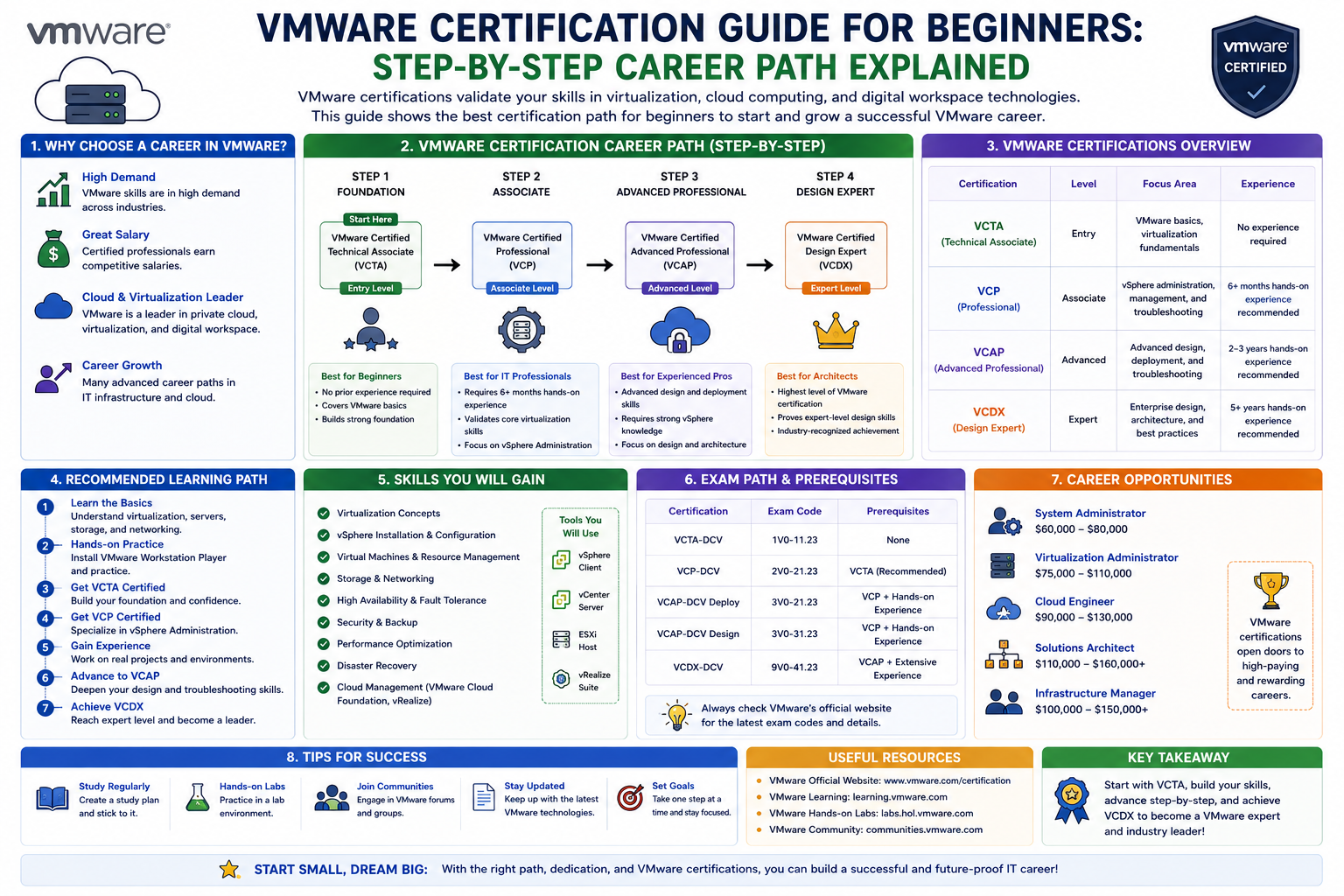
VMware certifications are professional credentials designed to validate an individual’s ability to work with virtualization and cloud infrastructure technologies. These certifications are widely recognized in the IT industry because VMware solutions are used in enterprise environments to manage servers, data centers, networks, desktops, and cloud systems efficiently.
At their core, VMware certifications focus on proving practical, job-ready skills rather than only theoretical knowledge. They are intended for IT professionals who design, configure, manage, and optimize virtual environments. Since virtualization has become a foundation of modern computing infrastructure, these certifications play an important role in shaping careers in system administration, cloud computing, networking, and cybersecurity.
Over time, VMware has evolved its certification structure. Earlier, it followed a level-based system that included associate, professional, advanced professional, and expert levels. While this structure still exists conceptually, VMware has shifted toward a role-based certification model. This change was made to better align certifications with real-world job roles and responsibilities.
Instead of only progressing through levels, candidates now choose certifications based on specific domains such as data center virtualization, network virtualization, cloud automation, end-user computing, security, and application modernization. Each domain includes multiple certification levels that reflect increasing expertise, from foundational to expert-level design capabilities.
This approach makes VMware certifications more flexible and practical, allowing professionals to specialize in the exact area that matches their career goals. It also ensures that certified individuals are better prepared for specific job functions in enterprise environments.
VMware Certification Structure and Role-Based Path
The modern VMware certification framework is organized around job roles and technical domains. Each domain represents a major area of enterprise IT infrastructure. Within each domain, certifications are structured across multiple levels of expertise, generally starting from entry-level technical associate certifications and progressing toward professional, advanced professional, and design expert levels.
This structure allows individuals to build their careers step by step while focusing on the skills most relevant to their responsibilities.
The entry-level certifications are designed for beginners who are new to virtualization or VMware technologies. These certifications validate foundational knowledge, such as understanding virtualization concepts, basic system configuration, and core product awareness.
The professional-level certifications are intended for IT administrators and engineers who actively work with VMware technologies in production environments. These certifications focus on installation, configuration, management, and optimization of systems.
Advanced professional certifications go deeper into specialized areas such as design and deployment. At this level, professionals are expected to handle complex infrastructure requirements, troubleshoot advanced issues, and implement scalable solutions.
At the highest level, design expert certifications represent mastery in VMware architecture. These certifications are aimed at senior professionals such as solution architects who design large-scale enterprise systems and lead virtualization strategies.
This structured pathway ensures that learners can progress logically from beginner-level knowledge to expert-level design capabilities while staying aligned with industry needs.
Major VMware Certification Tracks and Specializations
VMware certifications are divided into several key technology domains, each focusing on a different aspect of IT infrastructure.
Data Center Virtualization
Data center virtualization is one of the most important VMware domains. It focuses on technologies that power virtual machines, storage systems, and server infrastructure. Professionals in this field work with VMware vSphere and related tools to manage virtualized data centers.
This track is ideal for system administrators, virtualization engineers, and infrastructure specialists. It emphasizes skills such as deploying virtual machines, managing resources, ensuring system performance, and maintaining availability in enterprise environments.
As professionals advance in this track, they move from foundational understanding to designing and managing large-scale virtual infrastructures that support critical business operations.
Network Virtualization
Network virtualization focuses on transforming traditional physical networks into flexible, software-defined environments. This domain is centered around VMware NSX technology, which enables organizations to create virtual networks that operate independently of hardware constraints.
Professionals in this track learn how to configure virtual switches, manage network security policies, and design scalable network architectures. This specialization is highly valuable for network administrators and engineers who want to move into software-defined networking roles.
As networks become more complex and distributed, virtualization skills in this area are increasingly important for cloud and enterprise environments.
Cloud Management and Automation
Cloud management and automation certifications focus on managing cloud infrastructure using VMware tools. This includes automating workflows, optimizing resource usage, and maintaining cloud performance across hybrid environments.
Professionals in this domain work with cloud platforms to streamline IT operations and reduce manual processes. They are responsible for implementing automation strategies that improve efficiency and scalability.
This track is particularly relevant for cloud engineers, cloud architects, and IT professionals working in hybrid or multi-cloud environments.
End-User Computing
End-user computing focuses on managing digital workspaces and virtual desktop environments. This includes technologies that allow employees to access applications and desktops from any device securely.
Professionals in this domain work with VMware solutions that support remote work, centralized desktop management, and secure application delivery. They ensure that users have consistent and secure access to IT resources regardless of location.
This specialization is widely used in organizations that support remote or hybrid work environments and large-scale desktop deployments.
Security
The security track focuses on protecting virtual environments, workloads, and endpoints. VMware security solutions help organizations safeguard data, manage threats, and enforce security policies across virtual infrastructures.
Professionals in this area are responsible for securing cloud environments, managing endpoint protection, and ensuring compliance with security standards. As cybersecurity threats continue to increase, this specialization has become highly valuable.
Application Modernization
Application modernization focuses on modern development practices such as containerization and Kubernetes-based environments. This domain helps organizations transition from traditional applications to modern cloud-native architectures.
Professionals in this track work with platforms that support container orchestration, microservices, and scalable application deployment. It is especially relevant for DevOps engineers, cloud developers, and platform engineers.
VMware Certification Costs and Structure
The cost of VMware certification varies depending on the level and complexity of the exam. Entry-level certifications are generally more affordable, while advanced and expert-level certifications require significantly higher investment.
Professional-level exams typically have moderate fees, while advanced professional certifications cost more due to their complexity and practical requirements. Expert-level certifications involve multiple stages, including application assessments and practical defenses, making them the most expensive.
In addition to exam fees, candidates often invest in preparation resources such as training materials, practice environments, and hands-on labs. These additional costs can vary depending on individual preparation strategies.
Location and exam format can also influence pricing, especially for remote or proctored exams. Overall, pursuing VMware certification requires financial planning as well as time investment.
Career Opportunities and Industry Demand
VMware certifications open the door to a wide range of career opportunities in IT infrastructure and cloud computing. As organizations continue to adopt virtualization and cloud technologies, demand for skilled professionals continues to grow.
Certified professionals often work in roles such as system administrators, virtualization engineers, network engineers, cloud architects, and security specialists. As experience increases, professionals can move into senior roles such as IT architects, solution designers, and technical consultants.
Salary levels vary depending on certification level, experience, and job role. Entry-level professionals typically earn competitive salaries, while advanced and expert-level professionals can command significantly higher compensation due to their specialized skills.
VMware expertise is especially valuable in large enterprises, cloud service providers, and organizations with complex IT environments. These roles often involve managing mission-critical systems that require high availability and performance.
Preparation Strategy for VMware Certifications
Preparing for VMware certification requires a combination of theoretical learning and practical experience. Understanding concepts alone is not enough; hands-on practice is essential for success.
A strong preparation strategy begins with learning the fundamentals of virtualization and understanding how VMware products operate in real environments. Building familiarity with system architecture, networking concepts, and storage management is also important.
Hands-on practice is critical. Working in lab environments helps candidates gain real-world experience with configuration, deployment, and troubleshooting tasks. This practical exposure builds confidence and improves problem-solving skills.
It is also important to follow a structured study plan that covers all exam objectives. Breaking down topics into manageable sections makes preparation more effective and reduces complexity.
Consistent revision and practice tests can help reinforce knowledge and identify weak areas. Over time, this approach builds both confidence and technical proficiency.
Conclusion
VMware certifications represent a structured and highly respected pathway for IT professionals seeking to build careers in virtualization, cloud computing, and enterprise infrastructure. With a shift toward role-based learning, these certifications now align more closely with real-world job responsibilities, making them more practical and industry-relevant.
From foundational knowledge to expert-level architecture, VMware offers a clear progression path that supports long-term career development. Each specialization—whether in data center virtualization, networking, cloud automation, security, or application modernization—opens doors to specific and high-demand job roles.
As organizations continue to modernize their IT environments, VMware-certified professionals remain in strong demand. The certifications not only validate technical skills but also demonstrate the ability to manage complex systems efficiently and securely.
Ultimately, VMware certification is more than a credential; it is a structured learning journey that equips IT professionals with the skills needed to thrive in modern digital infrastructure environments and adapt to evolving technology landscapes.