Over the past decade, the way organizations communicate has shifted dramatically. Traditional office communication tools such as email and standalone conferencing systems have been replaced or heavily supplemented by integrated collaboration platforms. This change did not happen overnight. It was driven by global workforce expansion, remote and hybrid work models, and the need for real-time communication across time zones.
In this evolving environment, Microsoft Teams has become one of the central platforms for digital collaboration. It combines chat, meetings, calling, file sharing, and integration with Microsoft 365 services into a single ecosystem. What makes it particularly powerful is not just its feature set, but the way those features interact to create a unified communication experience.
As organizations began relying more heavily on Teams, the complexity of managing these systems also increased. It is no longer enough for IT professionals to simply know how to create meetings or manage users. They now need to understand how voice systems integrate with cloud services, how meeting policies affect user experience, and how physical meeting room devices connect into a cloud-managed environment.
This shift is what created the need for specialized roles focused entirely on collaboration systems. Instead of general IT administrators handling Teams as one of many responsibilities, organizations now require professionals who deeply understand how communication systems are designed, deployed, and maintained at scale.
The Purpose and Scope of MS-721 in Today’s IT Ecosystem
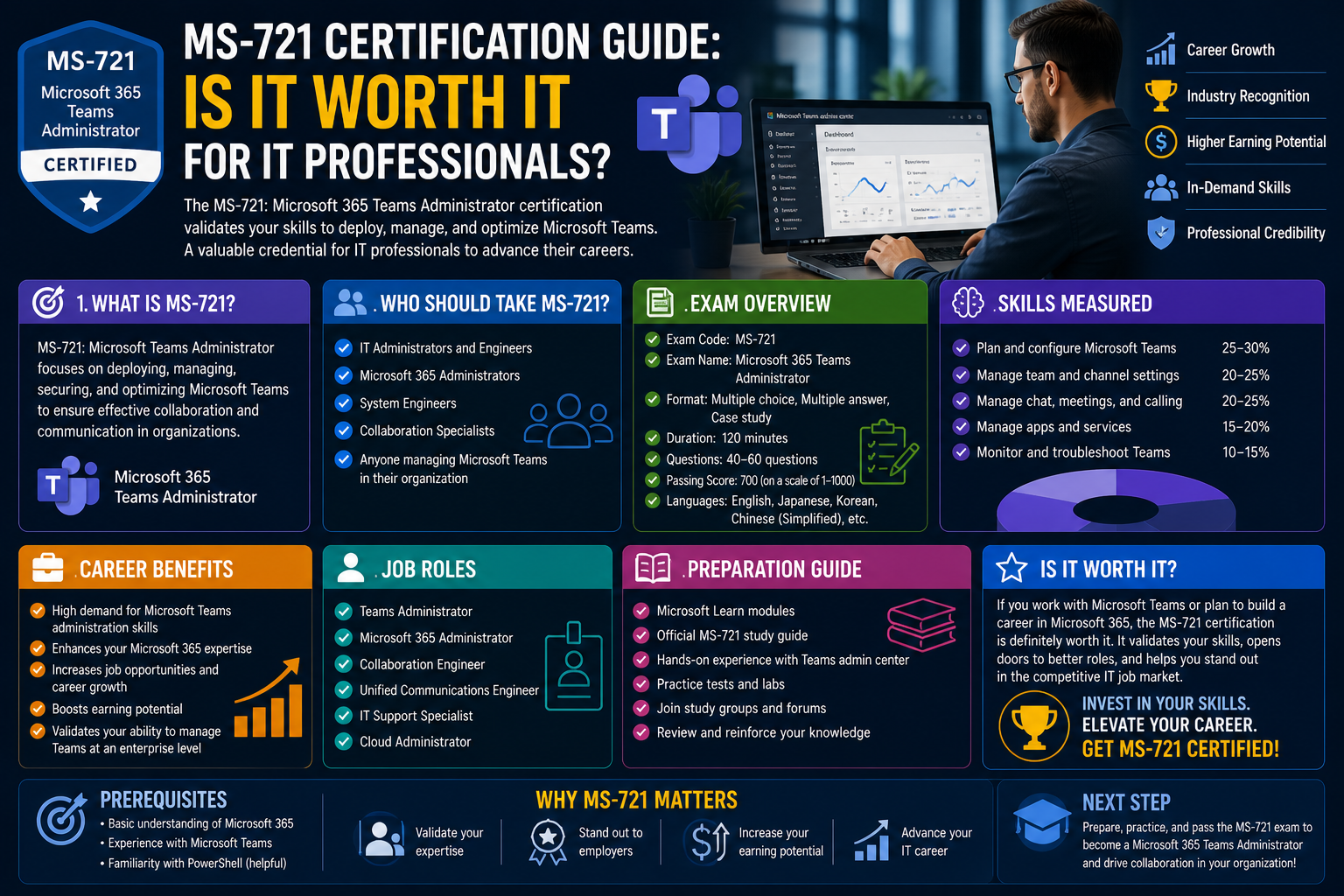
The MS-721 certification represents a specialized focus within the broader Microsoft ecosystem. It is designed for professionals who work with collaboration and communication systems built around Microsoft Teams. Rather than covering general IT administration, it concentrates on real-world scenarios involving meetings, calling systems, and meeting room technologies.
At its core, MS-721 validates the ability to design and manage communication systems that support modern workplace collaboration. This includes not only virtual meetings but also enterprise voice systems and physical conferencing environments. The scope of the certification reflects how deeply integrated Teams has become in business operations.
Organizations today expect seamless communication across devices and platforms. Employees join meetings from laptops, mobile devices, and conference rooms without thinking about the underlying infrastructure. However, behind this simplicity lies a complex architecture of policies, configurations, and integrations that must be carefully designed and maintained.
MS-721 focuses on ensuring professionals can handle this complexity. It emphasizes practical understanding rather than theoretical knowledge. Candidates are expected to know how different components of Microsoft Teams work together and how to troubleshoot issues when those components do not function as expected.
The Evolution of Microsoft Teams as a Communication Platform
To understand why MS-721 exists, it is important to understand how Microsoft Teams has evolved. Originally introduced as a chat-based workspace, Teams quickly expanded into a full communication hub. Over time, it absorbed capabilities from Skype for Business, added advanced meeting features, and integrated deeply with Microsoft 365 services.
This evolution transformed Teams into more than just a messaging application. It became a unified communications platform capable of handling enterprise-grade voice, video conferencing, webinars, and structured virtual events.
As new features were introduced, the complexity of managing Teams environments increased significantly. Features such as Teams Phone brought traditional telephony into the cloud. Teams Rooms introduced the need to manage physical meeting spaces using cloud-based tools. Enhancements like AI-powered meeting assistance and intelligent recaps further expanded the platform’s capabilities.
Each of these additions introduced new configuration requirements and administrative responsibilities. IT professionals now need to understand not only software configuration but also networking, device management, and communication policies.
This evolution is one of the primary reasons why specialized certifications like MS-721 became necessary. The platform is no longer simple enough to be managed through general IT knowledge alone.
Understanding Collaboration Communications Engineering as a Role
The MS-721 certification is closely associated with the role of a Collaboration Communications Systems Engineer. This role sits at the intersection of networking, communications, and cloud services.
A professional in this role is responsible for designing and maintaining systems that enable communication within an organization. This includes ensuring that meetings run smoothly, calls are reliable, and meeting rooms function properly. It also involves integrating voice systems with external telephony providers and ensuring compliance with organizational policies.
Unlike traditional IT roles that may focus on infrastructure or application support, this role is centered around user experience. The goal is to ensure that every communication channel works seamlessly regardless of where the user is located or what device they are using.
This requires a deep understanding of both technical systems and user behavior. For example, configuring a meeting policy is not just about enabling a feature. It involves understanding how that feature impacts collaboration, security, and bandwidth usage.
Similarly, managing enterprise voice systems requires knowledge of telephony concepts, routing, and emergency calling configurations. These are not typically covered in general IT certifications, which is why a dedicated certification path exists.
The Importance of Integrated Communication Systems in Organizations
Modern organizations rely heavily on integrated communication systems to function effectively. Teams meetings are used for daily collaboration, while Teams Phone replaces or extends traditional PBX systems. Meeting rooms equipped with Teams Rooms devices allow in-person and remote participants to collaborate seamlessly.
This integration brings several advantages. It reduces the need for multiple communication platforms, simplifies management, and improves user experience. However, it also introduces new challenges.
One of the biggest challenges is ensuring consistent performance across different environments. A user joining a meeting from a home network may experience different conditions compared to someone in a corporate office. Similarly, a meeting room device must be configured correctly to support audio, video, and content sharing without interruption.
Another challenge is maintaining security and compliance. Communication systems often handle sensitive information, so administrators must ensure that policies are correctly applied across all users and devices.
MS-721 focuses on these challenges by emphasizing practical configuration and management skills. It prepares professionals to think about communication systems holistically rather than as isolated tools.
Core Areas of Focus in Collaboration Communication Systems
While MS-721 covers multiple technical areas, its broader purpose is to ensure professionals understand how different communication components interact. These components include meetings, calling systems, and physical meeting environments.
Meetings form the foundation of collaboration in Teams. They include standard video conferences, webinars, and larger structured events such as town halls. Each type of meeting has different requirements in terms of capacity, features, and control.
Calling systems extend communication beyond meetings. Teams Phone allows organizations to make and receive calls using cloud-based telephony. This requires integration with traditional phone networks and careful configuration of routing policies.
Meeting rooms represent the physical aspect of collaboration systems. These rooms are equipped with specialized devices that connect directly to Teams. Managing them involves both hardware and software considerations, ensuring that devices remain updated and properly configured.
Together, these components form a unified communication ecosystem. Understanding how they interact is essential for anyone working in this field.
Why Specialized Knowledge is Becoming Essential
As communication systems become more advanced, general IT knowledge is no longer sufficient. Organizations need professionals who can handle complex scenarios involving multiple interconnected systems.
For example, troubleshooting a failed meeting may require analyzing network performance, checking meeting policies, and verifying device configurations. Similarly, resolving call quality issues may involve examining routing configurations and bandwidth usage.
These tasks require specialized knowledge that goes beyond basic administration. Professionals must understand how cloud services interact with on-premises infrastructure and how user configurations affect system behavior.
MS-721 addresses this need by focusing on real-world scenarios. It ensures that professionals are not just familiar with features but can also apply them effectively in complex environments.
The Role of Microsoft Teams in Digital Transformation
Microsoft Teams plays a central role in many organizations’ digital transformation strategies. It enables remote collaboration, supports hybrid work models, and reduces dependency on physical infrastructure.
By consolidating communication tools into a single platform, Teams simplifies workflows and improves efficiency. Employees can communicate, share files, and collaborate on projects without switching between multiple applications.
However, this transformation also requires a shift in IT management practices. Instead of managing isolated systems, IT professionals must now manage integrated ecosystems.
This is where the role validated by MS-721 becomes critical. Professionals must ensure that all components of the Teams ecosystem work together effectively to support business objectives.
The Increasing Complexity of Teams Environments
As organizations adopt more advanced features within Teams, environments become increasingly complex. Features such as AI-powered meeting assistance, advanced calling policies, and integrated device management introduce new layers of configuration.
Managing this complexity requires a structured approach. IT professionals must understand how each feature interacts with others and how changes in one area can impact the entire system.
For example, enabling a new meeting feature may affect bandwidth usage or device compatibility. Similarly, changes to calling policies may impact user experience across different regions.
MS-721 prepares professionals to navigate this complexity by focusing on scenario-based understanding. It encourages thinking in terms of systems rather than individual features.
The Strategic Importance of Collaboration Systems Engineers
Organizations increasingly view collaboration systems as strategic assets. Communication is no longer just a support function; it is a core part of business operations.
Collaboration systems engineers play a key role in ensuring that these systems are reliable, scalable, and secure. Their work directly impacts productivity, employee satisfaction, and operational efficiency.
As businesses continue to adopt hybrid work models, the demand for professionals who can manage these systems effectively is expected to grow.
MS-721 reflects this trend by validating skills that are directly aligned with modern workplace needs. It focuses on practical, real-world competencies that organizations rely on daily.
How MS-721 Fits into the Broader Microsoft Certification Ecosystem
Microsoft certifications are designed to align with specific roles and responsibilities. MS-721 fits into the collaboration and communication category, complementing other certifications focused on cloud administration, security, and infrastructure.
Unlike broader certifications, MS-721 is highly specialized. It does not attempt to cover all aspects of Microsoft 365. Instead, it focuses deeply on Teams collaboration systems.
This specialization makes it particularly valuable for professionals who already have a foundation in IT or Microsoft 365 and want to advance into a more focused role.
It also reflects a broader trend in IT certifications toward role-based learning. Instead of general knowledge, certifications now emphasize job-specific skills and practical application.
The Growing Dependence on Cloud-Based Communication
Cloud-based communication systems have become the standard for modern organizations. They offer scalability, flexibility, and accessibility that traditional systems cannot match.
Microsoft Teams is at the center of this shift. It provides a unified platform that supports communication across devices, locations, and time zones.
However, cloud systems also require new management approaches. Unlike traditional systems, they are continuously updated, which means administrators must adapt to frequent changes.
MS-721 prepares professionals for this environment by emphasizing adaptability and practical problem-solving. It ensures that they can manage evolving systems effectively.
Building the Foundation for Advanced Collaboration Skills
Before mastering advanced collaboration systems, professionals need a strong foundation in how communication platforms operate. This includes understanding user management, policy configuration, and basic networking concepts.
MS-721 builds on this foundation by introducing more advanced concepts such as voice integration, meeting optimization, and device management.
It is not an entry-level certification but rather a specialization that builds on prior experience. This ensures that certified professionals are ready to handle real-world challenges from day one.
The skills developed through this certification are applicable across a wide range of industries, including corporate IT, education, healthcare, and government organizations.
Designing Collaboration Systems for Real Organizational Needs
At the core of MS-721 is the ability to design communication systems that match how organizations actually operate. This goes beyond simply enabling features inside Microsoft Teams. It requires understanding business requirements, user behavior, and technical constraints, then translating those into functional collaboration architectures.
In real environments, no two organizations use Teams in exactly the same way. A small company might rely heavily on chat and basic meetings, while a global enterprise may require complex meeting structures, enterprise voice systems, and integrated conference room setups across multiple regions.
Designing for these environments requires careful consideration of scalability. Systems must support growth without requiring constant redesign. This means thinking ahead about user load, bandwidth requirements, and feature adoption patterns.
Another important factor is governance. Organizations often need to control how collaboration tools are used. This includes setting rules for meetings, controlling who can create large events, and managing external access. A well-designed system balances flexibility for users with control for administrators.
MS-721 emphasizes this design mindset by focusing on scenario-based thinking. Instead of asking what a feature does, it encourages professionals to ask why and when it should be used.
Structuring Teams Meetings for Different Communication Scenarios
Meetings in Microsoft Teams are not one-size-fits-all. They come in multiple formats, each designed for specific communication needs. Understanding these formats is essential for building effective collaboration systems.
Standard meetings are used for day-to-day collaboration. These are typically informal sessions involving team members discussing projects, sharing updates, or making decisions. The configuration of these meetings is usually straightforward, but policies still play an important role in controlling participant permissions and meeting behavior.
Webinars introduce a more structured format. Unlike standard meetings, webinars are designed for one-to-many communication. Presenters control the flow of information, while attendees typically have limited interaction. This format is commonly used for training sessions, product demonstrations, and organizational announcements.
Town halls represent large-scale communication events. These are designed for very large audiences and require careful planning to ensure stability and performance. Features such as moderated Q&A sessions, broadcast controls, and audience management become important in this context.
Each of these meeting types requires different configuration strategies. IT professionals must understand how to apply policies appropriately based on the intended use case. MS-721 evaluates this understanding through real-world scenarios where selecting the wrong configuration could impact communication quality or user experience.
Managing Meeting Policies and User Experience Controls
Meeting policies are a critical part of Microsoft Teams administration. They determine what users can and cannot do during meetings. These policies affect everything from screen sharing permissions to recording capabilities.
One of the challenges in managing meeting policies is balancing flexibility with control. Organizations want to empower users to collaborate effectively, but they also need to maintain security and compliance standards.
For example, allowing external participants into meetings can improve collaboration with partners or clients. However, it also introduces potential security risks if not properly controlled. Similarly, enabling recording features can be useful for documentation but may raise privacy concerns.
MS-721 places strong emphasis on understanding how these policies interact. It is not enough to know what each setting does. Professionals must understand how combinations of settings impact the overall meeting experience.
User experience is another important factor. Poorly configured policies can lead to frustration, confusion, or reduced productivity. For example, overly restrictive settings may prevent users from sharing content effectively, while overly permissive settings may create security risks.
Designing effective meeting policies requires both technical knowledge and an understanding of organizational culture.
Enterprise Voice Architecture and Calling System Design
One of the most technically complex areas covered in MS-721 is enterprise voice. Microsoft Teams Phone transforms Teams into a full business telephony system, replacing traditional PBX infrastructure in many organizations.
Designing a voice system requires understanding how calls are routed, how numbers are assigned, and how external communication is handled. There are multiple deployment models, each suited to different organizational needs.
Some organizations use cloud-based calling plans, while others integrate with existing telephony infrastructure using direct routing. Each approach has its own advantages and limitations.
Call routing is particularly important. When a user makes or receives a call, the system must determine how that call is handled, including whether it stays within the organization or connects to external networks.
Emergency calling is another critical component. Organizations must ensure that users can contact emergency services from any location. This requires careful configuration of location data and routing rules.
MS-721 expects professionals to understand these concepts at a practical level. It is not enough to know that voice systems exist. Candidates must be able to design, configure, and troubleshoot them in real environments.
Troubleshooting Communication Issues in Distributed Environments
One of the most challenging aspects of managing collaboration systems is troubleshooting. Issues can arise from multiple sources, including network problems, configuration errors, or device malfunctions.
In a distributed environment, these issues become even more complex. Users may be located in different regions, using different devices and network connections. This variability makes it difficult to isolate the root cause of problems.
For example, poor call quality may be caused by insufficient bandwidth, incorrect routing configuration, or even device hardware limitations. Identifying the cause requires a systematic approach.
Troubleshooting often involves analyzing logs, checking configuration settings, and testing connectivity between components. It also requires understanding how different parts of the system interact.
MS-721 evaluates this ability through scenario-based questions. Candidates are expected to diagnose problems based on limited information and identify the most likely cause.
This reflects real-world conditions, where IT professionals often must resolve issues quickly without having complete visibility into every component.
Integrating Physical Meeting Room Systems into Cloud Infrastructure
Meeting room systems represent the physical side of collaboration technology. These systems include cameras, microphones, displays, and dedicated computing devices designed to work with Microsoft Teams.
Managing these systems requires both hardware and software knowledge. Devices must be properly configured to connect to Teams services, and they must be maintained to ensure consistent performance.
One of the key challenges is ensuring that meeting rooms provide a seamless experience for users joining from different locations. A well-designed room should allow participants to join meetings effortlessly, share content easily, and communicate without technical barriers.
Device management is typically handled through centralized platforms that allow administrators to monitor and configure multiple rooms from a single interface. This simplifies maintenance and ensures consistency across locations.
However, physical environments introduce additional challenges such as audio quality, camera positioning, and display setup. These factors can significantly impact the overall meeting experience.
MS-721 includes these considerations as part of its focus on real-world collaboration environments. It ensures that professionals understand not only digital systems but also physical deployment scenarios.
Managing Identity, Access, and Security in Collaboration Systems
Identity and access management plays a crucial role in Microsoft Teams environments. Every user, device, and service must be properly authenticated and authorized before accessing collaboration tools.
Security is particularly important in communication systems because they often handle sensitive organizational information. This includes confidential meetings, internal discussions, and external communications.
Access control is managed through policies that define what users can do within the system. These policies can be applied at different levels, including individual users, groups, or entire organizations.
Conditional access policies add another layer of security by evaluating factors such as location, device compliance, and risk level before granting access.
MS-721 expects professionals to understand how these security mechanisms integrate with collaboration systems. This includes knowing how identity services interact with Teams and how security policies affect user experience.
Balancing security with usability is a recurring theme in collaboration system design. Overly strict policies may hinder productivity, while overly relaxed policies may expose organizations to risk.
The Role of Network Performance in Collaboration Quality
Network performance is one of the most critical factors affecting Microsoft Teams experience. Since Teams relies heavily on real-time communication, even small network issues can significantly impact quality.
Bandwidth, latency, and packet loss all play important roles in determining call and meeting performance. Poor network conditions can lead to audio delays, video freezing, or dropped calls.
In enterprise environments, network optimization becomes a key responsibility. IT professionals must ensure that traffic is properly prioritized and that sufficient bandwidth is available for collaboration tools.
Quality of Service (QoS) configurations are often used to prioritize Teams traffic over other types of network traffic. This ensures that communication remains stable even during periods of high network usage.
MS-721 includes these considerations as part of its broader focus on communication system reliability. It expects professionals to understand how network conditions impact user experience and how to mitigate potential issues.
Managing Advanced Collaboration Features and Enhancements
Microsoft Teams continues to evolve with the introduction of advanced features that enhance collaboration experiences. These include AI-powered meeting assistance, intelligent summaries, and enhanced content sharing capabilities.
These features are designed to improve productivity and make communication more efficient. However, they also introduce new configuration and management requirements.
For example, AI-based meeting tools may require specific policy settings to function correctly. Similarly, advanced meeting features may depend on licensing or device compatibility.
Understanding how these features integrate into existing systems is an important part of collaboration engineering. It requires staying up to date with platform changes and understanding how new capabilities affect system design.
MS-721 reflects this evolving landscape by including modern features in its scope. It ensures that professionals are prepared to work with both current and emerging technologies.
Scenario-Based Thinking in Collaboration Engineering
A defining characteristic of MS-721 is its emphasis on scenario-based problem solving. Instead of testing isolated knowledge points, it presents situations that reflect real organizational challenges.
These scenarios often involve multiple variables, such as user requirements, technical constraints, and system limitations. Candidates must analyze the situation and determine the best course of action.
This approach mirrors real-world work environments, where problems are rarely straightforward. IT professionals must often make decisions based on incomplete information and competing priorities.
Scenario-based thinking requires a combination of technical knowledge and practical experience. It also requires the ability to think critically about system behavior and user impact.
MS-721 reinforces this mindset by focusing on applied knowledge rather than memorization.
Understanding the Interaction Between Different Teams Components
Microsoft Teams is composed of multiple interconnected components. These include chat, meetings, calling systems, file sharing, and device management.
Each component plays a specific role, but they all work together to create a unified collaboration experience. Understanding how these components interact is essential for effective system design.
For example, a change in meeting policy may affect how users interact during calls. Similarly, changes in voice configuration may impact meeting connectivity.
This interconnectedness means that administrators must think holistically when making changes. Isolated adjustments can have unintended consequences elsewhere in the system.
MS-721 emphasizes this systems thinking approach. It ensures that professionals understand not just individual features but also how they contribute to the overall communication ecosystem.
How MS-721 Aligns with Modern IT Career Paths
The MS-721 certification sits in a very specific and increasingly important part of the IT landscape: collaboration and communications engineering. This is not a generalist role, and it is not focused on traditional infrastructure alone. Instead, it reflects a shift in the industry toward user-experience-centered IT roles, where success is measured by how effectively people can communicate, collaborate, and stay productive using digital platforms.
Modern IT careers are no longer limited to managing servers or maintaining networks in isolation. Instead, professionals are expected to understand how cloud platforms, identity systems, communication tools, and endpoint devices work together. MS-721 aligns directly with this expectation by focusing on the systems that enable real-time human collaboration.
Organizations are increasingly dependent on tools like Microsoft Teams for daily operations. Meetings, voice calls, webinars, and virtual events are no longer supplementary—they are the primary communication channels in many workplaces. As a result, professionals who can design, maintain, and troubleshoot these systems are becoming essential.
MS-721 reflects this reality by validating skills that are directly tied to operational communication systems. It is particularly relevant for professionals transitioning from general IT roles into more specialized cloud collaboration roles. It also supports those already working in Microsoft 365 environments who want to deepen their expertise.
The Shift from Traditional IT Administration to Collaboration Engineering
Traditional IT administration focused heavily on infrastructure components such as servers, storage systems, and network hardware. While these areas remain important, the rise of cloud computing has significantly changed the responsibilities of IT professionals.
In cloud-based environments, many infrastructure tasks are abstracted away. Instead of managing physical servers, professionals now manage services. Instead of configuring hardware directly, they configure policies and cloud-based systems.
Collaboration engineering is a direct result of this shift. It focuses on ensuring that communication systems function effectively in distributed, cloud-first environments.
Unlike traditional roles that emphasize system uptime alone, collaboration engineers are also responsible for user experience, communication quality, and feature adoption. This means they must understand both technical configurations and human interaction patterns.
MS-721 reflects this evolution by emphasizing applied knowledge. It requires professionals to think beyond technical settings and consider how those settings affect real-world communication.
Designing Scalable Collaboration Architectures
One of the most important responsibilities in collaboration systems engineering is designing scalable architectures. As organizations grow, their communication needs expand rapidly. More users, more devices, and more meeting activity all place additional demands on the system.
Scalability is not just about handling more users. It also involves ensuring consistent performance across different locations, networks, and device types. A well-designed collaboration system should function smoothly whether a user is in a corporate office, working remotely, or joining from a mobile device.
Designing for scale requires careful planning of policies, network infrastructure, and service configurations. It also involves anticipating future growth and ensuring that systems can adapt without major redesign.
For example, meeting policies must be structured in a way that allows flexibility without becoming overly complex. Voice systems must be designed to handle increasing call volumes without degradation in quality. Meeting room systems must support new devices and software updates without disruption.
MS-721 reinforces these concepts by focusing on design-level thinking. It encourages professionals to evaluate not just how systems work today, but how they will perform under future conditions.
Managing Hybrid Communication Environments
Many organizations operate in hybrid environments where cloud-based services coexist with on-premises infrastructure. This is especially true for communication systems, where legacy telephony systems may still be in use alongside modern cloud-based solutions.
Managing hybrid environments introduces additional complexity. Systems must be integrated in a way that allows seamless communication between cloud and on-premises components. This often involves configuring routing paths, identity synchronization, and interoperability settings.
Hybrid voice deployments are a common example. Some organizations use cloud calling services while maintaining existing PBX systems. Others rely on direct routing to connect Teams with traditional telephony infrastructure.
Each approach has advantages and trade-offs. Cloud-native solutions offer simplicity and scalability, while hybrid solutions provide flexibility and continuity for existing investments.
MS-721 includes these hybrid scenarios as part of its focus. Professionals are expected to understand how different deployment models work and how to manage them effectively.
Advanced Troubleshooting in Complex Collaboration Systems
Troubleshooting in collaboration environments is often more complex than in traditional IT systems. This is because issues can arise from multiple layers of the architecture, including user configuration, network performance, device behavior, and cloud service availability.
A single user issue may involve several components working together. For example, a failed meeting connection could be caused by incorrect policy settings, network restrictions, or device compatibility issues.
Effective troubleshooting requires a structured approach. Professionals must be able to isolate variables, test assumptions, and analyze system behavior systematically.
In many cases, troubleshooting also involves interpreting diagnostic data such as logs, call quality reports, and performance metrics. This data provides insight into how the system is functioning and where problems may be occurring.
MS-721 emphasizes this analytical approach. It expects professionals to think logically and methodically when resolving issues, rather than relying on guesswork.
Optimizing Communication Quality Across Global Networks
One of the biggest challenges in modern collaboration systems is ensuring consistent communication quality across global networks. Users may be located in different countries, using different internet service providers and network conditions.
Latency, jitter, and packet loss can significantly affect communication quality. Even small variations in network performance can impact voice clarity and video stability.
To address these challenges, collaboration systems often use global network optimization strategies. These include routing traffic through optimized pathways, prioritizing communication data, and reducing unnecessary network hops.
Quality of Service (QoS) configurations are also commonly used to ensure that communication traffic receives priority over less critical data.
Understanding these optimization techniques is essential for collaboration engineers. It allows them to design systems that maintain high performance even under challenging network conditions.
MS-721 includes these considerations as part of its focus on real-world system reliability.
Managing Large-Scale Meeting and Event Environments
Modern organizations frequently host large-scale virtual events such as company-wide meetings, training sessions, and product announcements. These events require specialized configuration and management to ensure stability and performance.
Unlike standard meetings, large events involve thousands of participants and require careful planning of resources. This includes managing attendee permissions, controlling audio and video distribution, and ensuring system scalability.
Town hall-style events often require additional features such as moderated Q&A sessions and structured presentation controls. These features help maintain order and ensure that communication remains clear and focused.
From a technical perspective, large-scale events place significant demands on backend systems. Network bandwidth, server capacity, and device compatibility all become critical factors.
MS-721 addresses these scenarios by testing understanding of how to configure and manage large communication events effectively.
Device Ecosystems and Endpoint Management in Collaboration Systems
Collaboration systems are not limited to software alone. They also include a wide range of physical devices such as conference room systems, webcams, microphones, and display units.
Managing these devices is an essential part of collaboration engineering. Devices must be properly configured, regularly updated, and monitored for performance issues.
Endpoint management systems allow administrators to control multiple devices from a centralized platform. This simplifies maintenance and ensures consistency across an organization.
However, device diversity introduces challenges. Different hardware models may have different capabilities, compatibility requirements, and update cycles.
Ensuring that all devices function correctly within the collaboration ecosystem requires careful planning and ongoing management.
MS-721 includes this area as part of its broader focus on real-world system administration.
Policy Management as the Foundation of System Control
Policies are at the heart of Microsoft Teams administration. They define how users interact with the system and what features are available to them.
Different types of policies exist for meetings, calling, messaging, and device usage. Each policy type controls a specific aspect of the collaboration experience.
One of the key challenges in policy management is consistency. Large organizations often have multiple policy sets applied across different departments or user groups. Ensuring that these policies do not conflict requires careful design.
Another challenge is adaptability. As organizational needs change, policies must be updated without disrupting existing workflows.
MS-721 emphasizes the importance of understanding policy hierarchy and interaction. Professionals must know how different policies affect each other and how to apply them effectively.
Security Considerations in Collaboration Systems
Security is a fundamental aspect of any communication system. In collaboration environments, security extends beyond traditional access control to include communication privacy, data protection, and compliance requirements.
Organizations must ensure that sensitive conversations remain protected and that only authorized users can access specific information.
Encryption plays a key role in securing communication channels. It ensures that data remains protected during transmission and cannot be intercepted by unauthorized parties.
Access control policies further enhance security by restricting who can join meetings, share content, or access certain features.
MS-721 includes security considerations as part of its overall system design focus. It ensures that professionals understand how to balance security with usability.
The Impact of Artificial Intelligence on Collaboration Systems
Artificial intelligence is increasingly integrated into modern collaboration platforms. Features such as automated meeting summaries, real-time transcription, and intelligent scheduling are becoming standard.
These AI-powered features are designed to improve productivity and reduce manual effort. They help users focus on communication rather than administrative tasks.
However, AI integration also introduces new configuration and management considerations. Administrators must understand how these features interact with existing systems and how to control their behavior through policies.
As AI continues to evolve, collaboration systems will become more intelligent and adaptive. This will further increase the importance of professionals who understand how to manage these technologies effectively.
MS-721 reflects this trend by incorporating modern collaboration enhancements into its scope.
Long-Term Value of Specialized Collaboration Skills
Specialized collaboration skills remain valuable over time because communication systems are central to organizational success. As long as businesses rely on meetings, calls, and virtual collaboration, there will be a need for professionals who can manage these systems.
Unlike some technologies that become obsolete quickly, collaboration platforms continue to evolve and expand. This ensures that skills related to system design, troubleshooting, and optimization remain relevant.
Professionals with expertise in collaboration systems often find opportunities in a wide range of industries, including enterprise IT, consulting, and cloud services.
The ability to manage communication systems effectively is also transferable across platforms. While MS-721 focuses on Microsoft Teams, many of the underlying principles apply to other collaboration tools as well.
Conclusion
The MS-721 certification represents more than just a technical milestone; it reflects how deeply communication systems have become embedded in modern business operations. As organizations continue to shift toward hybrid and cloud-first environments, tools like Microsoft Teams are no longer optional productivity add-ons. They are core infrastructure that directly supports how people meet, collaborate, and make decisions every day.
This shift has fundamentally changed what IT professionals are expected to know. In earlier IT models, communication systems were often managed separately from infrastructure, and responsibilities were more segmented. Today, those boundaries have blurred. A single platform can now handle chat, voice calling, video meetings, webinars, and even physical meeting room integration. This convergence has created a demand for professionals who understand not just how these systems work individually, but how they function together as part of a unified ecosystem.
MS-721 addresses this need by focusing specifically on collaboration communications systems engineering. It validates the ability to design, configure, manage, and troubleshoot Microsoft Teams environments at a deep operational level. The emphasis is not on memorizing features, but on applying knowledge in realistic scenarios where multiple systems interact and decisions have direct impacts on user experience.
Another key value of MS-721 lies in its relevance to real-world job roles. The certification aligns closely with responsibilities found in collaboration engineer, Microsoft 365 administrator, and enterprise communications specialist positions. These roles are becoming more common as businesses continue to rely on integrated communication platforms. Organizations are not just looking for IT staff who can “support Teams,” but professionals who can optimize it, secure it, and adapt it to evolving business needs.
The certification also highlights the increasing importance of cloud-based voice and meeting systems. Traditional telephony and conferencing systems are rapidly being replaced by cloud-native solutions that require a completely different approach to design and management. Understanding concepts such as Teams Phone architecture, meeting policies, device management, and network optimization is now essential for maintaining reliable communication systems at scale.
Beyond technical skills, MS-721 also reinforces critical thinking and troubleshooting capabilities. Real-world collaboration environments are rarely predictable. Issues can arise from network instability, device misconfiguration, policy conflicts, or user behavior. The ability to quickly identify root causes and apply effective solutions is a defining skill for professionals in this field. This makes the certification particularly valuable for those who want to move beyond routine administration into more advanced engineering roles.
From a career perspective, MS-721 supports long-term growth by positioning professionals within a specialized and expanding area of IT. As organizations continue to adopt remote and hybrid work models, demand for collaboration systems expertise is expected to grow steadily. Professionals who understand how to manage these environments will remain highly relevant across industries such as finance, healthcare, education, government, and technology services.
Ultimately, the value of MS-721 is not limited to passing an exam. It lies in the depth of understanding it builds around modern communication systems and the practical skills it develops for managing them. It encourages professionals to think holistically, act strategically, and respond effectively to complex technical challenges.
In a world where digital communication is the backbone of daily operations, mastering collaboration systems is no longer optional for IT professionals aiming to stay competitive. MS-721 serves as a structured path toward that expertise, equipping individuals with the knowledge and confidence needed to manage one of the most critical components of today’s digital workplace.