Modern computer networks are far more complex than they were in the early days of enterprise connectivity. Businesses now manage large numbers of users, devices, applications, cloud platforms, remote offices, and internet-connected systems simultaneously. As organizations expand, they face increasing pressure to maintain secure communication, efficient routing, and reliable network performance while keeping infrastructure costs under control.
Traditional routing methods were once sufficient for smaller environments. A single router with one routing table could manage traffic between networks without major complications. However, as organizations grew larger and more interconnected, this model started creating limitations. Companies needed stronger network isolation, more flexible traffic management, and better methods for separating users and services without constantly purchasing additional physical routers.
This challenge led to the development of technologies designed to virtualize networking functions. One of the most important of these technologies is Virtual Routing and Forwarding, commonly known as VRF. VRF allows a single router or Layer 3 device to function as though it were multiple independent routers operating simultaneously.
By creating multiple virtual routing tables inside one device, VRF allows organizations to isolate traffic, improve security, and simplify network management without requiring separate physical hardware for every network segment. This approach has become essential in enterprise networking, cloud computing, service provider environments, and large-scale business infrastructures.
What Cisco VRF Means in Networking
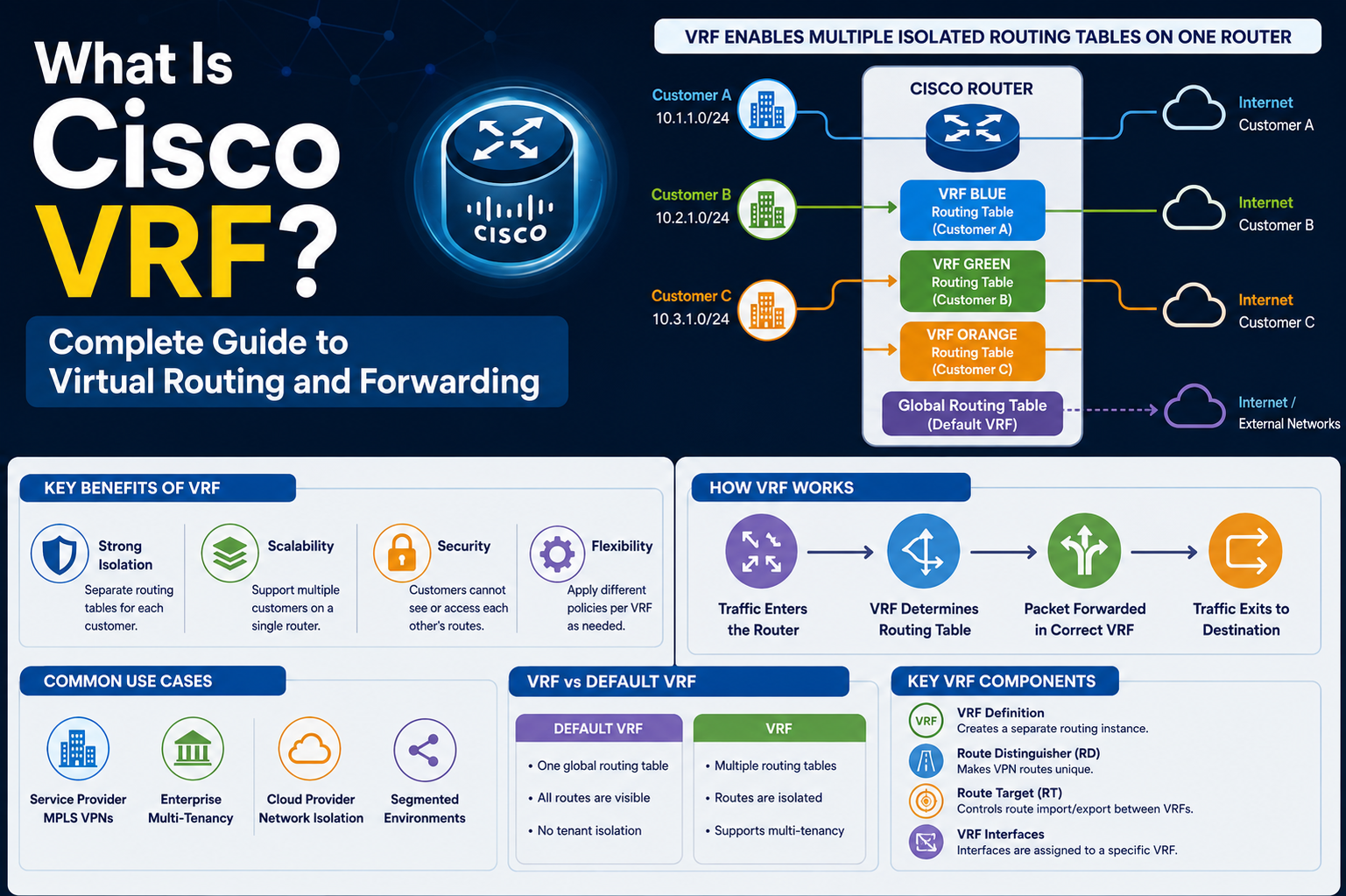
Cisco VRF, or Virtual Routing and Forwarding, is a technology that enables a network device to maintain multiple independent routing tables at the same time. Each routing table operates separately, almost as if the device were several different routers combined into one physical platform.
Normally, a router uses a single global routing table to determine how traffic should move between networks. Every interface connected to the router contributes information to this single routing environment. Without additional segmentation methods, all connected networks may potentially communicate with one another.
VRF changes this behavior by allowing interfaces to belong to separate virtual routing instances. Each VRF maintains its own routes, forwarding decisions, and network paths independently from the others. Devices assigned to one VRF typically cannot communicate directly with devices in another VRF unless administrators explicitly configure communication between them.
This separation creates strong logical isolation within a shared infrastructure. Different customers, departments, business units, or applications can operate on the same physical router while remaining completely separated from one another at the routing level.
The ability to virtualize routing functions significantly reduces the need for additional hardware while increasing flexibility and scalability.
The Relationship Between VRF and Network Virtualization
Network virtualization refers to the process of creating logical network environments that operate independently within shared physical infrastructure. VRF represents one of the most practical and widely used forms of routing virtualization.
The concept is somewhat similar to virtualization in computing systems. Just as a single physical server can host multiple virtual machines, a single router using VRF can host multiple virtual routing environments.
Each VRF behaves like a separate routing domain with its own interfaces, routes, and forwarding logic. From the perspective of connected devices, it appears as though they are communicating through their own dedicated router.
This approach provides enormous flexibility because organizations can create multiple isolated networks without deploying separate hardware for every routing requirement. Businesses save space, reduce equipment costs, simplify management, and improve scalability.
Virtualization also improves operational efficiency. Network administrators can configure and manage multiple environments from centralized infrastructure instead of maintaining large collections of independent routers across different departments or customer networks.
As businesses continue expanding cloud services, remote operations, and multi-tenant infrastructures, virtualized networking technologies such as VRF have become increasingly valuable.
How Routing Works Without VRF
To understand the value of VRF, it helps to first understand how traditional routing operates.
In a standard routing environment, a router maintains one global routing table. This table contains information about reachable networks and determines how packets travel between connected destinations.
When a packet arrives, the router examines the destination IP address and searches the routing table for the best path. Once a matching route is found, the router forwards the packet toward its destination.
The problem with this approach appears when organizations require multiple isolated environments. Without VRF, all interfaces and networks connected to the router typically share the same routing space. This can create security concerns, overlapping address conflicts, and operational limitations.
For example, two departments using identical IP address ranges could not coexist easily within the same routing table. Similarly, organizations hosting multiple customers would struggle to isolate customer traffic completely without deploying separate routers.
Before VRF became common, businesses often solved these challenges by installing multiple physical routers. While effective, this approach increased hardware costs, power consumption, maintenance complexity, and space requirements.
VRF introduced a far more efficient solution by allowing one device to simulate multiple routing environments internally.
Understanding Routing Tables in VRF
The routing table is one of the most important components in any router. It contains the information necessary to forward packets between networks.
With VRF, each virtual routing instance maintains its own independent routing table. These routing tables remain isolated from one another unless administrators intentionally configure route sharing or communication between VRFs.
This separation means two VRFs can even use identical IP address ranges without conflict because the router treats them as entirely separate routing environments.
For example, two customers connected to the same service provider may both use the same private IP address scheme internally. Without VRF, these overlapping addresses would create major routing conflicts. With VRF, each customer receives an isolated routing table, allowing both address spaces to coexist safely on shared infrastructure.
The independence of routing tables also improves security. Devices inside one VRF cannot automatically access networks in another VRF because their routing information remains separate.
Each VRF therefore acts almost like a private network operating within a larger physical system.
VRF and the OSI Model
VRF operates primarily at Layer 3 of the OSI model, which is the network layer responsible for routing packets between networks.
Layer 3 technologies focus on logical addressing, routing decisions, and packet forwarding. Routers examine IP addresses and determine how data should travel across networks.
Because VRF creates separate routing domains and routing tables, it directly affects Layer 3 operations. The router maintains independent forwarding decisions for each VRF environment.
This distinguishes VRF from technologies such as VLANs, which primarily operate at Layer 2 of the OSI model. VLANs separate broadcast domains within switching environments, while VRF separates routing domains within routing environments.
Understanding this distinction is important because VLANs and VRF often work together but serve different purposes.
Comparing VRF and VLAN Technologies
Many people compare VRF with VLANs because both technologies provide network segmentation. However, they operate differently and solve different networking challenges.
A VLAN, or Virtual Local Area Network, divides a switched network into separate broadcast domains. Devices within different VLANs remain isolated at Layer 2 unless routing occurs between them.
VLANs are extremely useful for separating departments, user groups, guest networks, or device categories within a local network environment. They improve security, reduce broadcast traffic, and simplify network organization.
VRF extends segmentation further into the routing layer. Instead of merely separating broadcast domains, VRF separates entire routing tables and forwarding environments.
This creates stronger isolation because devices in different VRFs do not share routing information at all unless explicitly configured.
Organizations often use VLANs and VRF together. VLANs may separate traffic locally within switching environments, while VRF provides broader routing isolation across larger network infrastructures.
For example, a company may place employee devices, guest wireless users, and payment systems in separate VLANs while also assigning those networks to different VRFs for enhanced routing separation.
The combination of Layer 2 and Layer 3 segmentation creates highly secure and scalable network architectures.
The Security Benefits of VRF
Security is one of the biggest reasons organizations implement VRF technology.
In traditional shared routing environments, all connected networks potentially exist within the same routing space. Even when access controls exist, the networks themselves remain visible within the routing environment.
VRF improves security by completely isolating routing information between environments. Networks assigned to separate VRFs are effectively invisible to one another unless administrators intentionally create communication paths.
This approach reduces the risk of unauthorized access and lateral movement within networks. Attackers compromising one VRF environment cannot automatically access resources inside another isolated VRF.
Service providers benefit significantly from this capability because they can host multiple customer networks on shared infrastructure while maintaining strict traffic isolation.
Large enterprises also use VRF to separate sensitive departments, production systems, development environments, and external-facing services.
The security advantages become even more valuable in environments requiring strict compliance, customer isolation, or segmented business operations.
Network Segmentation Through VRF
Segmentation refers to dividing a network into smaller, isolated sections for security, performance, and organizational purposes.
VRF provides advanced segmentation capabilities because each virtual routing environment functions independently. Organizations can separate traffic logically while still using shared physical infrastructure.
For example, a business may create separate VRFs for corporate users, voice systems, management traffic, cloud services, and partner networks. Each VRF operates independently while using the same routing hardware.
This segmentation improves operational control and simplifies troubleshooting because traffic remains organized according to business functions or customer requirements.
Segmentation also limits the spread of network problems. Routing issues, misconfigurations, or security incidents inside one VRF typically remain isolated from the others.
As networks continue growing more complex, segmentation becomes increasingly important for maintaining stability and security.
How Service Providers Use VRF
Internet service providers and cloud providers rely heavily on VRF technology because they must support large numbers of isolated customer networks simultaneously.
Without VRF, providers would need separate physical routers or fully isolated infrastructures for every customer. This approach would be extremely expensive and operationally inefficient.
VRF allows providers to host multiple customers securely on shared infrastructure while maintaining independent routing environments for each client.
Each customer receives a dedicated virtual routing table that keeps their traffic isolated from others. Even overlapping IP address ranges can coexist safely because the routing environments remain separate.
Cloud providers also use VRF to separate workloads, applications, and tenant environments within large-scale data centers.
This scalability makes VRF essential in modern multi-tenant networking environments.
The Performance Advantages of VRF
VRF not only improves security and segmentation but can also enhance network performance.
Because routing environments remain isolated, administrators can optimize traffic paths independently for different VRFs. Critical applications may receive priority routing paths while less sensitive traffic uses alternative routes.
Organizations can therefore design more efficient routing architectures tailored to business requirements.
Traffic isolation also reduces unnecessary routing complexity. Networks remain cleaner and more organized because routes stay contained within relevant VRFs.
Another important advantage involves IP address reuse. Multiple VRFs can use identical private address ranges without conflict because their routing environments remain independent.
This becomes especially valuable for service providers and large enterprises managing thousands of devices across different customers or departments.
The ability to reuse address space improves scalability and reduces address management challenges significantly.
The Flexibility of Modern VRF Deployments
Modern network infrastructures require flexibility because businesses constantly evolve.
Organizations open new branch offices, migrate services to the cloud, support remote workforces, and integrate new applications continuously. VRF helps support this flexibility by allowing administrators to create and modify routing environments dynamically.
New departments, customer environments, or service segments can be added without requiring entirely new physical routing infrastructure.
Administrators can also adjust routing policies independently for different VRFs, improving operational adaptability.
Cloud integration further expands VRF flexibility. Businesses can extend isolated routing environments across hybrid infrastructures connecting on-premises systems with cloud platforms securely.
This adaptability has made VRF a foundational technology in modern enterprise and service provider networking.
Why VRF Remains Essential in Modern Networking
The importance of VRF continues growing because networks themselves continue expanding in complexity.
Organizations need stronger segmentation, improved scalability, enhanced security, and more efficient infrastructure management. VRF addresses all of these requirements by virtualizing routing functions inside shared hardware platforms.
Instead of deploying large numbers of separate routers, businesses can consolidate routing functions while still maintaining isolated environments.
This approach reduces costs, simplifies management, improves scalability, and strengthens security simultaneously.
As cloud computing, remote connectivity, and multi-tenant environments continue evolving, VRF remains one of the most valuable technologies for building secure and efficient modern networks.
Cisco VRF Architecture, Configuration Concepts, and Traffic Behavior
Cisco VRF is built around the idea of creating multiple independent routing environments inside a single physical router. Although it may appear simple from a conceptual point of view, internally VRF involves several important components that work together to maintain separation between routing domains.
At the core of VRF is the routing table itself. In a standard router, there is only one routing table that stores all learned and configured routes. With VRF enabled, the router maintains multiple routing tables, each belonging to a different virtual routing instance. These instances are completely independent, meaning that routes learned in one VRF are not visible in another unless explicitly shared.
Each VRF instance is associated with a unique identifier or name. This identifier is used by the router to determine which routing table should be used when processing traffic on a particular interface. When a packet enters the router, the system first determines which VRF the incoming interface belongs to, and then consults the appropriate routing table for forwarding decisions.
This structure allows a single physical router to behave like multiple logical routers operating in parallel. Each logical router maintains its own routing decisions, forwarding policies, and network reachability information.
The Role of VRF Interfaces
Interfaces are the connection points between a router and external networks. In a traditional routing setup, all interfaces share the same routing table. With VRF, each interface can be assigned to a specific virtual routing environment.
When an interface is associated with a VRF, it becomes part of that VRF’s routing domain. Any traffic entering or leaving that interface is processed according to the routing rules defined within that VRF.
This assignment is critical because it defines how traffic is isolated within the network. Two interfaces connected to different VRFs cannot communicate with each other by default, even if they physically reside on the same device.
The assignment of interfaces to VRFs is what transforms a standard router into a multi-tenant or segmented routing system. It allows network administrators to design complex architectures where multiple isolated networks coexist on a single device without interference.
Understanding Routing Tables in VRF Environments
Routing tables in a VRF environment function similarly to those in traditional routing, but with one key difference: isolation. Each VRF has its own dedicated routing table, which stores only the routes relevant to that specific virtual network.
These routing tables are built dynamically through routing protocols, static routes, or connected interfaces. However, the information remains confined to the VRF unless route leaking or inter-VRF communication is configured.
This isolation is what gives VRF its power. Even if two VRFs contain identical IP address spaces, they do not conflict because each routing table exists independently.
For example, one VRF might include a network range used by internal corporate systems, while another VRF might include identical IP ranges used by a different department or customer. Because the routing tables are separate, the router treats them as unrelated environments.
This ability to separate routing logic is especially useful in large service provider environments where multiple clients must share infrastructure securely.
How Traffic Moves Through a VRF-Enabled Router
Traffic flow in a VRF-enabled environment follows a structured decision-making process. When a packet arrives at a router interface, the device first identifies which VRF the interface belongs to. This determines the routing context for the packet.
Once the VRF is identified, the router consults the corresponding routing table to determine the next hop or destination interface. The decision is based solely on the routes available within that VRF.
If no valid route exists within the VRF, the packet is dropped unless a default route or external routing mechanism is configured.
This behavior ensures that traffic remains strictly within its assigned routing environment unless explicitly allowed to leave or communicate with another VRF.
The separation of routing decisions is what makes VRF a powerful tool for enforcing traffic isolation and improving network security.
Route Isolation and Traffic Separation
One of the defining characteristics of VRF is route isolation. In a non-VRF environment, all routes are visible within a single routing table. This means that any network connected to the router may potentially be reachable depending on routing configurations.
VRF eliminates this shared visibility by isolating routing information into separate tables. Each VRF maintains its own set of reachable networks, ensuring that traffic remains contained within its defined environment.
This separation is particularly valuable in environments where multiple organizations, departments, or services share infrastructure. It ensures that sensitive traffic does not unintentionally leak into unrelated networks.
Route isolation also reduces complexity in large networks. Instead of managing a single massive routing table with thousands of entries, administrators can divide routing information into smaller, more manageable segments.
VRF Lite and Simplified Deployments
In many enterprise environments, a simplified version of VRF known as VRF Lite is commonly used. VRF Lite refers to VRF implementations that do not require advanced routing protocols between VRFs.
Instead, VRF Lite typically operates on a single router or across a limited number of routers without complex inter-provider configurations. It is widely used in enterprise campus networks where segmentation is needed but full service provider-level complexity is unnecessary.
VRF Lite allows organizations to create isolated routing domains without requiring extensive infrastructure changes. This makes it easier to implement VRF in smaller or mid-sized environments while still benefiting from segmentation and isolation.
Although simpler than large-scale provider VRF deployments, VRF Lite still provides strong separation between routing environments and is often sufficient for many business use cases.
The Concept of Route Distinguisher
In more advanced VRF implementations, especially in service provider environments, a concept known as a route distinguisher plays an important role. A route distinguisher is used to make identical IP prefixes unique across different VRFs.
Since multiple VRFs may use the same IP address ranges, the route distinguisher helps identify which VRF a particular route belongs to when routes are exchanged or managed at a higher level.
This mechanism ensures that even when address spaces overlap, routes remain uniquely identifiable within the system.
While this concept is more relevant in advanced networking scenarios, it highlights how VRF scales to support complex multi-tenant environments.
Traffic Leakage Between VRFs
Although VRFs are designed to be isolated, there are scenarios where controlled communication between VRFs is necessary. This process is often referred to as route leaking.
Route leaking allows specific routes or traffic flows to be shared between VRFs under controlled conditions. For example, a shared service such as authentication, logging, or centralized management may need to be accessible from multiple VRFs.
Rather than breaking isolation entirely, administrators can selectively permit communication between VRFs while maintaining overall separation.
This controlled interaction ensures flexibility without compromising the core security model of VRF.
However, route leaking must be carefully designed because improper configuration can weaken isolation and introduce security risks.
VRF and Routing Protocol Behavior
Routing protocols such as OSPF, EIGRP, or BGP can operate within VRF environments, but they function independently in each VRF instance.
Each VRF runs its own instance of the routing protocol, meaning that routing updates are exchanged only within that VRF’s boundaries.
For example, an OSPF process running inside one VRF does not share information with OSPF running in another VRF unless explicitly configured.
This separation ensures that routing intelligence remains isolated and consistent within each virtual network.
In service provider environments, BGP is often used to exchange routes between VRFs at a controlled level, allowing for scalable multi-tenant routing architectures.
Interface Binding and VRF Assignment Process
Assigning interfaces to VRFs is a critical step in configuration. When an interface is bound to a VRF, it immediately becomes part of that routing domain.
Once assigned, the interface no longer uses the global routing table. Instead, it references only the routing table associated with its VRF.
This change affects all traffic entering or leaving the interface. It ensures that packets are processed according to the correct routing context.
Incorrect interface assignment can lead to connectivity issues, which is why careful planning is essential before implementing VRF in production networks.
How VRF Impacts Network Design
VRF significantly influences how network architects design enterprise and service provider infrastructures. Instead of relying solely on physical separation or VLAN-based segmentation, designers can now implement logical routing separation at scale.
This allows more efficient use of hardware resources while maintaining strong isolation between different network segments.
Network design becomes more flexible because routing domains can be created, modified, or expanded without major physical infrastructure changes.
VRF also enables more scalable multi-tenant environments where multiple customers or departments share infrastructure securely.
Troubleshooting VRF Environments
Troubleshooting VRF networks requires a different mindset compared to traditional routing. Since each VRF has its own routing table, issues must be analyzed within the correct routing context.
Connectivity problems may arise if interfaces are assigned to the wrong VRF or if routes are missing from a specific VRF routing table.
Because VRFs are isolated, a route that exists in one VRF will not automatically resolve issues in another VRF. Administrators must therefore verify routing information within each individual VRF environment.
Understanding this separation is essential for maintaining and diagnosing VRF-enabled networks effectively.
Importance of VRF in Modern Network Architecture
As networks continue to scale and diversify, VRF has become a foundational technology in modern routing design. It enables organizations to build secure, scalable, and efficient infrastructures without excessive hardware investment.
The ability to isolate routing domains while maintaining shared physical infrastructure is especially valuable in cloud computing, enterprise segmentation, and service provider environments.
VRF continues to play a critical role in enabling modern network architectures that require flexibility, security, and scalability across complex digital ecosystems.
Advanced Cisco VRF Use Cases, Security Design, and Real-World Network Applications
As enterprise networks grow in size and complexity, the need for structured isolation and scalable routing becomes increasingly important. Cisco VRF plays a central role in helping organizations design networks that are both flexible and secure without requiring excessive physical infrastructure.
In a modern enterprise environment, different departments often have very different networking requirements. For example, finance systems require strict security controls, engineering teams need high-performance connectivity, and guest networks must be fully isolated from internal systems. Instead of deploying separate routers for each of these needs, VRF allows all environments to coexist on a single physical infrastructure while remaining logically separated.
This architectural approach reduces hardware costs, simplifies maintenance, and improves scalability. Network engineers can design segmented environments that reflect business structure rather than physical limitations.
VRF also enables organizations to prepare for future growth. As new departments, branches, or services are added, additional VRFs can be created without redesigning the entire network. This flexibility is one of the main reasons VRF has become a standard feature in enterprise-grade Cisco environments.
Service Provider Networks and Multi-Tenant Isolation
One of the most important real-world applications of Cisco VRF is in service provider networks. Internet service providers and cloud hosting companies must support multiple customers on shared infrastructure while maintaining strict isolation between them.
Without VRF, each customer would require separate physical routing systems, making infrastructure extremely expensive and difficult to scale. VRF solves this problem by allowing service providers to assign each customer to a dedicated virtual routing environment.
Each customer’s traffic is handled within its own VRF, ensuring that routing information, IP addresses, and network paths remain completely isolated from other customers. Even if two customers use identical private IP address ranges, VRF ensures that there is no conflict because each routing table is independent.
This multi-tenant capability is essential for cloud computing environments where thousands of users or organizations may share the same physical infrastructure. VRF provides the foundation for secure and scalable service delivery at large scale.
VRF and Network Security Architecture
Security is one of the most powerful advantages of VRF technology. By isolating routing tables, VRF creates a strong boundary between network segments. Unlike traditional filtering methods that rely on rules and policies, VRF inherently prevents communication between separated routing domains unless explicitly configured.
This structural isolation reduces the attack surface of a network. If a security breach occurs within one VRF, it does not automatically grant access to other VRFs on the same device. This containment significantly limits potential damage.
Organizations often use VRF to separate sensitive systems such as financial applications, human resources data, production environments, and external-facing services. Each of these systems can operate within its own secure routing domain.
In addition, VRF can be combined with other security technologies such as access control lists, firewalls, and intrusion detection systems. When layered together, these technologies create a highly secure network architecture that is difficult to compromise.
The separation provided by VRF also helps meet regulatory and compliance requirements in industries that demand strict data isolation and protection standards.
VRF for Traffic Engineering and Performance Optimization
Beyond security and segmentation, VRF is also widely used for traffic engineering. Traffic engineering refers to the process of controlling how data flows through a network to optimize performance, reduce congestion, and improve efficiency.
By creating multiple VRFs, network administrators can separate traffic types based on priority or function. For example, voice traffic, video traffic, and data traffic can each be assigned to different VRFs with tailored routing policies.
This separation allows each traffic type to follow optimized paths through the network. Critical applications can be prioritized, while less sensitive traffic can be routed through lower-cost or less congested paths.
Service providers also use VRF to differentiate service tiers. Premium customers may receive faster or more reliable routing paths, while standard customers use shared paths. This level of control allows providers to offer differentiated services based on performance requirements.
Traffic engineering with VRF also improves network stability. By isolating traffic types, congestion in one VRF does not directly affect others. This leads to more predictable performance across the network.
VRF in Cloud and Hybrid Network Environments
Cloud computing has significantly changed how networks are designed and operated. Many organizations now use hybrid environments that combine on-premises infrastructure with cloud-based systems. VRF plays an important role in enabling secure and structured connectivity between these environments.
In hybrid networks, VRF can be used to separate cloud-bound traffic from internal enterprise traffic. This ensures that different workloads remain isolated while still allowing controlled communication between systems when necessary.
Cloud providers also use VRF extensively within their internal infrastructures. Large-scale cloud platforms rely on VRF to manage multi-tenant environments where thousands of customers operate simultaneously.
Each tenant operates within a logically isolated routing environment, ensuring that data remains secure and separate even though physical resources are shared.
VRF also supports secure connectivity between enterprise data centers and cloud platforms. By maintaining separate routing domains, organizations can control how traffic flows between internal systems and cloud services.
This structured approach improves security, simplifies management, and supports scalable hybrid architectures.
VRF and Network Scalability Challenges
Scalability is one of the most important considerations in modern networking. As organizations grow, their networks must accommodate increasing numbers of users, devices, applications, and services.
Without VRF, scaling a network often requires adding more physical routers or redesigning existing infrastructure. This approach is costly, time-consuming, and operationally complex.
VRF provides a more efficient alternative by allowing multiple routing environments to exist on the same hardware. New VRFs can be created as needed without requiring major infrastructure changes.
This flexibility makes VRF particularly valuable in environments that experience frequent growth or change. Businesses can scale network segmentation dynamically based on operational requirements.
However, scalability must be carefully managed. As the number of VRFs increases, network complexity also increases. Proper planning, documentation, and monitoring become essential to ensure that the network remains manageable and efficient.
Operational Efficiency Through VRF
One of the long-term benefits of VRF is improved operational efficiency. By consolidating multiple routing environments onto a single device, organizations reduce hardware requirements and simplify infrastructure management.
Network administrators can manage multiple isolated environments from a centralized platform. This reduces the need for physical maintenance, lowers energy consumption, and simplifies troubleshooting.
Operational tasks such as configuration changes, routing updates, and policy adjustments can be applied independently within each VRF. This reduces the risk of unintended impact on other parts of the network.
VRF also simplifies network segmentation. Instead of designing complex physical separation strategies, administrators can use logical segmentation to achieve the same goals more efficiently.
This streamlined approach improves productivity and reduces operational overhead in large-scale network environments.
Integration of VRF with Routing Protocols
VRF works seamlessly with major routing protocols such as OSPF, EIGRP, and BGP. However, each routing protocol operates independently within each VRF instance.
This means that routing updates are contained within their respective VRFs and are not shared across routing domains unless explicitly configured.
For example, an OSPF process running in one VRF does not exchange routing information with OSPF in another VRF. This ensures complete separation of routing intelligence.
In more advanced environments, BGP is often used to exchange routes between VRFs or across service provider networks. This allows for controlled interconnection while maintaining segmentation.
The integration of VRF with routing protocols enables highly flexible network architectures that can support complex operational requirements.
VRF Route Redistribution and Controlled Connectivity
Although VRF is designed for isolation, there are scenarios where controlled communication between VRFs is necessary. This is achieved through route redistribution or route leaking techniques.
Route redistribution allows specific routes from one VRF to be shared with another VRF under controlled conditions. This is often used for shared services such as authentication servers, monitoring systems, or centralized databases.
Careful configuration is required because improper route sharing can weaken isolation and introduce security risks.
Network engineers must carefully define which routes are shared and under what conditions communication is allowed. This ensures that VRF maintains its core security and segmentation benefits while still supporting operational requirements.
Troubleshooting Complex VRF Networks
Troubleshooting VRF-based networks requires a structured approach because each VRF operates independently. Network issues must be analyzed within the correct routing context.
Common problems include incorrect interface assignments, missing routes in specific VRFs, or misconfigured routing protocols within a virtual routing environment.
Because routing tables are isolated, a solution in one VRF does not automatically resolve issues in another VRF. Engineers must verify each VRF separately to identify and resolve problems.
Understanding the separation between VRFs is essential for effective troubleshooting in complex environments.
The Strategic Importance of VRF in Networking
VRF has become a foundational technology in modern network design because it solves several critical challenges simultaneously. It enables segmentation, improves security, supports scalability, and enhances operational efficiency.
In enterprise environments, VRF allows networks to reflect organizational structure logically rather than physically. In service provider environments, it enables secure multi-tenant infrastructure at massive scale.
As networking continues evolving toward cloud-based and hybrid architectures, VRF remains a key tool for building secure and flexible systems.
Its ability to virtualize routing functions while maintaining strong isolation ensures that it will continue to play a central role in network engineering for years to come.
VRF in Data Center Network Design
Modern data centers rely heavily on VRF to support cloud computing, virtualization, and application isolation. Within a data center, thousands of applications and virtual machines may be running simultaneously, each requiring secure and efficient network connectivity.
VRF allows data center operators to separate different application environments. For example, development, testing, staging, and production systems can each operate within their own VRFs.
This separation ensures that experimental or non-production traffic does not interfere with live systems. It also improves security by preventing unauthorized access between environments.
In multi-tenant data centers, VRF plays an even more critical role. Each tenant is assigned isolated routing environments that protect their data and applications from other tenants sharing the same infrastructure.
This design approach is essential for cloud providers and hosting environments where scalability, security, and performance must be balanced simultaneously.
VRF and Network Security Strategy
Security architecture in modern networks is no longer limited to firewalls and access control lists. Instead, it involves multiple layers of protection, and VRF serves as one of the foundational layers.
By separating routing tables, VRF creates a structural boundary between network segments. This boundary is inherently more secure than purely policy-based controls because it prevents unintended route visibility.
Even if a misconfiguration occurs in one VRF, the impact is generally contained within that isolated environment. This containment significantly reduces the risk of widespread network compromise.
Security teams often use VRF as part of a larger segmentation strategy that includes firewalls, intrusion detection systems, and encrypted communication channels.
This layered approach ensures that even if one security layer is bypassed, others remain in place to protect critical systems.
VRF is especially valuable in environments where sensitive data must be protected, such as financial systems, healthcare networks, and government infrastructures.
Designing for Scalability with VRF
Scalability is one of the most important considerations in any network design. As organizations grow, their networks must evolve without requiring complete redesigns.
VRF supports scalability by allowing new routing environments to be created dynamically. Instead of deploying additional physical routers, administrators can simply add new VRFs to existing infrastructure.
This reduces both capital and operational expenses while maintaining strong network separation.
However, scalability must be planned carefully. As the number of VRFs increases, so does the complexity of the network. Without proper organization, VRF environments can become difficult to manage.
Network engineers must therefore design naming conventions, documentation standards, and management practices that ensure long-term scalability.
Proper planning ensures that VRF deployments remain efficient even as networks expand significantly over time.
Conclusion
Cisco VRF (Virtual Routing and Forwarding) represents one of the most important advancements in modern Layer 3 networking because it fundamentally changes how routing resources are organized, isolated, and managed within a single physical device. Instead of relying on multiple routers to separate traffic, VRF enables network engineers to build multiple logical routing systems on top of shared infrastructure. This shift not only reduces hardware requirements but also introduces a more flexible and scalable way of designing networks.
At its core, VRF is about isolation with control. Each virtual routing instance operates independently, maintaining its own routing table, forwarding decisions, and network visibility. This separation is especially valuable in environments where security, segmentation, and performance must coexist. Whether it is an enterprise dividing traffic between departments, a service provider hosting multiple customers, or a cloud environment supporting different tenants, VRF ensures that each network remains logically independent while still benefiting from shared physical resources.
Another key strength of Cisco VRF is its ability to support scalability without introducing unnecessary complexity in hardware design. As organizations grow, they can extend their network simply by creating additional VRFs rather than deploying new physical routers. This makes expansion faster, more cost-effective, and easier to manage over time. At the same time, VRF supports structured network design, allowing engineers to align routing environments with business functions, security zones, or service categories.
From a security perspective, VRF provides a strong foundational layer of isolation. Because routing information is separated at the system level, one VRF cannot directly access another unless explicitly configured. This reduces the risk of accidental exposure and limits the impact of potential security incidents. When combined with other security technologies such as access control lists, firewalls, and encryption, VRF becomes part of a broader defense-in-depth strategy that strengthens overall network resilience.
Operationally, VRF also improves efficiency by organizing complex networks into manageable segments. It simplifies troubleshooting by narrowing the scope of routing issues to specific virtual environments, while also supporting more predictable traffic flow and better resource allocation. In large-scale infrastructures, this structured approach is essential for maintaining stability and performance.
Ultimately, Cisco VRF is more than just a technical feature—it is a foundational design principle in modern networking. It enables secure multi-tenancy, efficient resource utilization, and scalable architecture across enterprise, cloud, and service provider environments. As networks continue to evolve toward greater complexity and virtualization, VRF remains a critical technology that bridges the gap between physical infrastructure and logical network design.